ePTFE membranes filter effectively because their microscopic node-and-fibril network creates controlled pores while retaining the chemical stability of fully fluorinated PTFE. The pores allow air and gases to pass with low resistance but can retain particulate contaminants and, in hydrophobic designs, block liquid water. The PTFE backbone also resists degradation, swelling, and leaching when exposed to many aggressive solvents, acids, bases, and corrosive process gases.
The key advantage of ePTFE is the combination of structure and chemistry: its porous node-and-fibril matrix controls transport, while its fluorinated PTFE material provides broad chemical and thermal stability.
How the Microstructure Enables Filtration
Nodes and fibrils form the filtration network
ePTFE is produced by stretching unsintered, high-molecular-weight PTFE resin. This expansion creates solid nodes connected by fine fluoropolymer fibrils, producing a stable microporous membrane.
The resulting network acts as a physical barrier. Particles larger than the effective pore pathways are retained, while gases and vapors can move through the interconnected voids.
Controlled pores balance flow and retention
Manufacturing conditions determine the membrane's porosity, pore distribution, thickness, and mechanical strength. Expansion direction, temperature, and strain rate can therefore be adjusted for a particular filtration or venting requirement.
Higher porosity generally increases gas permeability, but it can also reduce resistance to liquid entry and affect strength. The membrane must be designed around the required balance between throughput, retention, and pressure resistance.
Thin membranes provide efficient transport
The node-and-fibril matrix can be formed into very thin membranes, including configurations below 10 micrometers. A shorter transport path reduces resistance and supports high gas flow, rapid deaeration, and efficient pressure equalization.
Thin construction is especially useful in sterile gas filters, analytical instruments, fluidics assemblies, and venting components where limited space and low pressure drop matter.
Why ePTFE Resists Chemicals
Fluorinated PTFE provides a stable molecular backbone
PTFE's carbon-fluorine structure is highly resistant to chemical attack. As a result, ePTFE generally withstands prolonged contact with many acids, bases, organic solvents, and corrosive gases without significant degradation.
This stability helps prevent the membrane from contributing extractables or contaminating the process fluid. It is particularly important when filtration is used for trace analysis, pharmaceutical processing, or high-purity manufacturing.
Low surface energy limits wetting
ePTFE has a low-surface-energy, hydrophobic surface. Aqueous liquids do not readily wet or penetrate the pores under ordinary pressure conditions.
This property allows gas transmission while helping block liquid water, droplets, and many aqueous contaminants. It makes ePTFE useful as a vent barrier for reagent bottles, fluid reservoirs, pumps, sensors, and pressure-sensitive equipment.
Chemical resistance supports process purity
A chemically stable membrane is less likely to swell, embrittle, dissolve, or release contaminants during service. That supports consistent filtration performance and protects sensitive samples from membrane-derived impurities.
Chemical resistance is valuable in semiconductor, pharmaceutical, laboratory, and industrial processes where the filtrate must remain chemically clean.
How Structure Supports Laboratory and Industrial Uses
Sterile gas venting
ePTFE vent filters allow air or process gases to pass while retaining particulate contaminants and helping prevent liquid intrusion. They can maintain pressure balance in containers and equipment without opening the system to uncontrolled contamination.
This is useful for sterile gas handling, reagent storage, bioprocess equipment, and fluid reservoirs.
Corrosive-fluid filtration
PTFE-based membranes can be selected for filtering chemically aggressive fluids where less resistant polymers could degrade. Their low contamination risk supports laboratory sample preparation and industrial purification processes.
The exact membrane, support structure, and operating pressure still need to be matched to the chemical and thermal conditions.
Liquid and gas phase separation
The combination of microporosity and hydrophobicity allows gases to pass while retaining liquid water and aqueous solutions under suitable pressure conditions. This supports phase separation, deaeration, gas dissolution, and protective venting.
In fluidics systems, the membrane can also act as a barrier against liquid leakage while preserving gas exchange.
Protection of instruments and components
ePTFE membranes are used in transducer protectors, pump vents, sensor assemblies, protective gaskets, and specialized filtration cartridges. These components need to equalize pressure or transmit gas without allowing liquids, particles, or chemical contaminants to reach sensitive hardware.
The membrane's flexibility and low moisture absorption further support integration into compact assemblies.
How Manufacturing Controls Performance
Expansion creates the porous matrix
The resin is rapidly stretched at controlled temperatures and strain rates. This fibrillates the PTFE and establishes the characteristic node-and-fibril structure.
A subsequent heat treatment under restraint stabilizes the expanded form and limits shrinkage during use.
Porosity influences permeability
ePTFE porosity can be very high, with reported values reaching approximately 96% in highly expanded structures. As porosity increases, gas permeability generally rises because the connected void volume becomes larger.
However, greater porosity can reduce water-entry pressure and may require additional support or a different membrane geometry. Porosity is therefore a design variable rather than an independent measure of quality.
Orientation changes strength and transport
Uniaxial and biaxial expansion produce different structural orientations. These choices influence dimensional stability, tensile behavior, radial expansion, gas flow, and liquid-barrier performance.
A membrane intended for a flexible vent may require a different structure from one used in a pressure-driven liquid filter.
Understanding the Trade-offs
Gas permeability versus liquid resistance
A more open membrane provides higher gas throughput and lower pressure drop. The same openness can make liquid breakthrough more likely when pressure, surfactants, or low-surface-tension fluids are present.
The design must account for liquid properties and operating pressure, not only nominal pore size.
Filtration efficiency versus flow rate
Smaller effective pores can improve particle retention, but they also increase pressure drop and can reduce throughput. Larger or more porous structures improve flow but may provide less retention or lower liquid-entry resistance.
Filter selection should therefore consider the contaminant size, required flow, available pressure, and allowable loading.
Chemical resistance has operating limits
PTFE is exceptionally resistant to most laboratory and industrial chemicals, but “chemically inert” does not mean immune to every possible environment. Extreme temperatures, unusual reactive species, mechanical stress, and strongly non-wetting liquids can change performance.
Compatibility testing should cover the actual chemical concentration, temperature, exposure time, pressure, and membrane support materials.
Mechanical support may be necessary
A highly porous membrane can be thin and flexible but less resistant to tearing, compression, or pressure-driven deformation. Cartridges and assemblies may require a backing layer, support screen, suitable sealing method, or protected membrane orientation.
The support material must be evaluated as carefully as the ePTFE itself because it may determine the assembly's chemical and mechanical limits.
Making the Right Choice for Your Goal
The best ePTFE design is determined by the required combination of pore control, gas flow, liquid resistance, chemical exposure, pressure, and mechanical durability.
- If your primary focus is particulate or sterile gas filtration: Select a controlled microporous structure that provides the required retention with sufficient gas permeability and low pressure drop.
- If your primary focus is corrosive-fluid compatibility: Use PTFE-based filtration after verifying the complete chemical, temperature, pressure, and exposure conditions for the membrane and its supports.
- If your primary focus is pressure equalization: Choose a hydrophobic ePTFE vent that permits gas exchange while maintaining adequate resistance to liquid entry and contamination.
- If your primary focus is high-throughput processing: Favor higher porosity and a thin membrane, while checking that particle retention, water-entry pressure, and mechanical strength remain acceptable.
ePTFE membranes deliver reliable filtration by combining a tunable microporous architecture with the broad chemical stability of fluorinated PTFE.
Summary Table:
| Feature | Function | Benefit |
|---|---|---|
| Node-and-fibril network | Creates controlled pores | Effective particle retention with low gas resistance |
| Hydrophobic surface | Repels aqueous liquids | Prevents liquid water passage, enables venting |
| Fluorinated PTFE backbone | Resists chemical attack | Withstands acids, bases, solvents, and corrosive gases |
| Thin membrane structure | Short transport path | High gas flow and low pressure drop |
| Tunable porosity | Adjustable pore size and density | Balances flow rate and filtration efficiency |
| Biaxial orientation | Enhances strength and stability | Durability and consistent performance |
Optimize your filtration with our precision-engineered ePTFE components. At KINTEK, we specialize in high-performance PTFE and PFA labware and custom parts, designed to meet your exact requirements. From venting and filtration to corrosive-fluid handling, our products deliver purity and reliability. Contact us today to find the perfect solution for your lab or industrial process. Get in touch now!
Related Products
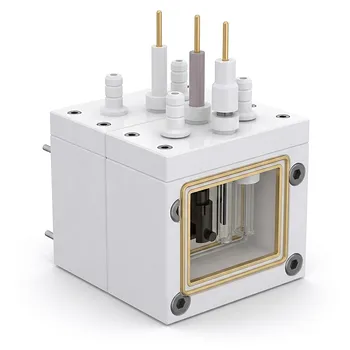
- All PTFE Exchangeable Membrane Electrochemical Cell Dual Chamber Three Electrode Photoelectrochemical Cell for Laboratory Trace Analysis
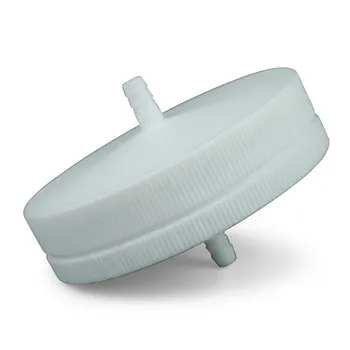
- PTFE Membrane Filter Holder for Aerosol Environmental Monitoring and Low Concentration Particulate Matter Sampling Chemical Resistant Air Quality Analysis Component
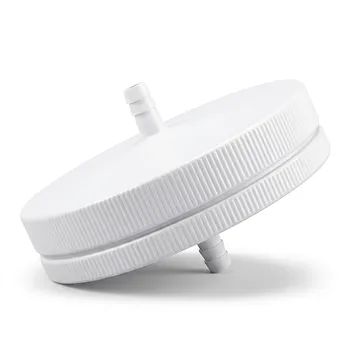
- PTFE Filter Membrane Holder for Hydrogen Chloride and Water Filtration 90mm Environmental Sampling Clamp Customizable
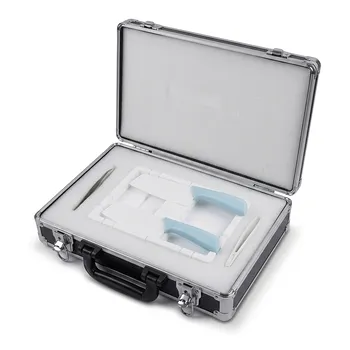
- High Purity PTFE Square Membrane Cutter Equipartition Device for Trace Analysis and Disease Control Centers Clean Non Stick No Leaching
- PTFE Filter Membrane Holder 47mm Leak Proof Corrosion Resistant Environmental Sampling Unit Customizable
People Also Ask
- What makes PTFE an ideal construction material for custom electrochemical cells and electronic analytical instrumentation housings? Discover superior chemical resistance and electrical insulation
- Why are high-performance fluoropolymers like PTFE and PFA preferred for electrochemical cells and sensitive analytical instrumentation? Achieve Reliable, Contamination-Free Measurements
- What material properties allow fluoropolymers to withstand extreme heat and corrosion? Discover how PTFE and PFA ensure inertness, stability, and purity for demanding lab applications.
- How does the microscopic node-and-fibril structure of ePTFE function in filtration and gas venting? Discover the key mechanisms for optimal lab performance.
- How is crushability of an ePTFE membrane evaluated, and why does crush resistance matter for fluoropolymer sealing and filtration products?