Cyclic voltammetry (CV) on a fluoropolymer-modified electrode is performed by sweeping the working-electrode potential while recording current in a three-electrode electrochemical cell. Oxidation and reduction onset potentials are then referenced to Ag/AgCl, SCE, or Fc/Fc⁺ and converted into approximate HOMO and LUMO energies. The resulting electrochemical bandgap depends not only on the polymer’s electronic structure, but also on reference calibration, solvation, ion transport, film morphology, kinetics, and how the CV baseline and onsets are defined.
Core takeaway: CV provides an electrochemical estimate of a fluoropolymer’s frontier energy levels, not a purely intrinsic bandgap measurement. Reliable values require controlled cell conditions, consistent onset-potential analysis, and explicit correction or reporting of reference, solvent, kinetic, and baseline effects.
How CV is performed on a fluoropolymer-modified electrode
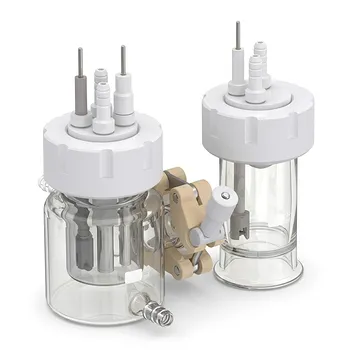
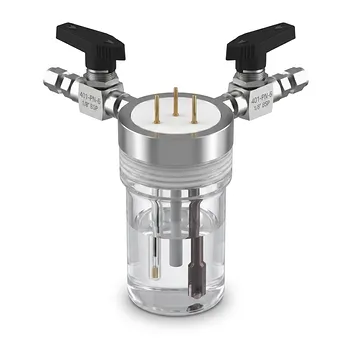
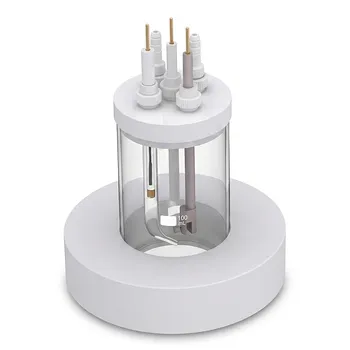
Constructing the electrochemical cell
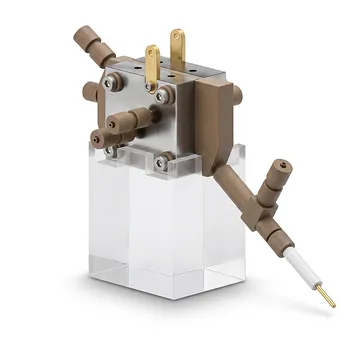
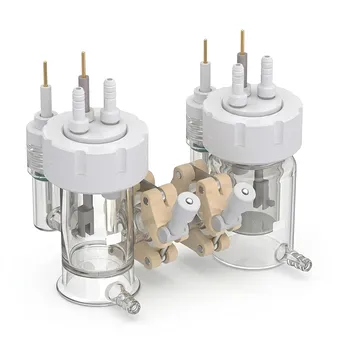
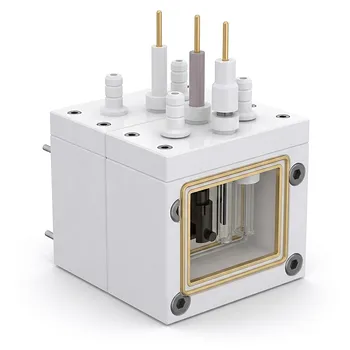
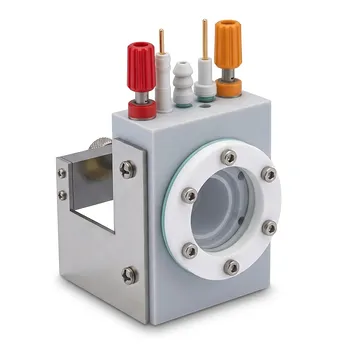
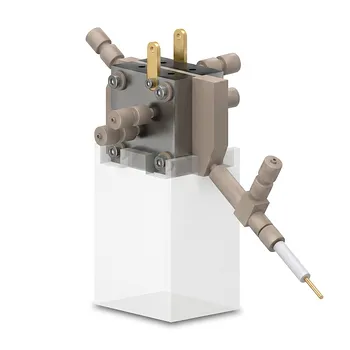
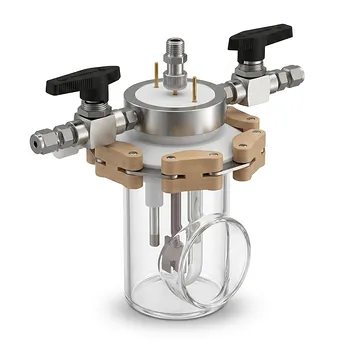
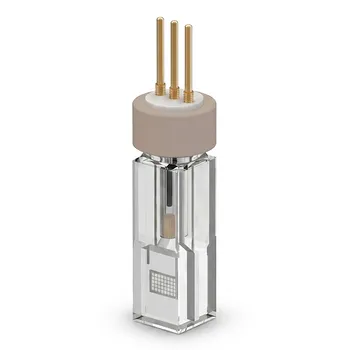
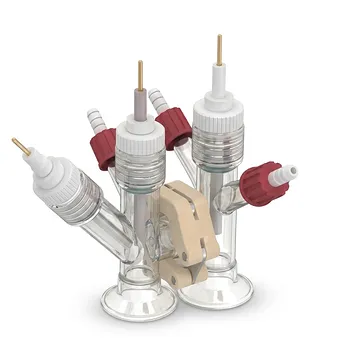
The modified substrate acts as the working electrode. A typical cell also contains a counter electrode to carry the current and a reference electrode, such as Ag/AgCl or SCE, to control and measure the working-electrode potential.
The electrolyte must provide sufficient ionic conductivity and an electrochemical window wide enough to encompass the polymer’s oxidation and reduction processes. The fluoropolymer may be present as a dissolved redox-active species or as a thin film grafted, coated, or otherwise immobilized on the working electrode.
Sweeping the applied potential
The potentiostat sweeps the working-electrode potential between selected limits and then reverses the direction of the sweep. The resulting current–potential trace is the cyclic voltammogram.
During the sweep, the polymer may undergo:
- Oxidation, associated with removal of electrons and estimation of the HOMO-related level.
- Reduction, associated with addition of electrons and estimation of the LUMO-related level.
- Reversible, quasi-reversible, or irreversible charge-transfer behavior.
For a film-modified electrode, charge compensation may require movement of electrolyte ions into or out of the polymer. Therefore, the measured current reflects both electron transfer at the electrode and ionic transport through or around the fluoropolymer film.
Recording solution and film responses
For a fluoromonomer or polymer that is electroactive in solution, CV can characterize its redox behavior before or during film formation. Repeated scans may show increasing current if an electroactive film is being deposited on the electrode.
For an already modified electrode, repeated scans can evaluate film stability, redox reversibility, and changes in peak position or current. The scan range should avoid electrolyte decomposition and irreversible damage to the film.
Converting CV potentials into energy levels
Identifying oxidation and reduction onsets
The relevant values are generally the oxidation onset potential and reduction onset potential, rather than simply the maximum positions of the anodic and cathodic peaks.
An onset is commonly estimated from the intersection of a baseline with a linear extrapolation of the rising faradaic current. Because the transition is gradual and the background current may be substantial, the selected baseline and extrapolation region strongly affect the result.
Referencing the potentials correctly
Measured potentials must be reported against a defined reference electrode or an external redox standard. Common choices include:
- Ag/AgCl
- SCE
- Fc/Fc⁺, using ferrocene as an internal or external calibration standard
Potentials measured against different references cannot be compared directly without conversion. The reference electrode, solvent, electrolyte, temperature, and calibration procedure should therefore be reported with the CV data.
Estimating HOMO and LUMO energies
The oxidation onset is used to estimate the polymer’s HOMO-related energy, while the reduction onset is used to estimate its LUMO-related energy. Conversion to an absolute energy scale requires a stated energy reference, such as the vacuum level, and a defined work-function or ferrocene calibration convention.
The electrochemical gap is commonly approximated from the separation between the oxidation and reduction onsets:
[ E_g^{\mathrm{EC}} \approx E_{\mathrm{red,onset}} - E_{\mathrm{ox,onset}} ]
when the potentials are expressed using a consistent sign convention. The exact HOMO and LUMO values depend on the chosen reference conversion, so the calculation method must accompany the reported numbers.
What controls the calculated bandgap
Solvation and reference-standard effects
Reference potentials are not universal constants independent of their environment. Solvent interactions, electrolyte composition, and solvation of the redox standard can shift the effective energy scale.
Consequently, using a standard work function or ferrocene value without considering the measurement medium can introduce a systematic error into the calculated HOMO, LUMO, or bandgap.
Thermodynamics and electrode kinetics
An observed onset potential contains both thermodynamic and kinetic information. Slow electron transfer, polymer reorganization, interfacial resistance, and nucleation effects can cause the current to appear only after the thermodynamically relevant potential has been exceeded.
This means that a CV onset is not always a direct equilibrium redox potential. The error can be particularly important for poorly conducting or weakly attached fluoropolymer films.
Film thickness and morphology
A thicker film can increase ion-transport distances and electrical resistance. It may also produce broader, shifted, or less reversible waves than a thin, uniform film.
Film roughness, porosity, crystallinity, fluorine content, grafting density, and contact with the underlying electrode can all change the apparent electrochemical response. Comparisons are most meaningful when film preparation and loading are controlled.
Ion diffusion and migration
Redox changes in a polymer film often require counter-ion compensation. Ions may move through the film by diffusion and migration, and this movement can limit the current response or shift the apparent redox potential.
The electrolyte’s ion size, concentration, solvent compatibility, and interaction with the fluorinated polymer therefore influence the measured CV. These effects are not necessarily evidence of a change in the intrinsic electronic band structure.
Scan rate and hysteresis
The scan rate affects how closely the measurement approaches equilibrium. At faster scan rates, charge transfer and ion transport may lag behind the applied potential, increasing peak separation and shifting apparent onsets.
Comparing scans at multiple rates helps distinguish reversible behavior from transport-limited or kinetically limited behavior. Repeated scans can also reveal hysteresis, film conditioning, degradation, or progressive electrochemical doping.
Baseline and onset extrapolation
A nonideal baseline can include capacitive charging, leakage current, substrate contributions, and background redox processes. If these components are not treated consistently, the extrapolated onset can move significantly.
Subjective choices about where to draw the baseline and linear rising-current region can produce substantial variation. Consistent extrapolation of both peak and baseline currents is essential for reproducible energy-level calculations.
Understanding the Trade-offs
Electrochemical and optical gaps are not identical
The CV-derived gap is an electrochemical bandgap estimate. An optical gap obtained from absorption spectroscopy reflects an optical transition and can differ because of excitons, molecular relaxation, disorder, and measurement method.
Differences of approximately 0.3 eV or more between electrochemical and optical gaps can arise from these effects and from uncertainty in CV onset determination. Such a difference is not automatically evidence that one measurement is incorrect.
Peak potentials are not always suitable substitutes
Using anodic and cathodic peak positions instead of onset potentials may be convenient, but it can produce a different energy estimate, particularly for irreversible or quasi-reversible polymer redox processes.
Peak positions are also more sensitive to scan rate, film resistance, and ion transport. The chosen method should be applied consistently across all samples.
A single CV scan can be misleading
One voltammogram may not reveal whether a signal originates from the fluoropolymer, the substrate, the electrolyte, or a degradation product. Control experiments with the unmodified electrode and the electrolyte are important.
Repeated scans, scan-rate studies, and measurements at different film loadings provide stronger evidence that the observed features belong to the intended fluoropolymer.
CV does not fully describe device operation
CV indicates when charge transfer occurs, but it does not by itself show how optical absorption, emission, or counter-ion motion changes during operation. For electrochromic and related devices, these properties can be central to performance.
Spectroelectrochemistry (SEC) addresses this limitation by combining controlled electrochemical potentials with in situ optical measurements. It can track electronic absorption and, where relevant, light emission and ion movement through the polymer film.
How to apply this to your measurement
Use a consistent experimental and calculation workflow rather than treating the onset potentials as absolute material constants.
- If your primary focus is reproducible energy levels: Use a defined three-electrode configuration, calibrate against a stated reference or Fc/Fc⁺ standard, control the solvent and electrolyte, and apply the same baseline and onset extrapolation procedure to every sample.
- If your primary focus is intrinsic polymer behavior: Compare unmodified and modified electrodes, measure multiple scan rates, and separate thermodynamic redox behavior from film resistance, ion transport, and kinetic effects.
- If your primary focus is device performance: Pair CV with spectroelectrochemistry to correlate redox potential with optical absorption, emission, and counter-ion movement in the fluoropolymer film.
- If your primary focus is comparing electrochemical and optical gaps: Report both values using their correct definitions and explain differences rather than assuming that the two measurements should be identical.
A carefully controlled CV experiment turns fluoropolymer redox responses into useful energy-level estimates while making the measurement limitations explicit.
Summary Table:
| Factor | Impact on Bandgap Calculation |
|---|---|
| Reference electrode calibration | Shifts absolute HOMO/LUMO values |
| Solvent and electrolyte | Alters solvation and ion transport |
| Film thickness and morphology | Broadens or shifts redox waves |
| Kinetics and scan rate | Introduces overpotential and hysteresis |
| Baseline and onset extrapolation | Changes apparent onset potentials |
| Electrochemical vs. optical gap | Can differ by >0.3 eV due to excitonic effects |
Need reliable energy-level characterization for your fluoropolymer materials? Our experts provide tailored CV and spectroelectrochemistry solutions. Contact us today to optimize your electrochemical analysis.
Related Products
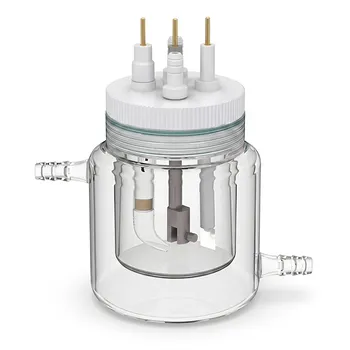
- Sealed Glass Electrochemical Cell with Jacketed Temperature Control and Chemical Resistant PTFE Lid
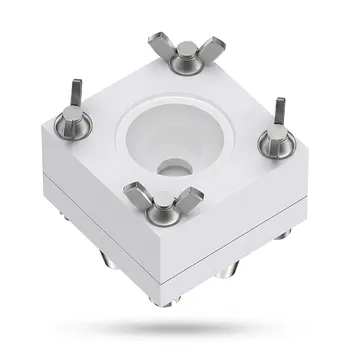
- PTFE Flat Plate Working Electrode Electrochemical Cell for Sheet Samples Corrosion Testing and SEM Sample Preparation
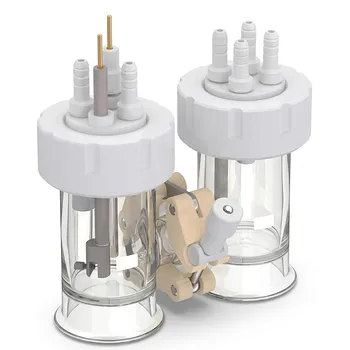
- H Type Replaceable Membrane Electrochemical Cell for Three Electrode System Jacketed Single Layer Gas Purging
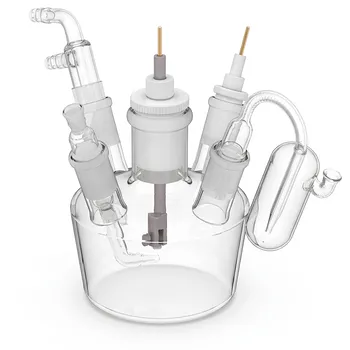
- Conventional Five Port Electrochemical Cell Borosilicate Glass Jacketed Three Electrode System
- H Type Replaceable Membrane Electrochemical Cell with Sampling Port for Gas Liquid Phase Reactions
People Also Ask
- Why are high-performance fluoropolymers like PTFE and PFA preferred for electrochemical cells and sensitive analytical instrumentation? Achieve Reliable, Contamination-Free Measurements
- What makes PTFE an ideal construction material for custom electrochemical cells and electronic analytical instrumentation housings? Discover superior chemical resistance and electrical insulation
- How are electrochemical cell systems utilized to evaluate the anodic degradation and defluorination of persistent perfluorinated compounds like PFOA? Discover key methods and metrics.
- What role does backbone fluorination play in modulating the solid-state microstructure and electron mobility of n-type conjugated polymers, and how are custom PTFE/PFA electrochemical cells utilized to characterize these redox-active materials?
- What material properties allow fluoropolymers to withstand extreme heat and corrosion? Discover how PTFE and PFA ensure inertness, stability, and purity for demanding lab applications.