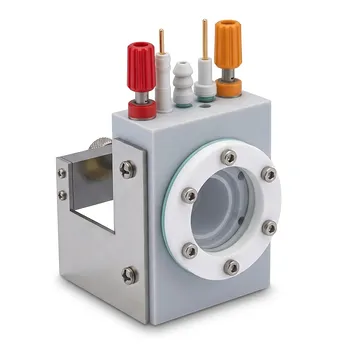
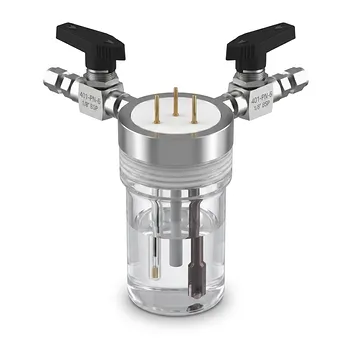
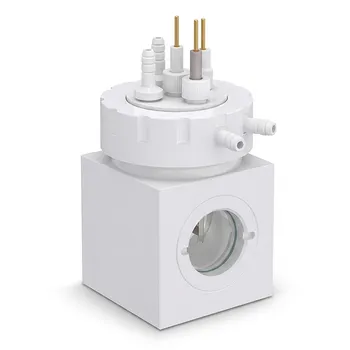
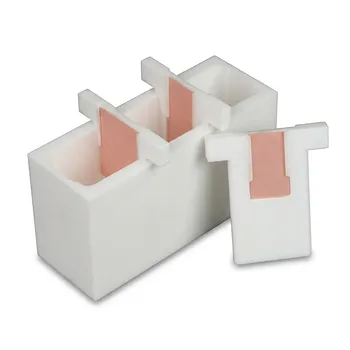
Backbone fluorination is a microstructure-control strategy, not merely a chemical substitution. In n-type conjugated polymers, fluorine creates noncovalent interactions such as S···F, F···F, H···F, and π···F, which alter how chains aggregate and crystallize. In NDI copolymers, fluorinating thiophene-vinyl-thiophene units to form FTVT can suppress excessive macro-crystallinity, produce smaller interconnected crystal domains, and shorten electron-transport pathways. The reported result is an approximately tenfold increase in electron mobility, from 0.006 to 0.06 cm² V⁻¹ s⁻¹.
Core takeaway: Backbone fluorination improves electron transport when it produces a balanced morphology—sufficient order for efficient transport, but not oversized crystallites that isolate domains. Custom PTFE/PFA electrochemical cells support reliable evaluation by providing chemically inert, electrically insulating environments for redox measurements and electrochemical polymerization.
How Backbone Fluorination Changes Polymer Microstructure
Fluorine introduces directional intermolecular interactions
Fluorine atoms affect more than the polymer’s electron density. Their incorporation can establish weak but influential contacts, including S···F, F···F, H···F, and π···F interactions, that modify chain packing and the balance between aggregation and crystallization.
These interactions act as structural constraints within and between polymer chains. The resulting packing can differ substantially from that of the nonfluorinated analogue, even when the overall conjugated backbone remains similar.
Fluorination can prevent excessive macro-crystallinity
Highly crystalline domains are not automatically beneficial for charge transport. If crystallites become too large or poorly connected, they can increase the distance electrons must travel through less ordered regions between domains.
In the cited NDI copolymers, fluorination of the TVT unit to produce FTVT suppresses excessive macro-crystallinity. Instead, the polymer forms smaller, interconnected crystal domains, creating a more continuous morphology for charge transport.
Domain size and connectivity matter together
Electron mobility depends on both local molecular order and long-range connectivity. Small ordered domains can be advantageous when they are sufficiently interconnected, because electrons encounter shorter transport channels and fewer severe morphological bottlenecks.
This is the central microstructural role of fluorination: it tunes the polymer toward a morphology that combines useful crystallinity with improved domain-to-domain communication.
Why the Modified Microstructure Improves Electron Mobility
Shorter transport pathways reduce bottlenecks
In the fluorinated NDI copolymer example, the smaller interconnected domains shorten the effective electron-transport channels. This can reduce the impact of disordered regions that would otherwise interrupt transport.
The reported mobility increases from 0.006 to 0.06 cm² V⁻¹ s⁻¹, an order-of-magnitude improvement associated with the fluorination-induced morphological change.
Fluorination supports the requirements of n-type transport
N-type conjugated polymers require efficient electron movement through the acceptor-rich backbone and its aggregated domains. Fluorination can simultaneously influence intermolecular packing and the electronic character of the backbone, helping align molecular organization with electron transport.
The improvement should therefore not be attributed to crystallinity alone. It results from the combined effect of fluorine-mediated interactions, domain refinement, and improved connectivity.
The optimum is a balance, not maximum order
The useful design principle is not “more crystallinity is always better.” Excessive crystallization can create large domains, inefficient interfaces, or transport paths that are less well connected at the film scale.
Backbone fluorination is valuable because it can tune the degree and scale of order rather than simply maximizing it.
How Custom PTFE/PFA Cells Characterize Redox-Active Fluoropolymers
They provide an inert electrochemical environment
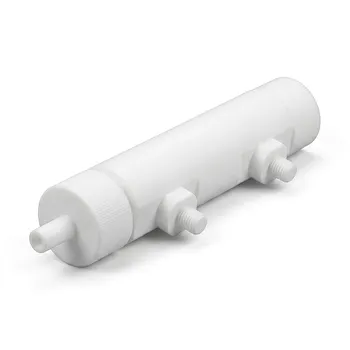
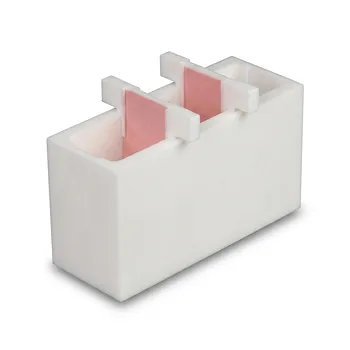
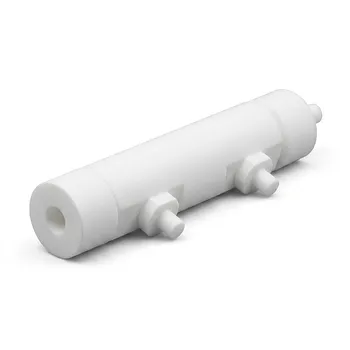
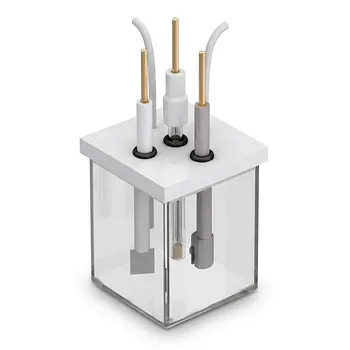
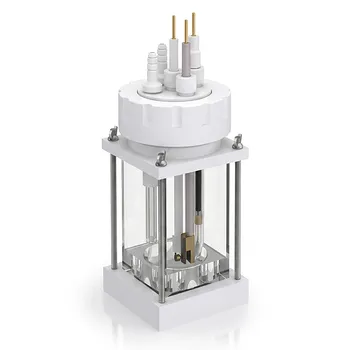
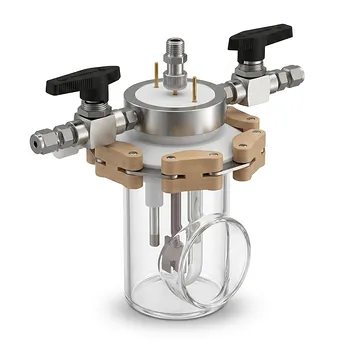
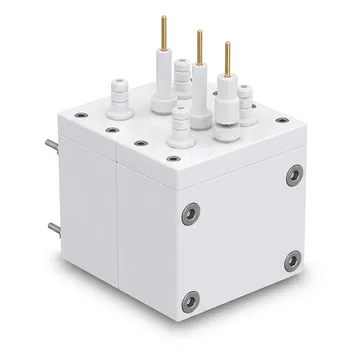
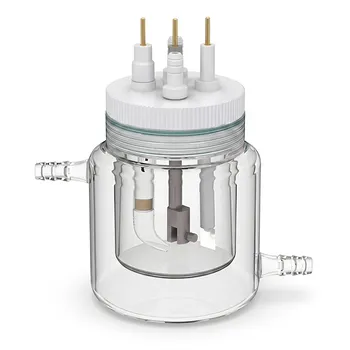
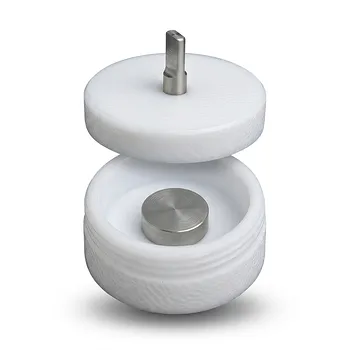
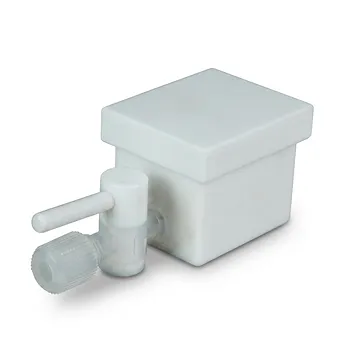
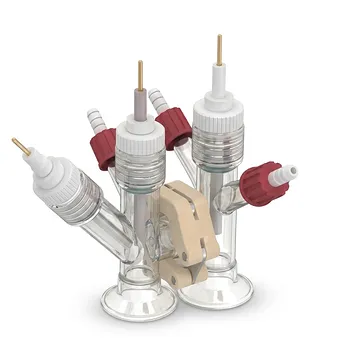
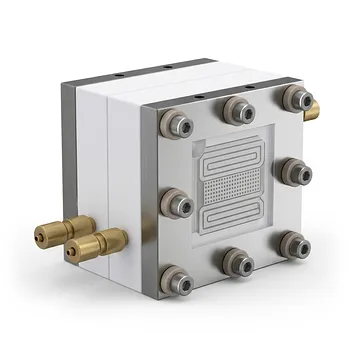
Custom cells made from PTFE or PFA are used for voltammetric characterization and, where required, electrochemical polymerization of fluorinated conjugated polymers. Their broad chemical tolerance makes them suitable for harsh organic electrolytes and fluorinated solvents that may attack conventional cell materials.
This chemical inertness helps prevent cell corrosion, contamination, and leaching that could distort redox signals or alter the polymer during deposition.
They support accurate redox measurements
Electrochemical measurements depend on distinguishing the material’s intrinsic oxidation and reduction processes from background reactions. A high-purity PTFE/PFA cell reduces the likelihood that electrolyte contact with the cell introduces interfering species.
The result is a more reliable assessment of redox potentials, reversibility, electrochemical stability, and charge-transfer behavior.
They enable electrochemical polymerization
For electrochemical polymerization, the cell must tolerate the monomer, supporting electrolyte, solvent, and applied potential over the full experiment. PTFE and PFA provide a stable reaction environment while allowing the electrode arrangement to be tailored to the polymerization method.
Their resistance to aggressive media is particularly important when fluorinated solvents or corrosive electrolytes are involved.
Their electrical insulation reduces measurement artifacts
PTFE and PFA are highly insulating materials. This helps reduce unwanted electrical pathways and can lower parasitic capacitance compared with less suitable cell constructions.
That feature is useful for high-sensitivity measurements, where background charging currents or cell-related interference could obscure weak redox peaks.
CNC machining allows nonstandard cell designs
Custom fluoropolymer cells can be precision-machined into complex geometries. This allows researchers to accommodate unusual electrode layouts, controlled working volumes, specialized reference-electrode positions, or integrated fluid-handling arrangements.
The cell can therefore be designed around the experiment rather than forcing the experiment to conform to a standard glass-vessel geometry.
What These Measurements Reveal About the Material
Voltammetry probes redox behavior
Cyclic voltammetry and related techniques can establish the accessible reduction and oxidation processes of the polymer. They also help assess electrochemical reversibility, potential stability, and changes that occur during repeated cycling.
For n-type materials, maintaining a clean and stable environment is especially important because reduction processes can be sensitive to electrolyte composition, solvent compatibility, and contamination.
Polymerization and characterization can be combined
The same type of custom cell can support both electrochemical growth and subsequent redox evaluation. This enables researchers to control the deposition environment and then examine the electrochemical response of the resulting fluorinated polymer without transferring it into a chemically incompatible setup.
Such integration can reduce handling-related contamination and improve experimental consistency.
Additional electroactive materials can be evaluated
The design principles extend beyond conjugated polymers. PTFE/PFA cells are also useful for studying fluorinated polymer electrolyte membranes, molecular redox systems, and carbon electrodes in aggressive electrolytes.
In each case, the purpose is the same: preserve chemical purity, withstand the applied field and electrolyte, and minimize artifacts that could be mistaken for intrinsic material behavior.
Understanding the Trade-offs
Fluorination does not guarantee higher mobility
Adding fluorine does not automatically improve electron mobility. Its benefit depends on where the fluorine is placed and how the resulting interactions affect chain packing, domain connectivity, and film morphology.
A poorly balanced substitution could increase disorder or create unfavorable packing despite improving the polymer’s electronic character.
Crystalline domains still need effective interfaces
Smaller domains are beneficial only when they remain interconnected. If fluorination fragments the morphology into isolated ordered regions, the material may suffer from additional interdomain barriers rather than improved transport.
Morphology must therefore be evaluated at both the local crystallographic scale and the larger film scale.
PTFE and PFA are resistant, not universally immune
These fluoropolymers offer broad chemical resistance, but cell compatibility should still be checked against the specific solvent, electrolyte, temperature, pressure, and applied potential. Material resistance does not eliminate the need for appropriate seals, fittings, cleaning procedures, and electrode compatibility.
Custom cells require careful design
Precision machining improves flexibility, but electrode alignment, solution volume, reference-electrode placement, and fluid handling directly affect data quality. A chemically inert cell can still produce unreliable measurements if its geometry creates poor mass transport or unstable electrical connections.
Making the Right Choice for Your Goal
The most effective approach is to treat polymer design and measurement hardware as linked parts of the same experiment.
- If your primary focus is electron mobility: Use backbone fluorination to tune intermolecular interactions and target smaller, interconnected crystalline domains rather than maximum crystallinity.
- If your primary focus is redox characterization: Use a custom PTFE/PFA cell to minimize corrosion, contamination, parasitic capacitance, and solvent-related artifacts.
- If your primary focus is electrochemical polymerization: Design the fluoropolymer cell around the electrode geometry, electrolyte, solvent, and required working volume.
- If your primary focus is high-sensitivity measurements: Prioritize high-purity materials, electrical insulation, controlled fluid handling, and compatibility with the full electrolyte system.
Together, fluorine-controlled morphology and inert custom electrochemical hardware provide a coherent route to designing and accurately evaluating high-performance n-type conjugated polymers.
Summary Table:
| Aspect | Role of Backbone Fluorination | Role of Custom PTFE/PFA Cells |
|---|---|---|
| Microstructure | Induces noncovalent interactions (S···F, F···F, H···F) that tune chain packing and prevent excessive crystallinity, forming smaller interconnected domains. | Provides inert, contamination-free environment for accurate redox measurements. |
| Electron Mobility | Improves domain connectivity, shortening transport pathways and increasing mobility from 0.006 to 0.06 cm² V⁻¹ s⁻¹. | Reduces parasitic capacitance and electrical interference, enabling reliable mobility-linked electrochemical data. |
| Characterization | Enables optimization of morphology for balanced order and connectivity. | Supports voltammetry, electrochemical polymerization, and high-sensitivity measurements in aggressive electrolytes. |
Optimize your polymer research with KINTEK's custom PTFE/PFA electrochemical cells, designed for high-performance fluoropolymers and harsh chemical environments. Our precision CNC machining delivers nonstandard geometries, inert construction, and superior electrical insulation—ensuring accurate redox characterization and electrochemical polymerization. Whether you're developing next-generation n-type polymers or need bespoke labware, contact us to enhance your experimental reliability. Get in touch today!
Related Products
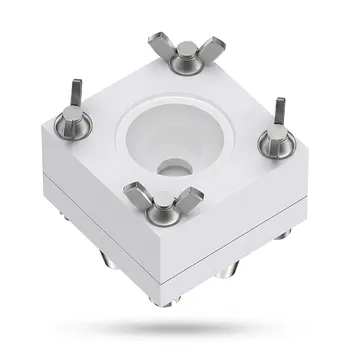
- PTFE Flat Plate Working Electrode Electrochemical Cell for Sheet Samples Corrosion Testing and SEM Sample Preparation
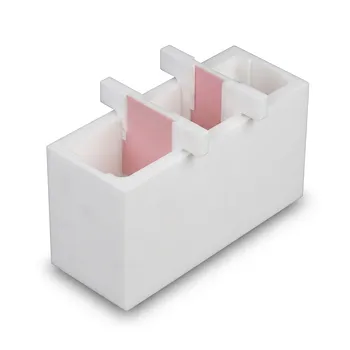
- Corrosion Resistant PTFE Electrochemical Cell for New Energy Research Inert Insulating Customizable Lab Reaction Vessel
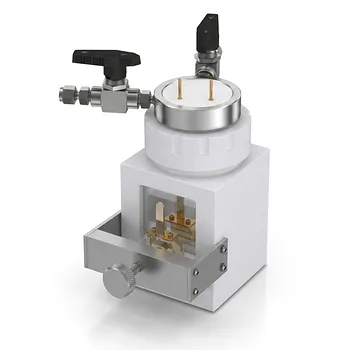
- Corrosion Resistant PTFE Photoelectrochemical Cell High Purity All PTFE Three Electrode Test Cell with Quartz Window
- All PTFE Exchangeable Membrane Electrochemical Cell Dual Chamber Three Electrode Photoelectrochemical Cell for Laboratory Trace Analysis
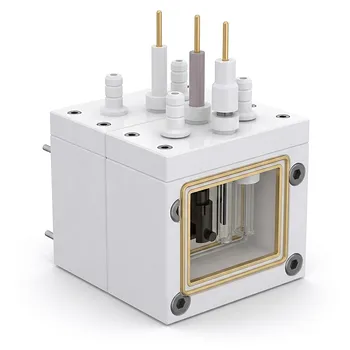
- PTFE Photoelectrochemical Cell with Quartz Window for Photoelectrolysis and Electrocatalysis Testing
People Also Ask
- What makes PTFE an ideal construction material for custom electrochemical cells and electronic analytical instrumentation housings? Discover superior chemical resistance and electrical insulation
- Why are high-performance fluoropolymers like PTFE and PFA preferred for electrochemical cells and sensitive analytical instrumentation? Achieve Reliable, Contamination-Free Measurements
- How is cyclic voltammetry performed on fluoropolymer-modified electrodes within electrochemical cells, and what factors affect energy bandgap calculations?
- What material properties allow fluoropolymers to withstand extreme heat and corrosion? Discover how PTFE and PFA ensure inertness, stability, and purity for demanding lab applications.
- How are electrochemical cell systems utilized to evaluate the anodic degradation and defluorination of persistent perfluorinated compounds like PFOA? Discover key methods and metrics.