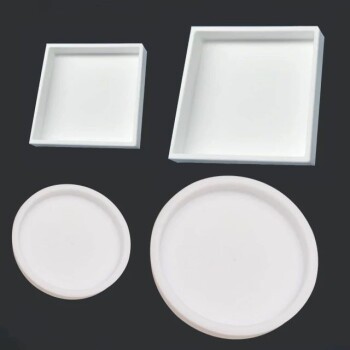
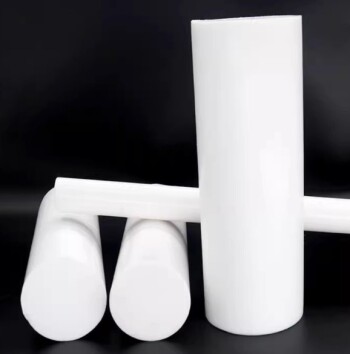
Granular suspension PTFE and fine-powder dispersion PTFE differ mainly in particle morphology and processing behavior. Suspension polymerization produces relatively coarse, fibrous or granular resin that can be compacted, sintered, and machined into rigid laboratory components. Dispersion polymerization produces much finer particles that fibrillate under shear, making them suitable for paste extrusion into flexible tubing, thin films, membranes, and seals.
Choose granular PTFE when the laboratory supply must be rigid, thick-walled, and machinable; choose fine-powder dispersion PTFE when it must be flexible, thin, continuously extruded, or formed into a compliant seal.
How the Two PTFE Structures Are Formed
Granular PTFE from suspension polymerization
Suspension polymerization uses aqueous media with vigorous agitation and relatively low surfactant levels. The polymer precipitates into comparatively coarse, fibrous resin particles or agglomerates.
These particles are compacted under pressure and sintered into solid stock shapes such as billets, rods, sheets, and thick-walled tubes. The resulting material can then be machined into custom laboratory equipment.
Fine-powder PTFE from dispersion polymerization
Dispersion polymerization uses milder agitation and polymerization aids, commonly including fluorinated surfactants. It produces submicron-scale primary particles that may be supplied as a liquid dispersion or recovered as coagulated fine powder.
Fine powder is not normally treated like a conventional molding powder. It is blended with a lubricant and processed by paste extrusion, where shear causes the particles to fibrillate and form a coherent polymer structure.
The important structural distinction
The key difference is not simply that one powder is larger than the other. Their particle morphology determines how each resin responds to pressure, heat, and shear.
- Granular PTFE: compacts and sinters into dense solid stock suitable for machining.
- Fine-powder PTFE: fibrillates during paste processing, enabling continuous extrusion of thin or flexible shapes.
- Aqueous PTFE dispersion: remains suitable for coating, impregnation, or surface-treatment applications rather than conventional solid molding.
How Structure Determines Laboratory Supply Design
Rigid vessels and machined components
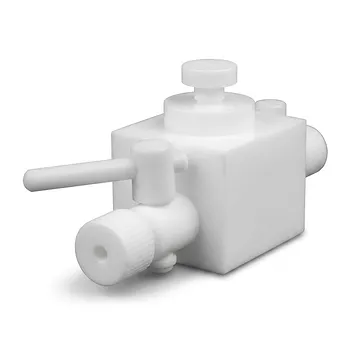
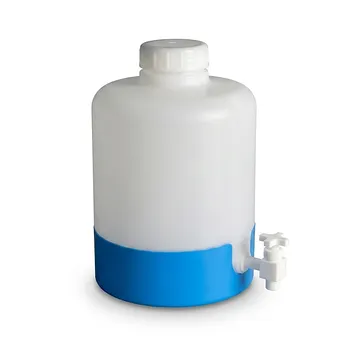
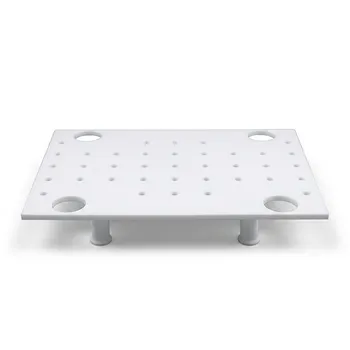
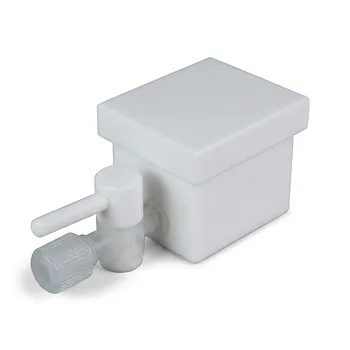
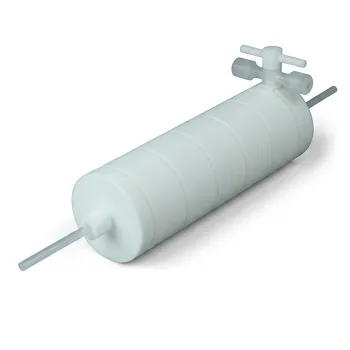
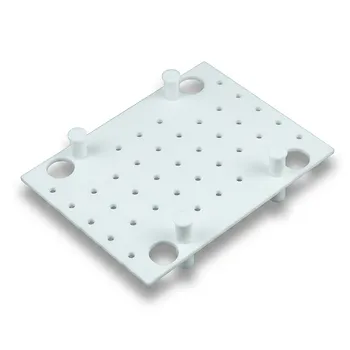
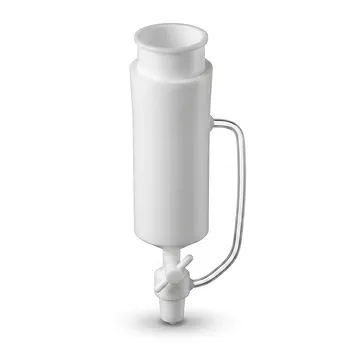
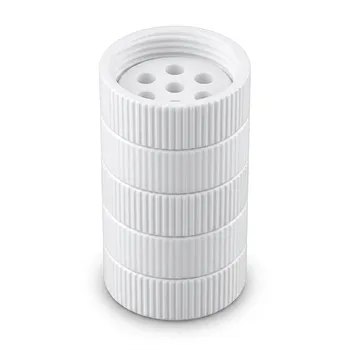
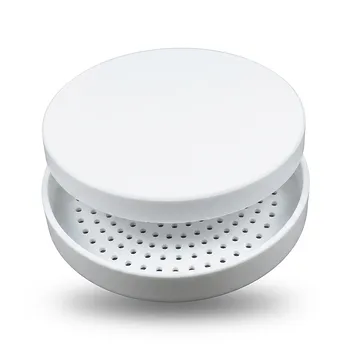
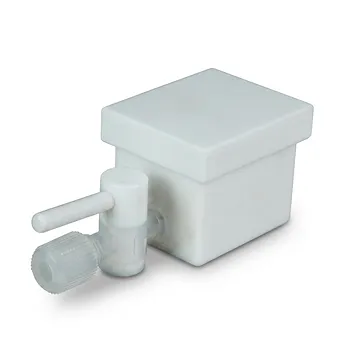
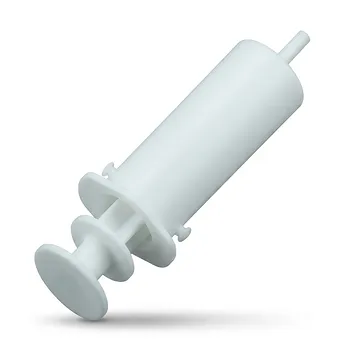
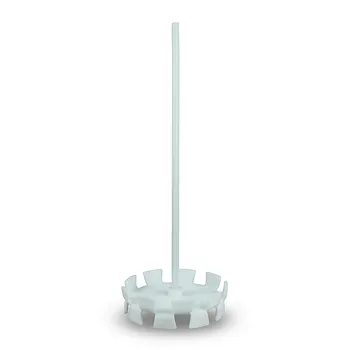
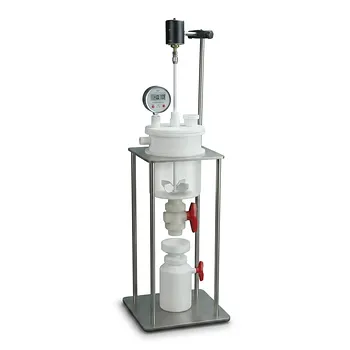
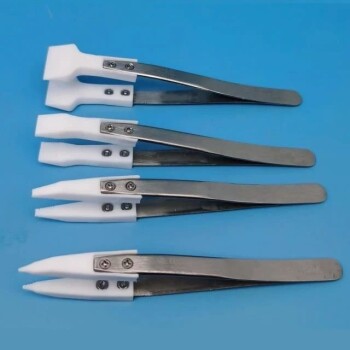
Granular PTFE is the preferred starting material for heavy-duty beakers, crucibles, reagent bottles, digestion vessels, reaction cells, storage tanks, stopcocks, and custom fittings.
Compression molding and sintering produce dense blocks or tubes. CNC machining can then create precise bores, threads, channels, ports, and complex geometries.
Flexible tubing and fluid-transfer lines
Fine-powder PTFE is better suited to thin-wall tubing, flexible fluid lines, wire insulation, and certain films or membranes.
Paste extrusion allows long, continuous geometries that would be inefficient or impractical to produce by machining a solid block. The material can provide chemically resistant fluid contact while maintaining the flexibility required for routing and connection.
Gaskets, tapes, and thin sealing elements
Fine-powder processing is also advantageous for thin sealing products, including unsintered sealing tapes and some flexible gasket forms.
The fibrillated structure can support compliance and conformability. However, the exact sealing performance depends on the product design, density, thickness, and service conditions—not solely on the resin category.
Coatings and non-wetting surfaces
Liquid PTFE dispersions are primarily selected when the requirement is a thin coating, impregnation, or hydrophobic non-wetting surface.
They should not be treated as interchangeable with granular molding resin or fine powder used for paste extrusion. The intended product geometry and processing route are fundamentally different.
Why the Processing Route Matters
Compression molding favors structural stability
Granular PTFE is compacted and sintered into a dense, stable mass. This supports thick sections and gives machined components the dimensional foundation needed for laboratory handling.
That makes it appropriate where the part must resist deformation while containing corrosive chemicals, elevated-temperature fluids, or mechanical loads.
Paste extrusion favors continuous flexibility
Fine powder PTFE relies on shear-induced fibrillation rather than simple powder compaction. The fibrils connect the fine particles during extrusion, allowing the material to form thin-wall, continuous products.
This processing route is especially valuable for tubing and other parts where flexibility, low wall thickness, or continuous length matters.
Machining and extrusion solve different design problems
Machining begins with a solid molded shape and removes material to create the final geometry. It is well suited to customized, three-dimensional laboratory apparatus.
Extrusion creates a profile directly and is therefore more efficient for tubing, films, tapes, and other continuous or thin geometries.
Understanding the Trade-offs
Granular PTFE is strong for custom shapes but less efficient for thin products
Granular PTFE is the stronger choice for rigid and custom-machined laboratory supplies. However, machining thin, long, or flexible components from a solid billet can be wasteful and may not deliver the required flexibility.
Fine powder supports flexibility but is not the default for rigid apparatus
Fine-powder PTFE is well suited to tubing, films, membranes, and compliant seals. It is not usually the first choice for a thick-walled vessel or a precision-machined reaction cell because its processing route is designed around paste extrusion rather than solid-block machining.
“PTFE” alone does not identify the correct grade
Two products can both be chemically PTFE yet require entirely different manufacturing methods. Selecting only by chemical resistance can lead to poor dimensional stability, unsuitable flexibility, or an incompatible fabrication process.
Dispersion and fine powder should not be conflated
Fine powder and aqueous dispersion PTFE are related to dispersion polymerization, but they are not identical product forms. Fine powder is generally used for paste processing, while liquid dispersion is commonly used for coatings or impregnation.
Performance still depends on the finished design
Resin morphology determines the available processing options, but final laboratory performance also depends on wall thickness, sintering quality, machining tolerances, sealing geometry, temperature, pressure, and chemical exposure.
Making the Right Choice for Your Goal
Select the resin form according to the required geometry and mechanical behavior, not merely the fact that the application involves PTFE.
- If your primary focus is rigid custom labware: Choose granular suspension PTFE that can be compression molded, sintered, and CNC-machined into vessels, cells, fittings, or structural components.
- If your primary focus is flexible fluid transfer: Choose fine-powder dispersion PTFE processed by paste extrusion for thin-wall tubing and continuous fluid lines.
- If your primary focus is sealing: Consider fine-powder-derived tapes, gaskets, or thin sealing elements when compliance and conformability are important.
- If your primary focus is surface protection or non-wetting behavior: Consider an aqueous PTFE dispersion intended for coating or impregnation rather than a molding or extrusion grade.
Match granular PTFE to dense, machinable structures and fine-powder dispersion PTFE to flexible or thin continuous products to ensure the laboratory supply is designed for its actual service demands.
Summary Table:
| Feature | Granular Suspension PTFE | Fine Powder Dispersion PTFE |
|---|---|---|
| Particle Size | Coarse, fibrous/agglomerated | Submicron primary particles |
| Processing Method | Compression molding and sintering, then machining | Paste extrusion with lubricant |
| Typical Products | Rigid vessels, machined parts, custom fittings | Flexible tubing, thin films, seals |
| Key Properties | High rigidity, machinability, dimensional stability | Flexibility, continuous length, conformability |
| Best For | Thick-walled components and complex geometries | Thin, continuous, or flexible products |
Looking for high-performance PTFE labware? At KINTEK, we specialize in precision-crafted PTFE and PFA components, from custom-machined vessels to flexible tubing. Our experts help you choose the right resin and processing method for your application. Contact us today to discuss your requirements and get a quote! Contact KINTEK
Related Products
- Custom PTFE Filtration System Acid Resistant High Purity Semiconductor Grade Chemical Processing Filter
- High Corrosion Resistant PTFE Faucet Polytetrafluoroethylene Valve for Chemical Storage Drums and Fluid Transfer Systems Customizable Industrial Grade
- PTFE PFA Vacuum Filtration System Corrosion Resistant Customizable Shatterproof Laboratory Device
- PTFE Corrosion Resistant Filter with PFA Valve Connections and Integrated Sieve Plate
- High Temperature Chemical Resistant 50ml PTFE Syringe Customized Teflon Injector with Threaded Seal for Trace Analysis
People Also Ask
- What makes PTFE filtration systems advantageous for industrial and scientific use? Unmatched Chemical & Thermal Stability
- What steps are involved in selecting the proper PTFE filter? A 4-Step Guide to Optimal Filtration
- What sizes and pore options are available for PTFE filters? Choose the Right Filter for Your Application
- How does the hydrophobicity of PTFE filters benefit their use? Ensure Uninterrupted Gas Flow and Solvent Filtration
- What temperature resistance do PTFE filters offer? Unmatched Thermal Stability from -200°C to +260°C