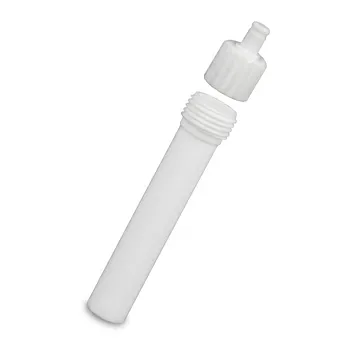
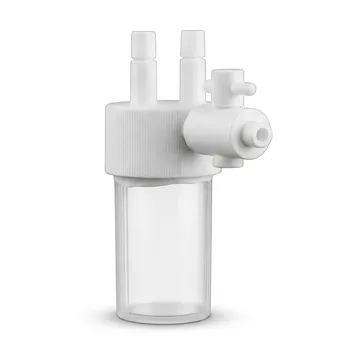
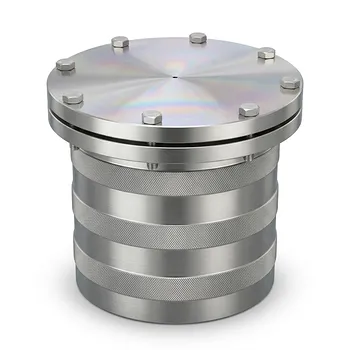
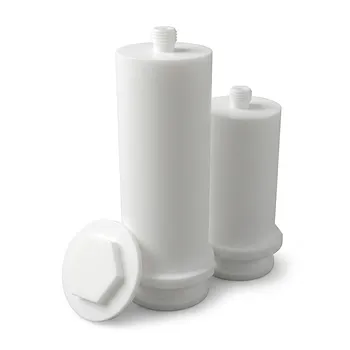
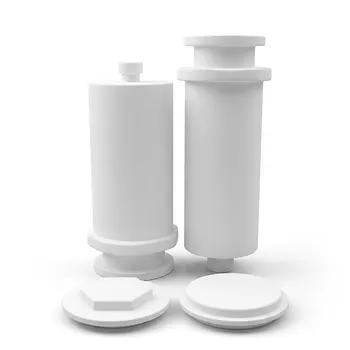
The PTFE lining acts as a critical chemical barrier and recovery aid. During the hydrothermal synthesis of hexagonal plate-shaped Magnesium Hydroxide at 180 °C, the PTFE lining provides a corrosion-resistant environment that protects the reactor walls from harsh alkaline mineralizers. Its non-stick properties ensure that the synthesized nano-scale powder is fully recovered without yield loss or contamination from the vessel walls.
The PTFE lining serves as an inert reaction chamber that isolates corrosive chemicals from the metal autoclave while facilitating the complete recovery of high-purity Magnesium Hydroxide through its non-adhesive surface.
Protecting the Structural Integrity of the Reactor
Neutralizing Alkaline Erosion
The synthesis of hexagonal Magnesium Hydroxide typically requires the use of strong alkaline mineralizers to control crystal morphology. PTFE is chemically inert to nearly all strong bases, preventing these reagents from chemically "attacking" or etching the reaction container during the heating process.
Shielding the External Metal Shell
High-pressure hydrothermal reactions are housed within a stainless steel outer vessel for safety and pressure containment. The PTFE liner acts as a physical shield, preventing the internal reaction media from reaching and corroding the metal jacket, which would otherwise lead to structural failure over time.
Ensuring Product Purity and High Yield
Preventing Metal Contamination
By isolating the reaction from the stainless steel walls, the PTFE liner ensures that the synthesized Magnesium Hydroxide remains free from metal impurities. This is essential for maintaining the specific electronic and chemical properties of the hexagonal plates, as leached ions from a metal reactor would degrade the product's quality.
The Role of Non-Adhesive Surfaces
The unique non-stick characteristic of PTFE is vital when working with nano-scale powders. It prevents the Magnesium Hydroxide particles from adhering to the container walls, ensuring that the entire batch can be collected and simplifying the post-experimental cleaning process.
Understanding the Trade-offs
Thermal Limitations
While PTFE is highly effective at the 180 °C required for this synthesis, it has a strict functional ceiling, typically around 220 °C. Operating near or above this limit can cause the liner to soften, deform, or lose its structural integrity, potentially leading to leaks.
Thermal Expansion and Sealing
PTFE has a higher coefficient of thermal expansion than the steel vessel surrounding it. If the cooling process is not managed correctly, or if the liner is poorly fitted, the differential expansion can lead to "creeping," where the liner permanently changes shape or compromises the seal.
Strategic Recommendations for Hydrothermal Synthesis
How to Apply This to Your Project
- If your primary focus is high-purity crystal growth: Ensure the PTFE liner is thoroughly cleaned with dilute acid between runs to remove any residual nucleation sites from the previous synthesis.
- If your primary focus is maximizing product yield: Utilize the non-stick properties of the liner by using a soft plastic spatula or ultrasonic bath to dislodge any nano-powders settled at the bottom.
- If your primary focus is vessel longevity: Never exceed the 220 °C safety threshold and allow the autoclave to cool naturally to room temperature to prevent the liner from warping or cracking.
The PTFE lining is the invisible safeguard that transforms a standard high-pressure vessel into a controlled, high-precision environment for the synthesis of advanced nanomaterials.
Summary Table:
| Feature | Role in Synthesis | Impact on Results |
|---|---|---|
| Chemical Inertness | Protects reactor from alkaline erosion | Maintains structural integrity & purity |
| Non-Stick Surface | Facilitates complete powder recovery | Increases yield & simplifies cleaning |
| Physical Shield | Isolates reaction from metal autoclave | Prevents metal ion contamination |
| Thermal Stability | Operates safely up to 220 °C | Enables controlled hydrothermal growth |
Elevate Your Synthesis with KINTEK
Maximize the purity and yield of your advanced nanomaterials with KINTEK’s high-performance fluoropolymer solutions. From everyday basic labware like beakers and reagent bottles to specialized hydrothermal synthesis liners and microwave digestion vessels, we manufacture virtually all imaginable laboratory supplies from PTFE and PFA.
Backed by end-to-end custom CNC fabrication, KINTEK delivers everything from high-volume consumables to complex, non-standard machined parts tailored to your specific research needs. Experience the difference that absolute focus on high-performance materials can make for your lab.
Contact KINTEK today to discuss your custom project or bulk order!
References
- Qinghua Chen, Qianqian Zhang. Synthesis of highly dispersed magnesium hydroxide and its application in flame-retardant EVA composites. DOI: 10.1039/d5ra01067e
This article is also based on technical information from Kintek Knowledge Base .
Related Products
- High Purity PTFE Microwave Digestion Vessel Replacement Liner for Acid Sample Preparation and Trace Analysis
- Custom PTFE Sleeves and Hollow Rods for Advanced Applications
- PTFE Anti Scald Heat Insulation Sleeve Hot Plate Support Feet Laboratory Benchtop Protection Customizable Thermal Barrier
- PTFE Lined High Pressure Digestion Vessel 50ml High Temperature Hydrothermal Synthesis Tank
- Custom PTFE Reaction Lid with Integrated Valve and Fitting Corrosion Resistant No Leaching PFA FEP Bottle Cap System
People Also Ask
- How does the dielectric property of PTFE benefit microwave-assisted digestion? Unlock Rapid and Uniform Sample Heating
- What are the advantages of using microwave digestion vessels for environmental analysis? Boost speed and sample accuracy.
- What safety features are commonly integrated into microwave digestion vessels? Ensuring High-Pressure Laboratory Safety
- What are the advantages of using microwave digestion vessels? Optimize EG@MO synthesis with superior thermal control.
- How do microwave digestion vessels support pharmaceutical elemental impurity testing? Achieve Precise USP Compliance