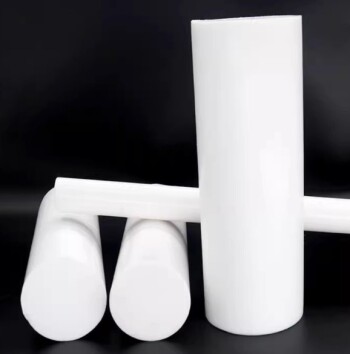
PTFE and PFA differ primarily in melt processability: standard PTFE has such high melt viscosity that it cannot be formed reliably with conventional injection molding or ordinary thermoplastic extrusion. PTFE labware is therefore typically compression molded and sintered, paste-extruded, or machined from stock shapes. PFA, by contrast, flows sufficiently when heated to support injection molding, extrusion, thermal welding, and other conventional melt-fabrication methods, making it better suited to complex, seamless laboratory components.
PTFE is selected when chemical resistance, temperature capability, and custom machining are the priority; PFA is selected when complex geometry, translucency, seamless construction, or welded fluidic assemblies are required.
Why PTFE Requires Specialized Fabrication
Extremely High Melt Viscosity
PTFE has an exceptionally high melt viscosity. Although it has a melting point near 327°C, it does not flow like an ordinary thermoplastic when heated, so conventional melt molding is impractical.
This behavior results from PTFE's molecular structure and high molecular weight. Heating it above its melting point does not produce the free-flowing melt needed to fill intricate molds or pass easily through standard extrusion equipment.
Non-Melt Processing Routes
Manufacturers commonly process granular PTFE through compression molding followed by sintering. Fine-powder PTFE may also be formed through paste extrusion, depending on the product geometry.
For specialized labware, PTFE is often produced as a block, sheet, tube, or other stock shape and then finished using precision CNC machining. This approach supports custom reaction vessels, electrochemical cell bodies, seals, and heavy-duty apparatus without requiring a dedicated complex mold.
Why PFA Supports Conventional Melt Fabrication
Lower Melt Viscosity
PFA has a lower melting range, commonly around 302°C to 310°C, and a far lower melt viscosity than standard PTFE. The difference allows PFA to flow through processing equipment and fill detailed mold features.
PFA's melt viscosity is still high compared with many conventional plastics, but it is sufficiently low for industrial thermoplastic methods such as injection molding and extrusion.
Molding, Extrusion, and Welding
PFA can be injection molded, melt-extruded, thermoformed, and heat-welded. These methods allow manufacturers to produce complex fittings, valves, tubing, bottles, and fluid-handling assemblies with fewer individually machined pieces.
Thermal welding is especially useful for creating continuous, leak-resistant systems. PFA can also be formed into translucent containers, allowing visual inspection of fluid levels, particles, or flow conditions.
How Processing Changes the Labware Design
PTFE Favors Machined and Robust Components
PTFE's processing route makes it practical for low-volume, highly customized parts. A fabricator can machine a design directly from stock material without creating an expensive injection mold.
This is valuable for specialized reaction vessels, microwave digestion components, custom electrochemical cells, and other apparatus where geometry may vary from project to project.
PFA Favors Integrated Fluidic Geometries
PFA's melt processability supports more integrated designs, including molded internal passages, thin-walled tubing, low-dead-volume fittings, and seamless containers.
Those capabilities are important in high-purity fluid handling and trace analysis, where minimizing joints, trapped volume, and contamination opportunities can be more important than the ease of one-off machining.
Understanding the Trade-offs
PTFE's Processing Limitations
PTFE fabrication is generally slower and less adaptable to complex molded geometries than PFA processing. Compression molding, sintering, and subsequent machining can require several operations, particularly for intricate or dimensionally demanding parts.
Sintered or assembled PTFE components may also require careful attention to dimensional control, surface finish, joints, and sealing performance. The exact result depends on the material grade and manufacturing route.
PFA's Manufacturing Requirements
PFA enables complex molding and welding, but these processes require specialized high-temperature equipment, tooling, and process control. For a single custom component, producing a mold may be less economical than machining PTFE from stock.
PFA may also be chosen for its translucency and weldability rather than because it exceeds PTFE in every material property. Both materials provide excellent chemical resistance and high-temperature stability, so fabrication requirements often determine the better choice.
Avoiding a Property-Only Decision
Chemical compatibility alone does not settle the material choice. A design that is chemically suitable for both materials may still be better made from PFA if it needs seamless molded passages, or from PTFE if it requires a heavily machined, rigid custom body.
The correct decision considers part geometry, production volume, joining requirements, inspection needs, tolerances, and available fabrication equipment.
Making the Right Choice for Your Goal
Material selection should follow the required geometry and manufacturing route as closely as the chemical environment.
- If your primary focus is one-off or low-volume custom labware: Choose PTFE when the component can be made efficiently from machined stock shapes and needs strong chemical and thermal resistance.
- If your primary focus is complex molded geometry: Choose PFA when injection molding or extrusion can integrate passages, fittings, or thin-walled features into the component.
- If your primary focus is leak-tight fluid handling: Choose PFA when thermal welding and seamless construction can reduce joints, dead volume, and potential contamination points.
- If your primary focus is visual inspection: Choose PFA when translucent containers or tubing provide useful visibility into the process.
- If your primary focus is minimizing tooling for a highly customized design: Choose PTFE when CNC machining avoids the cost and lead time of specialized molds.
Understanding how each fluoropolymer flows, forms, joins, and finishes allows labware designers to match the material to the fabrication method rather than choosing on chemical resistance alone.
Summary Table:
| Characteristic | PTFE | PFA |
|---|---|---|
| Melt Processability | Not melt-processible via conventional methods | Melt-processible (injection molding, extrusion) |
| Typical Fabrication Methods | Compression molding + sintering, paste extrusion, CNC machining | Injection molding, extrusion, thermoforming, heat welding |
| Melting Point | ~327°C | ~302-310°C |
| Geometries | Simple, machined, custom | Complex, molded, welded |
| Translucency | Opaque | Translucent |
| Key Applications | Custom machined parts, heavy-duty apparatus | Seamless fluid handling, translucent containers |
Looking for custom PTFE or PFA labware? KINTEK, exclusively dedicated to high-performance fluoropolymers, leverages unmatched PTFE/PFA CNC machining to craft everything from standard beakers to bespoke electrochemical cells. Whether you need complex machined parts or high-purity fluid systems, our experts are ready to help. Contact us today for a tailored solution that meets your exact specifications.
Related Products
- Custom PTFE Filtration System Acid Resistant High Purity Semiconductor Grade Chemical Processing Filter
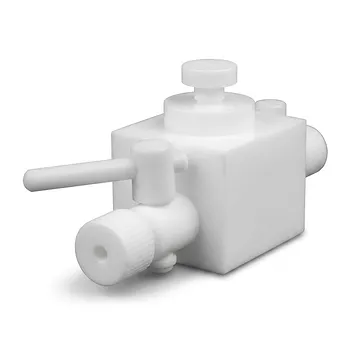
- High Corrosion Resistant PTFE Faucet Polytetrafluoroethylene Valve for Chemical Storage Drums and Fluid Transfer Systems Customizable Industrial Grade
- PTFE PFA Vacuum Filtration System Corrosion Resistant Customizable Shatterproof Laboratory Device
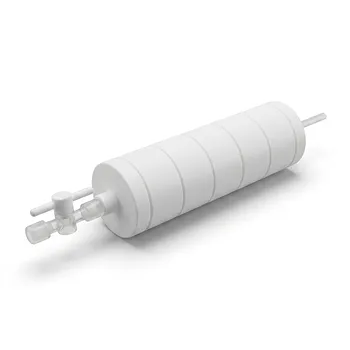
- PTFE Corrosion Resistant Filter with PFA Valve Connections and Integrated Sieve Plate
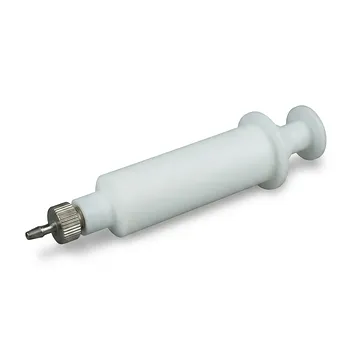
- High Temperature Chemical Resistant 50ml PTFE Syringe Customized Teflon Injector with Threaded Seal for Trace Analysis
People Also Ask
- What makes PTFE filtration systems advantageous for industrial and scientific use? Unmatched Chemical & Thermal Stability
- What steps are involved in selecting the proper PTFE filter? A 4-Step Guide to Optimal Filtration
- What sizes and pore options are available for PTFE filters? Choose the Right Filter for Your Application
- What temperature resistance do PTFE filters offer? Unmatched Thermal Stability from -200°C to +260°C
- How does the hydrophobicity of PTFE filters benefit their use? Ensure Uninterrupted Gas Flow and Solvent Filtration