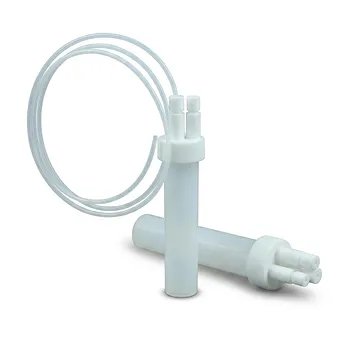
For high-heat, chemically aggressive laboratory service, PTFE and PFA generally provide the broader performance envelope than polysulfone (PSU) and polyphenylenesulfone (PPSU). PSU and PPSU offer high heat-deflection temperatures, excellent dimensional stability, and strong impact performance during repeated steam sterilization. However, their susceptibility to ketones, chlorinated hydrocarbons, and aromatic hydrocarbons can be a decisive limitation, while PTFE and PFA provide much broader resistance to acids, bases, and organic solvents.
The right choice depends on the combination of temperature, chemical exposure, sterilization cycles, mechanical loading, purity, and manufacturing requirements. PSU and PPSU are strong candidates for reusable steam-sterilizable labware when solvent exposure is controlled; PTFE and PFA are usually preferred when chemical compatibility and low contamination risk dominate.
Start With the Actual Service Environment
Identify Every Chemical Exposure
Material selection must account for the complete exposure profile, including process fluids, cleaning agents, rinses, and sterilization chemicals.
PSU and PPSU can be softened or dissolved by ketone solvents, chlorinated hydrocarbons, and aromatic hydrocarbons. That limitation matters for tubing, valves, fittings, cleaning tanks, and labware used with solvent-rich workflows.
PTFE and PFA offer near-universal chemical resistance across common laboratory acids, bases, and organic solvents. Engineers should still verify compatibility for unusual reagents, elevated temperatures, concentration extremes, permeation-sensitive chemicals, and reactive molten materials.
Evaluate Exposure at Operating Temperature
Chemical resistance is not independent of temperature. A polymer that performs acceptably at room temperature may swell, creep, permeate, or lose strength more rapidly when exposed to heated fluids.
The compatibility assessment should therefore combine chemical identity, concentration, temperature, exposure duration, pressure, and mechanical stress rather than relying on a room-temperature compatibility chart alone.
Separate Containment From Permeation
Chemical resistance does not automatically mean zero transport through the material. Permeation, absorption, and trace contamination can affect analytical work even when the component remains visibly intact.
For high-purity or trace-analysis applications, engineers should assess chemical uptake, extractables, ionic contamination, and gas or vapor permeability in addition to bulk compatibility.
Compare Thermal and Sterilization Performance
PSU and PPSU Provide Strong Steam-Sterilization Performance
Polysulfone has a reported heat-deflection temperature of approximately 185°C, while polyphenylenesulfone reaches approximately 207°C.
Both materials exhibit exceptional dimensional stability, with reported dimensional changes below 0.1% after exposure to boiling water or high-temperature steam. PPSU also retains high impact strength after repeated steam sterilization cycles.
These characteristics make PSU and PPSU attractive for reusable labware, trays, housings, fittings, and other components that must remain dimensionally stable through repeated autoclave cycles.
PTFE and PFA Offer Higher Thermal Endurance
PTFE has a melting range of approximately 320-340°C, while PFA is approximately 302-310°C. Both materials provide very high thermal resistance and remain suitable for demanding chemical and sterilization environments when the complete design temperature range is respected.
PTFE is generally selected when maximum thermal stability and rigid, heavy-duty construction are important. PFA provides comparable chemical and thermal endurance while adding melt-processability and improved transparency.
Melting point is not the same as recommended continuous service temperature. Engineers must also consider pressure, wall thickness, creep, thermal cycling, joint construction, and the specific sterilization profile.
Validate Repeated Cycles, Not Just One Cycle
A reusable component must survive cumulative exposure. Repeated steam sterilization can produce changes in color, impact strength, dimensions, seals, joints, and surface condition even when the polymer itself remains chemically stable.
Qualification should include the actual sterilizer cycle, number of cycles, cooling conditions, load configuration, and post-cycle dimensional and mechanical inspection.
Assess Mechanical and Dimensional Behavior
Dimensional Stability Supports Reliable Sealing
PSU and PPSU are inherently rigid and dimensionally stable, which can help maintain reliable interfaces in reusable fittings, valve bodies, and laboratory vessels.
PTFE also provides strong dimensional stability and high temperature tolerance, but its behavior under sustained mechanical load must be evaluated carefully because fluoropolymers can experience creep and deformation.
For pressurized fluid paths, threaded connections, compression fittings, and valve seats, the design must account for long-term load rather than only short-term tensile strength.
Friction Favors PTFE in Moving Interfaces
PTFE has an exceptionally low static coefficient of friction, approximately 0.1, making it useful for seals, valve components, sliding interfaces, and low-friction fluid-transfer mechanisms.
This advantage does not automatically make PTFE the strongest structural choice. Unsupported PTFE parts can deform under load, so backing structures, appropriate tolerances, and component geometry remain important.
PPSU Offers Impact Advantages
PPSU is particularly useful where repeated sterilization must be combined with resistance to impact and handling damage. Its retention of high impact strength after repeated steam cycles can benefit reusable containers, housings, and mechanically handled labware.
PSU and PPSU may therefore be preferable to PTFE or PFA when rigidity, impact resistance, and repeated autoclaving matter more than resistance to aggressive organic solvents.
Consider Purity, Visibility, and Fluid Control
PFA Supports Visual Inspection
PFA is melt-processable and can be molded or extruded into translucent or transparent tubing, bottles, fittings, valve bodies, and vessels.
That visibility can help engineers detect bubbles, particulates, phase separation, discoloration, or incomplete cleaning without opening the fluid path.
PTFE Supports Heavy-Duty Custom Labware
PTFE is non-melt-processible by conventional methods. It is typically produced through compression molding and sintering, then machined into finished parts.
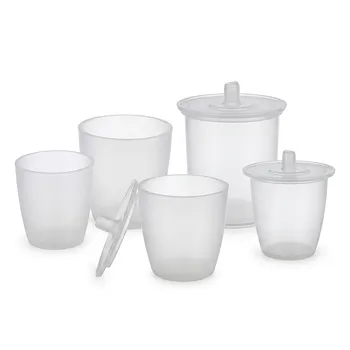
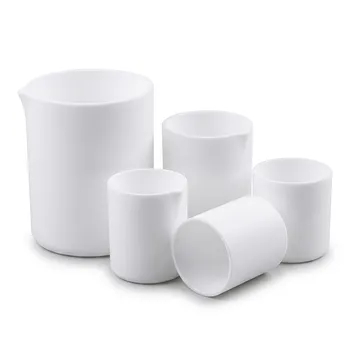
This manufacturing route is well suited to heavy-walled reaction vessels, crucibles, microwave digestion components, electrochemical cell bodies, and other custom structures where chemical inertness and machining flexibility outweigh optical clarity.
Evaluate Trace Contamination Risk
PFA and PTFE are widely used in high-purity laboratory applications because of their chemical inertness and low interaction with aggressive fluids. PFA can be particularly useful where low trace-metal absorption and cleanable, visually inspectable surfaces are required.
The final assessment should include the resin grade, fillers, pigments, welds, machining residues, surface finish, cleaning method, and any ancillary elastomers or adhesives. The polymer alone does not determine the cleanliness of the complete assembly.
Match the Material to the Component Design
Tubing and Flexible Fluid Paths
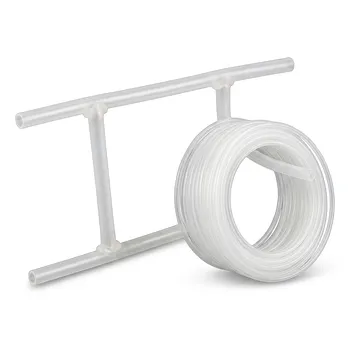
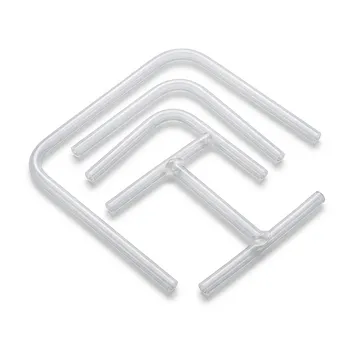
PFA is often advantageous for complex tubing and fluidic assemblies because it can be extruded, heat-welded, and formed into specialized geometries.
PTFE provides excellent chemical resistance and low friction but is less convenient for conventional melt fabrication. Its use may be better suited to specific tubing designs, liners, seals, or machined components where its properties justify the more involved processing route.
Fittings, Valves, and Seals
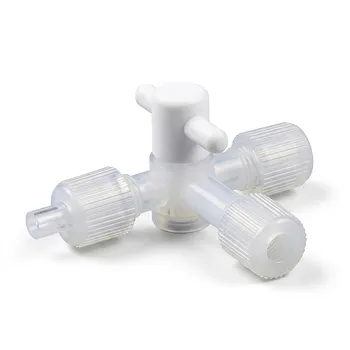
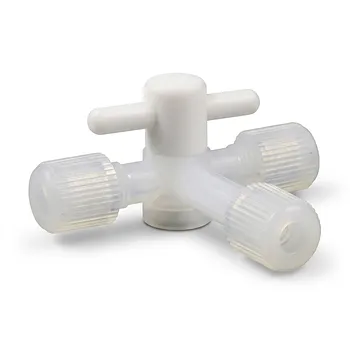
PFA supports molded and welded fittings and valve bodies with high chemical resistance and useful visual access. PTFE is valuable for valve seats, seals, gaskets, and machined fittings where low friction and extreme chemical inertness are central requirements.
PSU and PPSU are attractive for rigid fittings and valve bodies used in steam-sterilizable systems, provided the exposed chemicals do not fall within their solvent-sensitivity range.
Cleaning Tanks and Reusable Vessels
PSU and PPSU can provide lightweight, rigid, dimensionally stable vessels for repeated hot-water or steam exposure.
For cleaning tanks and vessels exposed to ketones, aromatic hydrocarbons, chlorinated solvents, or broad mixtures of aggressive reagents, PTFE or PFA provides a more robust chemical-resistance margin.
Understanding the Trade-offs
Do Not Treat “Chemical Resistant” as Universal
PSU and PPSU are not poor materials; their chemical resistance is simply narrower than that of perfluorinated fluoropolymers.
The common mistake is selecting them based on temperature and sterilization performance while overlooking cleaning solvents, sample matrices, or process residues that can attack the polymer.
Do Not Select PTFE Solely by Its Melting Point
PTFE's high melting point and chemical inertness are major advantages, but component performance can still be limited by creep, sealing stress relaxation, frictional wear, and manufacturing tolerances.
A PTFE part carrying a sustained load may require a different geometry or supporting structure than a rigid PSU or PPSU part.
Do Not Assume PFA and PTFE Are Interchangeable
PFA and PTFE have similar chemical-resistance profiles, but their manufacturing and mechanical behavior differ.
PFA is melt-processable, weldable, and optically clearer. PTFE generally provides greater flexibility for machining heavy or custom structures and is often favored for maximum thermal stability and low-friction interfaces.
Account for Porosity and Permeability
Porosity must match the intended function. Dense material is required for reliable liquid containment, while controlled porosity may be appropriate for gas venting or particle retention in filtration applications.
For assemblies using ePTFE or other porous fluoropolymer structures, engineers must evaluate pore size, permeability, wetting behavior, particle retention, and pressure limits separately from the properties of dense PTFE.
Test the Complete Assembly
A chemically resistant polymer can still fail because of an incompatible O-ring, adhesive, lubricant, weld, insert, or metal fitting.
Qualification should test the complete fluid path under representative pressure, temperature, chemical, cleaning, and sterilization conditions.
Making the Right Choice for Your Goal
Select the material based on the dominant failure risk in the intended workflow.
- If your primary focus is repeated steam sterilization with impact-resistant reusable labware: Choose PPSU, or PSU where its lower heat-deflection temperature is adequate and solvent exposure is controlled.
- If your primary focus is maximum chemical resistance across diverse laboratory solvents: Choose PTFE or PFA, subject to verification for the specific chemicals, temperatures, and pressures involved.
- If your primary focus is transparent or weldable fluidic assemblies: Choose PFA for its melt-processability, optical clarity, and suitability for molded or heat-welded components.
- If your primary focus is heavy-duty custom vessels, crucibles, or electrochemical apparatus: Choose PTFE where machining flexibility, low friction, high purity, and maximum thermal resistance are more important than transparency.
- If your primary focus is dimensional stability in rigid sterilizable components: Evaluate PSU and PPSU first, then confirm that the cleaning and process chemicals remain compatible.
- If your primary focus is reliable long-term sealing or sliding performance: Evaluate PTFE for its low friction, while explicitly designing for creep, deformation, and load retention.
The best material is the one that preserves chemical integrity, dimensional accuracy, mechanical function, and cleanliness throughout the entire validated service life.
Summary Table:
| Factor | PSU/PPSU | PTFE/PFA |
|---|---|---|
| Chemical Resistance | Susceptible to ketones, chlorinated hydrocarbons, aromatics | Near-universal resistance to acids, bases, organics |
| Heat Deflection/Melting | PSU: ~185°C, PPSU: ~207°C | PTFE: 320-340°C, PFA: 302-310°C |
| Sterilization | Excellent dimensional stability (<0.1% change), PPSU retains impact | High thermal endurance, but creep considerations |
| Impact Strength | PPSU retains high impact after sterilization | Lower, more susceptible to deformation under load |
| Mechanical Rigidity | Rigid and dimensionally stable | Creep under sustained load |
| Friction | Higher friction | Very low (coefficient ~0.1) |
| Transparency/Clarity | Opaque (typically) | PFA translucent/transparent, PTFE opaque |
| Manufacturing | Injection moldable, machinable | PTFE: compression molded and machined; PFA: melt-processable |
| Typical Applications | Reusable sterilizable labware, fittings, housings | Tubing, seals, heavy-duty, high-purity custom apparatus |
Make the Right Material Choice for Your Lab's Demanding Needs. At KINTEK, we specialize in high-performance fluoropolymers (PTFE and PFA) and offer a comprehensive range of labware, fluid transfer components, and custom machined parts. Our experts can help you select the ideal material for your application, ensuring reliability and purity. Contact us today to discuss your requirements!
Related Products
- Corrosion Resistant High Purity PFA Valve and Weldable Transparent Tubing for Semiconductor Fluid Transfer
- High Purity PFA Valves and Weldable Corrosion Resistant Transparent Tubing for Semiconductor Sensor Manufacturing Fluid Transfer
- High Purity PFA Crucible and Corrosion Resistant PTFE Beaker for Trace Analysis and Custom Laboratory Applications
- Corrosion Resistant PFA Tubing 1/4 Inch Custom Molded Welded Fluid Transfer Components
- Custom PTFE Constant Pressure Separatory Funnel Corrosion Resistant Low Background Labware for PFA Flasks
People Also Ask
- Why are high-purity PFA fluid transfer components preferred for battery electrolytes? Ensure Purity & Data Accuracy
- How do high-precision PFA fluid transfer components, such as tubing and fittings, affect the results of continuous-flow synthesis?
- How do PFA fluid transfer components contribute to chemical research precision? Achieve high-purity results today.
- What role do PFA tubing and valves play in high-precision laboratory fluid transfer systems? Ensure Ultra-Pure Results
- Which material characteristics of fluoropolymers are most critical for high-purity fluid transfer and labware? Key factors: chemical inertness, low extractables, thermal stability.