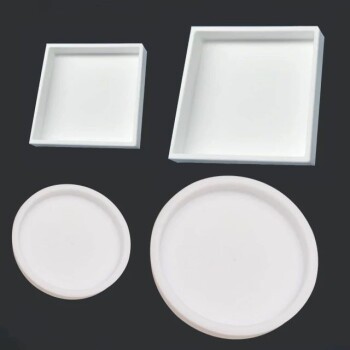
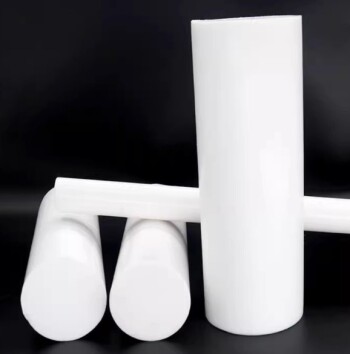
The molecular mechanism is a fluorine shield around a carbon backbone. In PTFE and PFA, hydrogen is essentially replaced by fluorine, creating highly stable carbon-fluorine bonds and a dense, low-polarizability outer surface. This sheath both protects the polymer from chemical attack and gives the surface exceptionally low surface energy, which reduces liquid wetting, sample adhesion, and friction.
Perfluorinated polymers behave this way because their strong, tightly packed C-F bonds protect the carbon backbone, while their weak surface interactions make the material difficult to wet, stick to, or chemically react with.
How Fluorine Protects the Polymer
The carbon-fluorine bond resists chemical attack
PTFE consists primarily of repeating tetrafluoroethylene units, while PFA is a related perfluoropolymer containing small perfluoroalkoxy side groups. In both materials, fluorine atoms surround the carbon framework and form exceptionally stable C-F bonds.
Chemical reagents would need to break or penetrate this fluorinated outer structure before attacking the carbon backbone. Because the surface is densely fluorinated and chemically unreactive, common solvents, concentrated acids, strong bases, and many oxidizing or reducing reagents have little ability to react with it under ordinary laboratory conditions.
The fluorine atoms form an electronic and physical shield
Fluorine is highly electronegative, and the C-F bond is short and strong. The surrounding fluorine atoms therefore create both a tightly bonded outer layer and an electronically shielded carbon skeleton.
This description is a useful molecular model, but it does not mean PTFE is immune to every chemical or thermal condition. Extremely reactive fluorinating agents, molten alkali metals, high-energy radiation, and sufficiently high temperatures can damage fluoropolymers.
Polymer structure adds further stability
The carbon-fluorine sheath works together with the polymer's chain structure and crystallinity. PTFE's long, linear chains pack into ordered regions, limiting access to the backbone and reducing the number of chemically accessible reactive sites.
PFA has a modified structure that improves melt processability while retaining the perfluorinated chemical environment responsible for its resistance.
Why the Surface Does Not Stick
Low surface energy limits wetting
Fluorinated surfaces have very low surface energy, with PTFE commonly reported near 18 dynes per centimeter as a critical surface-tension value. A liquid must overcome this surface-energy mismatch to spread across the material.
As a result, many aqueous and organic liquids form droplets or retreat from the surface instead of wetting it completely. Poor wetting reduces the contact area available for adhesion and makes residues easier to remove.
Weak intermolecular attraction reduces adhesion
The outer surface is rich in fluorine and has low polarizability compared with many hydrocarbon or polar materials. This reduces dispersion and other intermolecular attractions between the polymer surface and contacting chemicals or sample components.
The result is not that liquids never contact PTFE or PFA. Rather, the contact is usually weak enough that residues, particles, and reaction products do not adhere strongly under normal laboratory conditions.
Low friction comes from weak surface interactions
PTFE has an exceptionally low coefficient of friction, often reported in the approximate range of 0.04 to 0.1, depending on load, surface condition, temperature, and whether the value is static or dynamic.
When two surfaces slide, the fluorinated outer layers generate relatively little adhesive interaction. This allows surfaces to move past one another with low resistance, which is why PTFE is useful in valve seats, seals, fittings, tubing, and moving laboratory components.
The low friction is therefore primarily a surface-chemistry effect, supported by the smooth, nonpolar character of the fluoropolymer. It should not be attributed solely to polymer chains slipping freely inside the bulk material.
Why This Matters in Laboratory Apparatus
Chemical resistance protects the apparatus
PTFE and PFA can remain stable when exposed to aggressive reagents that would attack metals, glass coatings, elastomers, or ordinary hydrocarbon plastics. This makes them suitable for digestion vessels, tubing, valves, fittings, beakers, and reaction components.
PFA is often selected when a transparent, melt-processable fluoropolymer is needed. PTFE is widely used where maximum chemical resistance and low friction are the primary requirements.
Low adhesion improves sample recovery
A low-energy surface is less likely to retain droplets, precipitates, digestion products, or trace analytes. This supports more complete liquid transfer and simplifies cleaning.
In trace analysis, minimizing residue is important because even a small amount of retained material can create carryover into a later sample.
Inert surfaces reduce contamination risks
Perfluoropolymers generally do not require the same plasticizer systems used by some flexible plastics. Their low reactivity and low absorption tendency can therefore reduce sources of leachable contamination and sample interaction.
This does not guarantee zero contamination. Cleanliness, manufacturing quality, previous chemical exposure, surface damage, and seals or additives elsewhere in the assembly still determine the actual analytical background.
Understanding the Trade-offs
Chemical inertness has limits
PTFE and PFA resist a very broad range of laboratory chemicals, but they are not universally compatible with every reagent or condition. Strong elemental fluorinating systems, molten alkali metals, certain high-energy environments, and excessive temperatures can cause degradation.
Compatibility should be checked against the specific reagent concentration, temperature, pressure, exposure time, and mechanical stress.
Low surface energy can complicate bonding
The same weak surface interactions that prevent sticking also make fluoropolymers difficult to glue, coat, print, or bond. Components may require mechanical connections, specialized surface treatment, or carefully selected adhesives.
Mechanical and thermal performance still matters
A chemically resistant material can still deform, creep, soften, or fail under load. PTFE is especially known for creep under sustained mechanical stress, while PFA's processing and mechanical characteristics differ because of its copolymer structure.
Material selection must therefore consider pressure, temperature cycling, dimensional stability, and seal performance, not chemical compatibility alone.
“Non-stick” does not mean self-cleaning
Particles can still become trapped in scratches, surface defects, joints, or porous contamination layers. Repeated exposure can also leave a film even when the polymer itself is not chemically attacked.
Proper cleaning and inspection remain necessary in high-purity workflows.
How to Apply This to Your Project
The correct choice depends on whether chemical resistance, sample recovery, friction, processability, or mechanical performance is the dominant requirement.
- If your primary focus is chemical compatibility: Use PTFE or PFA when the apparatus must withstand aggressive acids, bases, solvents, or digestion reagents, after checking the specific operating conditions.
- If your primary focus is sample purity: Favor clean, well-characterized fluoropolymer components with minimal additives, and control cleaning, handling, and contamination from the rest of the assembly.
- If your primary focus is low friction: Use PTFE-based components for sliding interfaces, valve seats, seals, and fittings where weak surface adhesion and low shear resistance are valuable.
- If your primary focus is liquid recovery: Use the low-energy fluoropolymer surface to reduce wetting and residue retention, while designing joints and geometries that do not trap material.
- If your primary focus is fabrication or transparency: Consider PFA when melt processability and visual inspection are important while retaining perfluoropolymer chemical resistance.
The defining advantage of PTFE and PFA is the combination of a chemically protected carbon backbone and a weakly interacting, low-energy fluorinated surface.
Summary Table:
| Property | Molecular Mechanism | Practical Benefit |
|---|---|---|
| Chemical Inertness | Strong C-F bonds shield carbon backbone | Resists acids, bases, solvents |
| Low Surface Energy | Dense fluorine atoms reduce wetting | Non-stick, easy cleaning |
| Low Friction | Weak intermolecular forces | Smooth sliding for seals and fittings |
| Low Adhesion | Low polarizability surface | Higher sample recovery |
Maximize your lab's efficiency with KINTEK's high-performance PTFE and PFA labware. From beakers and digestion vessels to custom CNC-machined components, we provide the durable, chemically inert solutions you need. For distributors, we offer OEM/ODM support, competitive margins, and reliable supply. Contact us today to discuss your requirements and elevate your lab operations!
Related Products
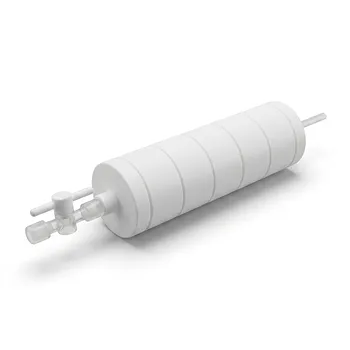
- Custom PTFE Filtration System Acid Resistant High Purity Semiconductor Grade Chemical Processing Filter
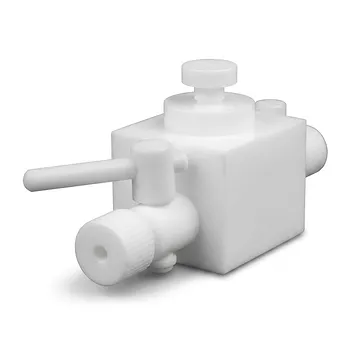
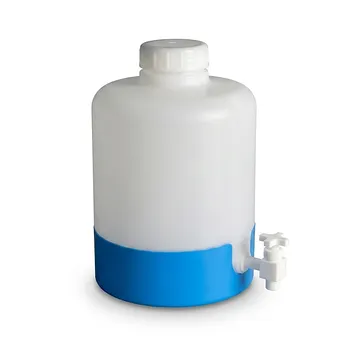
- High Corrosion Resistant PTFE Faucet Polytetrafluoroethylene Valve for Chemical Storage Drums and Fluid Transfer Systems Customizable Industrial Grade
- PTFE PFA Vacuum Filtration System Corrosion Resistant Customizable Shatterproof Laboratory Device
- PTFE Corrosion Resistant Filter with PFA Valve Connections and Integrated Sieve Plate
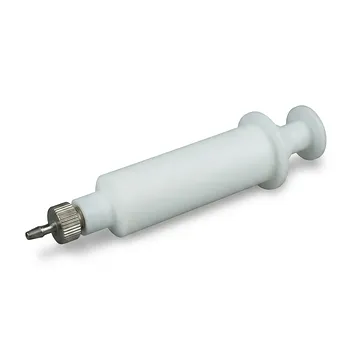
- High Temperature Chemical Resistant 50ml PTFE Syringe Customized Teflon Injector with Threaded Seal for Trace Analysis
People Also Ask
- What makes PTFE filtration systems advantageous for industrial and scientific use? Unmatched Chemical & Thermal Stability
- What steps are involved in selecting the proper PTFE filter? A 4-Step Guide to Optimal Filtration
- What sizes and pore options are available for PTFE filters? Choose the Right Filter for Your Application
- What temperature resistance do PTFE filters offer? Unmatched Thermal Stability from -200°C to +260°C
- How does the hydrophobicity of PTFE filters benefit their use? Ensure Uninterrupted Gas Flow and Solvent Filtration