Microporous ePTFE membranes overcome conventional PTFE's main mechanical weakness: low strength and susceptibility to creep. Solid PTFE has excellent chemical resistance and a broad operating range of approximately -260°C to +260°C, but it can deform under sustained tensile or compressive loads. Expanding PTFE into a fibrillated microporous structure substantially improves tensile strength, dimensional stability, fatigue resistance, and resistance to cold flow while preserving PTFE's chemical inertness.
The key improvement is structural reinforcement through expansion. ePTFE retains PTFE's chemical and thermal advantages but replaces its relatively weak, solid structure with a strong node-and-fibril network that supports pressure, repeated flexing, and long-term filtration service.
Why Conventional PTFE Is Mechanically Limited
Low tensile strength and rigidity
Solid PTFE has relatively low mechanical strength compared with many engineering polymers. It is therefore poorly suited to applications where the material must carry sustained tensile, compressive, or pressure-related loads without reinforcement.
Creep under sustained load
PTFE tends to undergo cold flow, also called creep. Under continuous pressure or compression, it can gradually deform, which may cause loss of sealing force, dimensional change, or reduced support for a filtration component.
Limited fatigue and abrasion resistance
Repeated flexing, vibration, pressure cycling, or handling can expose solid PTFE's limited mechanical durability. Its resistance to wear and flexural fatigue is lower than that of the expanded membrane structure.
Difficult mechanical integration
Conventional PTFE is difficult to process using ordinary molten-state methods and can be difficult to join or form into complex components. These processing characteristics can make mechanically robust assemblies more difficult and costly to produce.
How Expansion Changes PTFE's Mechanical Behavior
The node-and-fibril structure carries loads
ePTFE is produced by expanding high-molecular-weight PTFE resin into a microporous node-and-fibril network. The interconnected fibrils distribute applied loads across the membrane rather than relying on the comparatively weak bulk structure of solid PTFE.
Tensile strength increases substantially
The expanded structure can provide much higher matrix tensile strength than solid PTFE. Reported values are approximately 50-800 MPa for ePTFE, compared with roughly 20-30 MPa for solid PTFE, depending on the membrane's orientation, density, and processing conditions.
Resistance to creep improves
The fibrillated matrix is more resistant to deformation under sustained pressure or tension. This helps ePTFE maintain its shape and functional pore structure in vent filters, fluid-handling barriers, and pressure-exposed filtration assemblies.
Flexural fatigue improves
ePTFE tolerates repeated flexing and pressure cycling more effectively than solid PTFE. This is important in applications exposed to vibration, repeated handling, pulsing, or changes in differential pressure.
Abrasion resistance improves
The expanded matrix also provides better resistance to mechanical wear. This can extend service life when membranes are handled, supported by porous substrates, or exposed to repeated cleaning and filtration cycles.
Why These Improvements Matter in Filtration and Fluid Handling
Pressure support without sacrificing permeability
A solid PTFE component is mechanically stable only because it is dense and impermeable. ePTFE provides a stronger membrane structure while retaining interconnected pores for gas and vapor transport.
This allows a membrane to tolerate differential pressure and handling stresses while still performing as a vent, filter, or phase-separation barrier.
Reliable pressure equalization
In laboratory venting and fluid-handling systems, ePTFE allows gases and water vapor to pass while its hydrophobic surface resists liquid-water penetration under the specified pressure conditions. The result is pressure equalization without fluid leakage.
Stable filtration performance
ePTFE membranes perform primarily as surface filters. Particles are captured at or near the membrane surface instead of becoming deeply embedded in a bulky filter matrix.
The mechanically stable structure helps preserve a consistent pore network and supports easier filter-cake removal during cleaning or replacement.
Lower and more stable pressure drop
A uniform microporous structure can maintain a lower and more stable pressure drop over extended operation than conventional felt media. This supports consistent airflow, lower energy demand, and potentially longer service life.
Lower mass and greater design flexibility
ePTFE has a much lower density than solid PTFE because much of its volume is pore space. Reported specific gravity ranges from approximately 0.1-1.0 g/cm³ for ePTFE, compared with about 2.1 g/cm³ for solid PTFE.
This enables lightweight membranes and compact filtration assemblies without abandoning PTFE's chemical resistance.
Understanding the Trade-offs
Strength depends on membrane design
ePTFE is not uniformly stronger in every direction or configuration. Tensile performance depends on expansion conditions, density, orientation, thickness, and whether the membrane is supported by another material.
A mechanically demanding design may therefore require a backing layer, support screen, housing, or controlled clamping arrangement.
Porosity and pressure resistance compete
Smaller pores and lower porosity generally improve liquid breakthrough resistance, while higher porosity and larger pores improve gas flow. These properties must be balanced against the required differential pressure and airflow rate.
Liquid blocking is pressure-dependent
Hydrophobic ePTFE does not create an absolute barrier to every liquid under every condition. Liquid breakthrough depends on pore size, surface energy, liquid properties, and applied pressure, so the membrane must be selected against a defined liquid-entry or breakthrough requirement.
Expansion does not eliminate all PTFE limitations
ePTFE preserves many of PTFE's beneficial properties, but it does not make PTFE universally suitable for structural loads. Unsupported membranes can be damaged by puncture, excessive clamping, sharp edges, or pressure beyond their design rating.
Chemical and thermal compatibility still require verification
PTFE is broadly chemically resistant and tolerates extreme temperatures, but the complete assembly may include supports, adhesives, seals, or housings with narrower limits. Compatibility must therefore be assessed for the membrane and every contacting component.
Making the Right Choice for Your Goal
ePTFE is most valuable when the application needs PTFE's chemical resistance together with a mechanically stable, permeable membrane.
- If your primary focus is pressure and dimensional stability: Choose a supported or appropriately reinforced ePTFE design to reduce creep, deformation, and fatigue under sustained or cyclic loads.
- If your primary focus is gas venting and liquid containment: Select a hydrophobic ePTFE membrane with a pore structure and liquid-entry pressure matched to the operating fluid and differential pressure.
- If your primary focus is particle filtration: Use a surface-filtration ePTFE membrane with the required pore rating and a construction that supports stable pressure drop and filter-cake release.
- If your primary focus is lightweight system design: Use ePTFE to reduce membrane mass while retaining chemical resistance, permeability, and improved mechanical performance over solid PTFE.
ePTFE turns PTFE from a chemically durable but mechanically limited solid into a stronger, fatigue-resistant, microporous membrane suited to demanding filtration and fluid-handling duties.
Summary Table:
| Limitation of Conventional PTFE | How ePTFE Overcomes It |
|---|---|
| Low tensile strength and rigidity | Expanded node-and-fibril structure provides higher matrix tensile strength (50-800 MPa vs 20-30 MPa) |
| Creep under sustained load | Fibrillated matrix resists deformation under sustained pressure or tension |
| Limited fatigue and abrasion resistance | Improved flexural fatigue and abrasion resistance for repeated flexing and handling |
| Difficult mechanical integration | Lower density (0.1-1.0 g/cm³ vs 2.1 g/cm³) enables lightweight, compact designs |
| Dense, impermeable structure | Microporous structure maintains permeability while providing mechanical support |
Ready to enhance your filtration and fluid handling systems with high-performance ePTFE membranes? At KINTEK, we specialize in precision-engineered PTFE and PFA lab supplies, including microporous ePTFE membranes and custom components. Our end-to-end CNC machining capabilities allow us to deliver tailored solutions for your specific needs—whether you require standard labware, high-purity trace analysis tools, or complex custom assemblies. Experience improved tensile strength, creep resistance, and durability in your applications. Contact us today to discuss your requirements and discover how our expertise can optimize your processes. Get in touch with our specialists and let's build a solution together!
Related Products
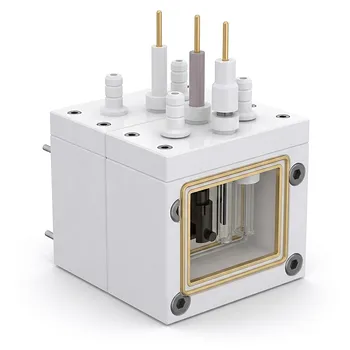
- All PTFE Exchangeable Membrane Electrochemical Cell Dual Chamber Three Electrode Photoelectrochemical Cell for Laboratory Trace Analysis
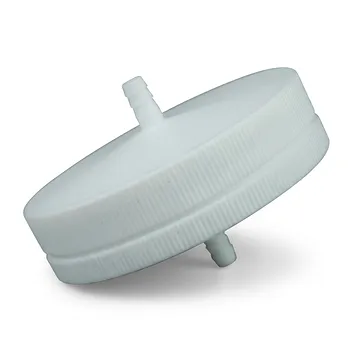
- PTFE Membrane Filter Holder for Aerosol Environmental Monitoring and Low Concentration Particulate Matter Sampling Chemical Resistant Air Quality Analysis Component
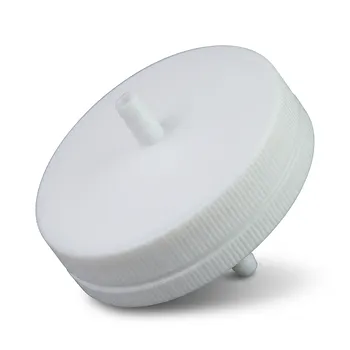
- PTFE Filter Membrane Holder 47mm Leak Proof Corrosion Resistant Environmental Sampling Unit Customizable
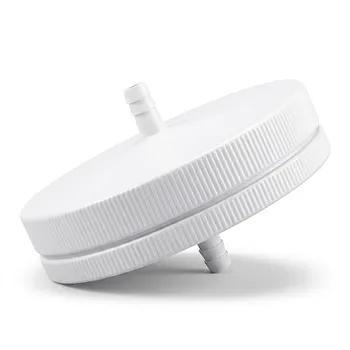
- PTFE Filter Membrane Holder for Hydrogen Chloride and Water Filtration 90mm Environmental Sampling Clamp Customizable
- High Purity PTFE Square Membrane Cutter Equipartition Device for Trace Analysis and Disease Control Centers Clean Non Stick No Leaching
People Also Ask
- What makes PTFE an ideal construction material for custom electrochemical cells and electronic analytical instrumentation housings? Discover superior chemical resistance and electrical insulation
- What parameters govern the electrochemical decomposition of perfluorooctanoic acid (PFOA) in aqueous solutions, and why are custom PTFE electrochemical cells preferred? Key factors include anode material, current density, electrolyte, and cell design.
- Why are high-performance fluoropolymers like PTFE and PFA preferred for electrochemical cells and sensitive analytical instrumentation? Achieve Reliable, Contamination-Free Measurements
- What material and design considerations are critical for electrofluorination and aggressive fluorinated intermediates? Key factors for safe PTFE/PFA systems
- How is cyclic voltammetry performed on fluoropolymer-modified electrodes within electrochemical cells, and what factors affect energy bandgap calculations?