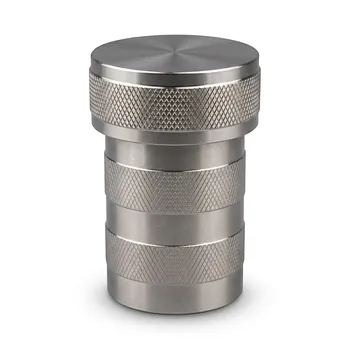
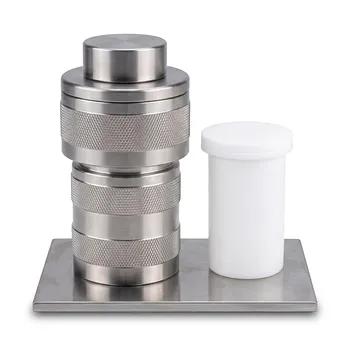
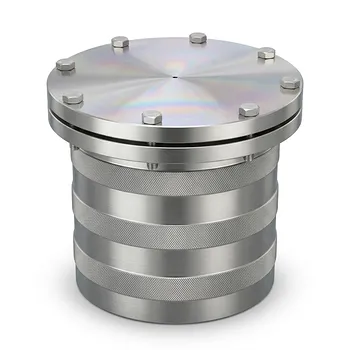
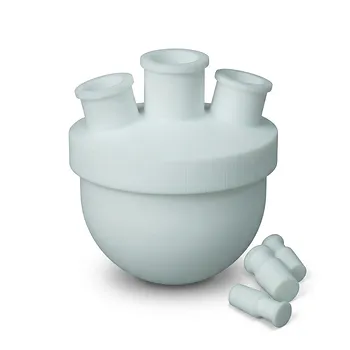
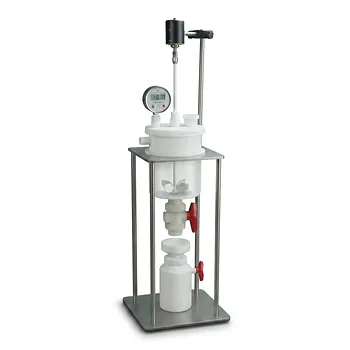
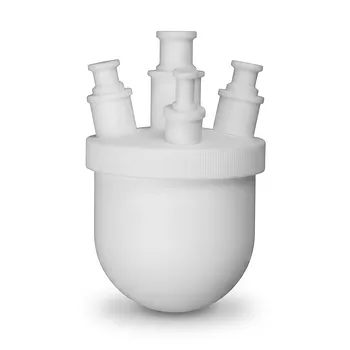
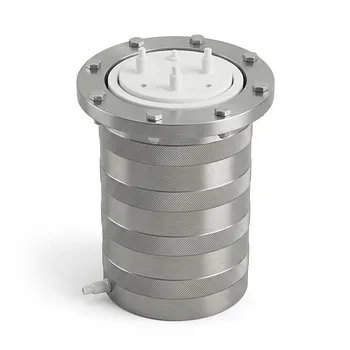
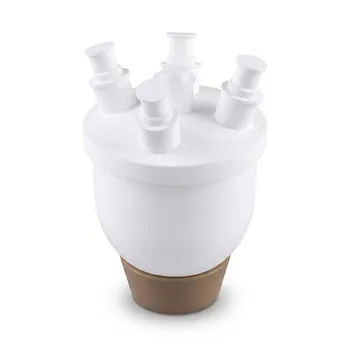
The Teflon-lined hydrothermal synthesis autoclave is the fundamental reaction vessel for the in-situ growth of $\text{NiMoO}_4$ nanowires. It provides a chemically inert, high-pressure, and high-temperature environment that allows precursor solutions—typically containing nickel salts and molybdates—to crystallize directly onto conductive substrates. At reaction temperatures such as 160 °C, the Teflon liner ensures that the solution does not react with the autoclave's outer metal shell, preserving the high purity and specific morphology required for high-performance battery anodes.
Core Takeaway: The autoclave serves as a controlled "pressure cooker" where the Teflon liner prevents chemical contamination while the stainless steel shell provides the mechanical strength to withstand high-pressure synthesis. This dual-material design is essential for producing high-purity $\text{NiMoO}_4$ nanowires with the structural regularity needed for electrochemical applications.
Preventing Chemical Contamination and Corrosion
The Role of Chemical Inertness
The internal Teflon (PTFE) liner is chosen for its extreme resistance to highly polar precursor solutions. In the synthesis of $\text{NiMoO}_4$, the solution contains aggressive nickel salts and molybdates that would otherwise corrode standard metal containers.
Isolation from the Stainless Steel Shell
At the standard hydrothermal temperature of 160 °C, the liner acts as a physical barrier between the reaction fluid and the autoclave’s outer casing. This isolation is critical to prevent metal ion leaching from the stainless steel, which would introduce impurities into the nanowire crystal lattice.
Facilitating High-Purity Nucleation
By maintaining a pure chemical environment, the autoclave ensures that $\text{NiMoO}_4$ nucleates and grows exclusively from the intended precursors. This results in the uniform growth of nanowires on substrates like carbon paper or metal fiber felts, which is vital for the consistency of the resulting anode.
Managing High-Pressure Reaction Kinetics
Creating a Sealed, Superheated Environment
The autoclave creates a sealed system where the precursor solution is heated above its boiling point under significant pressure. This hydrothermal environment increases the solubility of the precursors and provides the kinetic energy necessary for the deep chemical reactions that form complex nanostructures.
Anisotropic Growth of Nanowires
The high-pressure conditions within the sealed vessel facilitate the anisotropic growth of crystals. This pressure-driven process is what allows the $\text{NiMoO}_4$ to form elongated, high-aspect-ratio nanowires rather than irregular particles.
Synergy Between Liner and Shell
While the Teflon liner handles chemical resistance, the stainless steel outer shell provides the mechanical integrity to contain the internal pressure safely. This combination allows for long-duration reactions—often lasting several hours—at constant temperatures and pressures.
Understanding the Trade-offs and Risks
Thermal Limitations of PTFE
While Teflon is chemically robust, it has a clear thermal ceiling, typically around 250 °C. Exceeding the recommended temperature for $\text{NiMoO}_4$ synthesis can cause the liner to soften or deform, potentially leading to a seal failure or "blown" autoclave.
The Impact of Filling Ratios
The volume of the precursor solution relative to the liner's capacity—the filling ratio—is a critical safety and performance factor. Overfilling the liner leaves no room for thermal expansion, which can generate excessive pressure and compromise the structural integrity of the vessel.
Potential for Impurity Accumulation
Despite its inertness, Teflon is porous at a microscopic level and can absorb trace amounts of chemicals over multiple uses. If not rigorously cleaned between synthesis cycles, cross-contamination from previous experiments can degrade the electrochemical performance of the $\text{NiMoO}_4$ nanowires.
Applying These Principles to Your Synthesis
To achieve the best results when preparing $\text{NiMoO}_4$ nanowire anodes, consider the specific requirements of your project:
- If your primary focus is Maximum Purity: Ensure you use a high-quality PTFE liner that has been acid-washed to remove any residual metal ions from previous runs.
- If your primary focus is Morphological Uniformity: Maintain strict control over the heating ramp rate and the final reaction temperature (e.g., 160 °C) to ensure consistent nucleation across the substrate.
- If your primary focus is Safety and Durability: Never exceed a 70-80% filling ratio and regularly inspect the Teflon liner for signs of thinning, pitting, or permanent deformation.
The success of $\text{NiMoO}_4$ nanowire synthesis depends on the autoclave's ability to maintain a pristine, high-pressure environment that forces chemical precursors into a specific crystalline architecture.
Summary Table:
| Component | Role in Synthesis | Material Advantage |
|---|---|---|
| Teflon (PTFE) Liner | Prevents chemical contamination | High chemical inertness and corrosion resistance |
| Stainless Steel Shell | Provides mechanical integrity | High pressure and structural durability |
| Sealed Interior | Facilitates anisotropic growth | Enables formation of elongated nanowire structures |
Optimize Your Nanomaterial Synthesis with KINTEK
Achieve the highest purity in your electrochemical research with KINTEK’s premium fluoropolymer labware. Whether you are synthesizing $\text{NiMoO}_4$ nanowires or developing next-generation battery anodes, we offer a comprehensive range of high-performance PTFE and PFA products tailored for demanding hydrothermal environments.
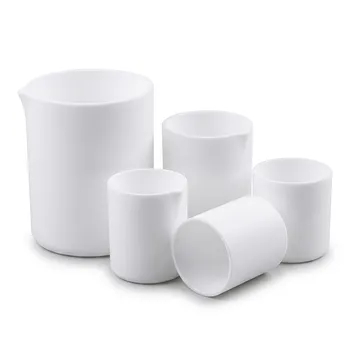
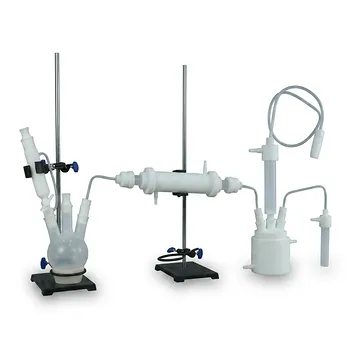
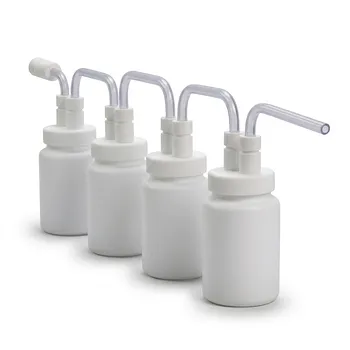
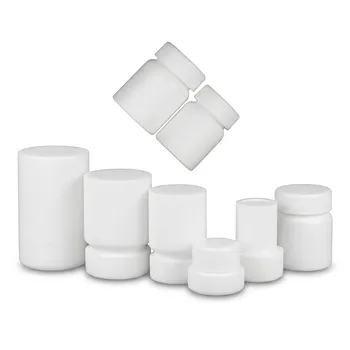
From everyday essentials like beakers, crucibles, and reagent bottles to advanced hydrothermal synthesis liners, microwave digestion vessels, and custom electrochemical cells, KINTEK is your partner in precision. Our end-to-end custom CNC fabrication allows us to deliver everything from complex non-standard machined parts to high-volume orders of specialized tubing, fittings, and filtration tools, maintaining an absolute focus on high-performance materials.
Don't let chemical contamination or equipment failure compromise your results. Contact us today to discover how KINTEK’s specialized fluoropolymer equipment can enhance your laboratory's efficiency and research accuracy.
References
- Li-Da Chiu, Jian‐Zhang Chen. NiMoO<sub>4</sub> Nanowires Supported on Stainless-Steel, Carbon, and Nickel Fiber Papers as Catalysts for the Oxygen Evolution Reaction in Anion Exchange Membrane Water Electrolysis. DOI: 10.1021/acsanm.5c03175
This article is also based on technical information from Kintek Knowledge Base .
Related Products
- High Temperature Corrosion Resistant Hydrothermal Synthesis Reactor with TFM Inner Liner and Straight Cylinder Design
- PTFE Lined High Pressure Digestion Vessel 50ml High Temperature Hydrothermal Synthesis Tank
- Custom TFM Reaction Vessel with Stainless Steel Jacket and PTFE Inner Cup for High Corrosion Resistance
- High Temperature PTFE Reaction Flask 1000ml Single Neck Round and Flat Bottom Laboratory Bottle
- Large Scale PTFE Beakers and Flasks for High Temperature Corrosion Resistant Laboratory Applications with Custom CNC Fabrication
People Also Ask
- What is the role of a corrosion-resistant reactor in the synthesis of lignin-based carbon dots? Ensure Maximum Purity
- What are the technical advantages of using hydrothermal synthesis reactors for advanced electronic & optical nanomaterials?
- How does a hydrothermal synthesis reactor facilitate the production of crystalline materials with tailored morphologies? Precision Crystal Growth
- Why is the sealing reliability of a hydrothermal synthesis reactor critical for 24-hour cycles? Ensure Nano-Precision
- What role do hydrothermal synthesis reactors play in CQD preparation? Achieve High-Purity Nanomaterial Synthesis