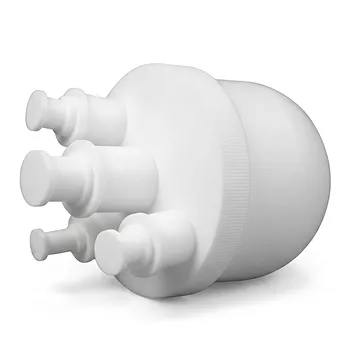
The sealing reliability of a hydrothermal synthesis reactor is the fundamental safeguard for maintaining the precise thermodynamic and chemical environment required for uniform nanoparticle growth. In long-duration reactions, such as a 24-hour cycle at 220°C, even a microscopic leak causes pressure fluctuations and the loss of volatile components like ammonia. This instability disrupts the delicate balance of chemical concentrations and internal pressure, leading to abnormal grain growth and preventing the formation of monodisperse particles with a low coefficient of variation.
Core Takeaway: Superior sealing ensures a closed system where pressure and concentration remain constant, preventing the premature termination of crystal growth or the degradation of particle uniformity during extended heating cycles.
Maintaining Thermodynamic and Kinetic Stability
Preventing Volatile Component Loss
In reactions involving volatile precursors or catalysts, such as ammonia, the seal prevents these components from escaping under high temperatures. If these volatiles leak, the chemical concentration within the reactor shifts, which can fundamentally alter the reaction pathway and the resulting product.
Stabilizing Internal Pressure
Maintaining a constant internal pressure is a physical requirement for the slow, controlled self-assembly of complex lattice structures. Any minor pressure fluctuations resulting from a failing seal can interrupt the growth process, often resulting in lower-quality polycrystalline powders instead of the desired single crystals.
Ensuring Consistent Reaction Kinetics
A reliable seal ensures that kinetics—such as carbonization rates or coating thicknesses—remain uniform throughout the entire 24-hour duration. Without this consistency, the final product will exhibit a wide range of sizes and structural defects rather than the intended monodisperse distribution.
Impact on Particle Morphology and Crystallinity
Inhibiting Abnormal Grain Growth
During long reaction cycles, particles undergo Ostwald ripening, where larger particles grow at the expense of smaller ones. A stable, leak-proof environment is essential to inhibit abnormal grain growth during this phase, which is the only way to achieve a low coefficient of variation in particle size.
Promoting High-Quality Lattice Formation
For applications requiring diffraction analysis, the formation of a stable, high-quality single crystal lattice is paramount. Reliable sealing provides the steady-state environment necessary for molecules to arrange themselves into these highly ordered structures without interruption from solvent loss.
Maintaining Solvent Volume
Hydrothermal synthesis relies on the solvent remaining in a subcritical or supercritical state; losing solvent through a poor seal changes the solvent-to-solute ratio. This change can cause precursors to precipitate prematurely or form unintended chemical phases.
The Mechanics of a Reliable Seal
Viscoelastic Deformation of Liners
The sealing mechanism typically relies on the viscoelastic deformation of a polymer lining, such as PTFE or PPL, against the reactor lid. When the outer stainless-steel cap is tightened, it compresses these materials to create a physical barrier that can withstand extreme internal forces.
Self-Energizing Design Features
Advanced reactors often utilize tongue-and-groove or flat-face designs that become "self-energizing." As the internal pressure rises during the 24-hour heating cycle, the pressure itself pushes the liner more firmly against the sealing surface, further tightening the seal.
Thermal and Chemical Resistance
PTFE gaskets are favored for their chemical inertness and thermal stability at temperatures up to 220°C. Their ability to remain resilient under pressure without degrading ensures that the reactor remains a closed system even during the final hours of a long synthesis.
Understanding the Trade-offs and Risks
Material Fatigue in PTFE
While PTFE is highly effective, it is subject to creep and deformation over repeated 24-hour cycles. Users must monitor the thickness and shape of the gaskets, as a "set" or permanently deformed liner will eventually lose its ability to maintain a self-energizing seal.
The Risks of Over-Tightening
Attempting to compensate for a poor seal by over-tightening the stainless-steel cap can lead to mechanical failure. Excessive force can crush the polymer liner or strip the threads of the reactor, creating safety hazards under high-pressure conditions.
Making the Right Choice for Your Goal
To ensure success in hydrothermal synthesis, your sealing strategy must align with your specific experimental objectives:
- If your primary focus is Monodisperse Nanoparticles: Prioritize a self-energizing seal design to maintain the constant pressure required to inhibit abnormal grain growth during Ostwald ripening.
- If your primary focus is Single Crystal Growth: Ensure your reactor uses high-grade PTFE or PPL liners that can maintain a leak-proof environment for 72 hours or more to allow for slow lattice assembly.
- If your primary focus is Safety and Longevity: Implement a strict replacement schedule for polymer gaskets to avoid the risks associated with material fatigue and "creep" during high-temperature cycles.
Mastering the integrity of the reactor seal is the most critical step in transitioning from unpredictable chemical batches to high-precision material synthesis.
Summary Table:
| Feature | Impact on 24-Hour Cycle | Key Mechanism |
|---|---|---|
| Thermodynamic Stability | Prevents pressure/concentration shifts | Maintains a closed system |
| Particle Morphology | Ensures monodisperse distribution | Inhibits abnormal grain growth |
| Solvent Retention | Prevents premature precipitation | Subcritical/Supercritical state preservation |
| Material Integrity | Resists high-temp deformation | Viscoelastic PTFE/PPL liners |
| Pressure Design | Enhances seal under load | Self-energizing tongue-and-groove |
Achieve Uncompromising Precision in Your Synthesis
At KINTEK, we understand that the success of your 24-hour hydrothermal reactions depends on the absolute reliability of your equipment. Specializing exclusively in high-performance fluoropolymers, we provide the critical components needed to maintain a perfect seal and a stable reaction environment.
From high-purity hydrothermal synthesis liners and microwave digestion vessels to everyday essentials like beakers, reagent bottles, and comprehensive fluid transfer components (tubing, valves, and fittings), KINTEK delivers unmatched quality. Whether you require standard labware or bespoke, complex non-standard parts machined through our end-to-end custom CNC fabrication, we support everything from niche research setups to high-volume industrial orders.
Don't let a microscopic leak compromise your material science—trust the fluoropolymer experts.
Contact KINTEK Today for Custom Solutions
References
- Yuki Makinose. Exploring Monodisperse Condition for Ceramic Nanoparticles Using Hydrothermal Synthesis and Machine Learning. DOI: 10.14356/hptf.22115
This article is also based on technical information from Kintek Knowledge Base .
Related Products
- High Temperature Corrosion Resistant Hydrothermal Synthesis Reactor with TFM Inner Liner and Straight Cylinder Design
- PTFE Lined High Pressure Digestion Vessel 50ml High Temperature Hydrothermal Synthesis Tank
- Custom PTFE Reaction System with Hose Barb Fittings Corrosion Resistant High Sealing 2L 4L Lab Reactor with Separatory Funnel
- High Pressure Custom TFM Reactor Stainless Steel Outer Vessel PTFE Inner Cup for Corrosive Synthesis
- High Purity PFA Reaction Vessel for Biopharmaceutical Synthesis and Corrosive Chemical Fluid Handling with Customizable Tube Fittings
People Also Ask
- What is the role of a corrosion-resistant reactor in the synthesis of lignin-based carbon dots? Ensure Maximum Purity
- What are the technical advantages of using hydrothermal synthesis reactors for advanced electronic & optical nanomaterials?
- How does a hydrothermal synthesis reactor facilitate the production of crystalline materials with tailored morphologies? Precision Crystal Growth
- What role do hydrothermal synthesis reactors play in CQD preparation? Achieve High-Purity Nanomaterial Synthesis
- What is a hydrothermal synthesis reactor and what are its primary functions in material research? Master Nano-Synthesis