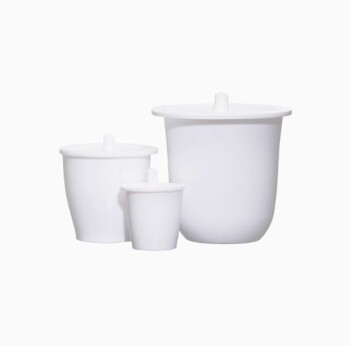
Polymerization temperature strongly affects how much molded PTFE shrinks after forming and sintering. PTFE resin polymerized at approximately 30 °C generally has a lower specific surface area—about 1.5 m²/g—and lower standard resin shrinkage, typically 1.5–2.0%. Resin polymerized near 65 °C tends to have a higher specific surface area—about 3.0 m²/g—and mold shrinkage exceeding 3.0%.
The practical relationship is inverse: lower-temperature PTFE polymerization generally produces resin with lower shrinkage and better dimensional stability, while higher-temperature polymerization produces resin that requires greater mold-shrinkage compensation.
Why Polymerization Temperature Changes Shrinkage
Temperature changes resin morphology
Polymerization temperature influences the physical structure of the PTFE powder, including its specific surface area, particle characteristics, and packing behavior.
Lower-temperature polymerization, around 30 °C, produces resin with lower specific surface area. Higher-temperature polymerization, around 65 °C, produces resin with higher specific surface area.
Higher surface area generally means greater molded shrinkage
A resin with higher specific surface area has more surface structure that must consolidate during molding and sintering. As the particles coalesce into a dense PTFE body, this consolidation contributes to greater dimensional reduction.
Accordingly, high-temperature-polymerized resin commonly exhibits mold shrinkage above 3.0%, compared with approximately 1.5–2.0% for lower-temperature-polymerized resin.
Shrinkage is measured after processing
The relevant dimensional change is not simply the size difference between loose powder and a molded part. PTFE shrinkage develops during compression, heating, particle coalescence, cooling, and final stabilization.
For laboratory labware, the final dimensions therefore depend on both the resin’s inherent shrinkage behavior and the selected molding and sintering cycle.
What This Means for Molded PTFE Laboratory Labware
Low-temperature resin supports dimensional precision
Lower-shrinkage PTFE is advantageous when the finished part must maintain tight dimensions, such as a molded vessel, valve body, fitting, or analytical container.
This is especially important for thick billets that will later be CNC-machined. A billet with less post-molding dimensional change provides a more predictable starting geometry and reduces machining allowance uncertainty.
High-temperature resin requires greater mold compensation
When resin shrinkage exceeds 3.0%, the mold must be designed with more deliberate oversizing to achieve the required final dimensions.
If this compensation is underestimated, the finished component may be undersized, have incorrect wall thickness, or fail to align with mating components.
Lower shrinkage can support lower porosity
The supplementary information indicates that low-temperature suspension-polymerized PTFE can produce molded and sintered parts with lower void content and reduced porosity.
For high-purity laboratory equipment, reduced porosity can help minimize chemical absorption, sample retention, and contamination risk. Dimensional stability and low porosity are related benefits of resin selection, but they should not be treated as identical properties.
The Role of Powder and Thermal Processing
Polymerization temperature is not the only temperature variable
Polymerization temperature should be distinguished from milling temperature, molding temperature, and sintering temperature.
For example, PTFE processed above its approximately 19 °C transition becomes softer and more pliable. Grinding at elevated temperatures can create more elongated or dendritic particles, which may increase molded shrinkage independently of the original polymerization temperature.
Particle shape can modify the result
Higher-temperature milling can produce particles with lower bulk density and greater volumetric shrinkage. This means that two PTFE resins made at similar polymerization temperatures may still shrink differently if their comminution and powder-handling histories differ.
The polymerization temperature establishes an important baseline, but final shrinkage depends on the complete resin-processing route.
Sintering must be controlled
PTFE is typically sintered above its melting point of approximately 342 °C, commonly in the 360–380 °C range, so that the particles coalesce into a dense matrix.
Insufficient or nonuniform sintering can leave voids and produce dimensional inconsistency. Excessive temperatures—particularly above approximately 380–385 °C—or unnecessarily long holds can degrade the polymer and reduce mechanical integrity.
Understanding the Trade-offs
Lower shrinkage improves dimensional control
Low-temperature-polymerized resin is generally the safer choice when the primary requirement is predictable geometry, especially for thick sections and precision-machined laboratory components.
Its lower shrinkage also reduces the amount of mold oversizing and dimensional correction required during production.
Higher shrinkage is not automatically unusable
High-temperature-polymerized PTFE can still be used successfully when the mold is designed for its measured shrinkage and the process is consistently controlled.
The problem is not simply that the resin shrinks more; the problem is applying the wrong shrinkage assumption to the mold design.
Standard values are design guides, not guarantees
The reported values—approximately 1.5–2.0% for low-temperature resin and more than 3.0% for high-temperature resin—should be treated as practical reference ranges rather than universal constants.
Actual shrinkage can vary with powder morphology, part thickness, applied pressure, sintering profile, cooling conditions, and measurement direction.
Avoid confusing strength with dimensional stability
Particle treatments that increase tensile strength or improve filled-compound performance may also reduce bulk density and increase volumetric shrinkage.
For laboratory labware, the best resin is therefore determined by the required balance of strength, porosity, chemical purity, dimensional accuracy, and thermal performance.
Applying the Relationship to Mold Design
Use resin-specific shrinkage data
Mold dimensions should be calculated from shrinkage data for the actual PTFE grade and processing route, not from a generic PTFE percentage.
Where tolerances are tight, characterize shrinkage using representative test specimens with similar wall thickness and molding conditions.
Account for thick-section behavior
Thick billets and heavy-walled vessels may not shrink uniformly because heat transfer and sintering progression differ between the surface and the core.
Lower-shrinkage, low-temperature-polymerized resin can improve predictability, but thick sections still require validated process controls.
Inspect the final machined component
Dimensional verification should occur after the complete cycle of molding, sintering, cooling, and machining.
For critical labware, inspect both external dimensions and functional features such as internal volume, wall thickness, flatness, port alignment, and sealing surfaces.
Making the Right Choice for Your Goal
The polymerization temperature should be selected as part of a complete resin and process specification.
- If your primary focus is dimensional accuracy: Prefer lower-temperature-polymerized PTFE, typically associated with 1.5–2.0% shrinkage, and design the mold using resin-specific validation data.
- If your primary focus is low porosity and chemical cleanliness: Favor a low-temperature PTFE grade with demonstrated low void content after sintering, then verify density and absorption performance on representative parts.
- If your primary focus is high mechanical strength: Evaluate particle morphology and milling conditions as well as polymerization temperature, because strength-enhancing powder structures may also increase shrinkage.
- If your primary focus is production flexibility: Higher-temperature-polymerized PTFE can be used, but the mold, machining allowance, and process controls must accommodate shrinkage above approximately 3.0%.
For precision PTFE laboratory labware, polymerization temperature is a key predictor of shrinkage, but reliable dimensions come from controlling the entire powder, molding, sintering, and inspection process.
Summary Table:
| Polymerization Temperature | Specific Surface Area | Typical Mold Shrinkage | Dimensional Stability |
|---|---|---|---|
| ~30 °C | ~1.5 m²/g | 1.5–2.0% | High |
| ~65 °C | ~3.0 m²/g | >3.0% | Requires Compensation |
Choose KINTEK for precision PTFE labware. Our expert team selects the optimal resin polymerization temperature to ensure your custom parts meet tight tolerances and low porosity. From standard beakers to complex CNC-machined components, we deliver reliability. Contact us today to discuss your project and get a quote.
Related Products
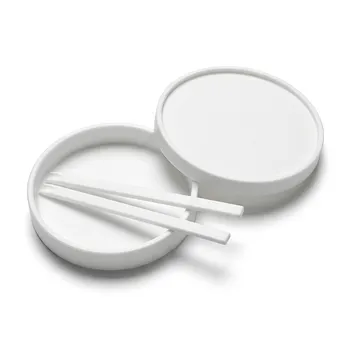
- Custom Polytetrafluoroethylene PTFE Petri Dishes 60mm Corrosion Resistant Low Background Labware
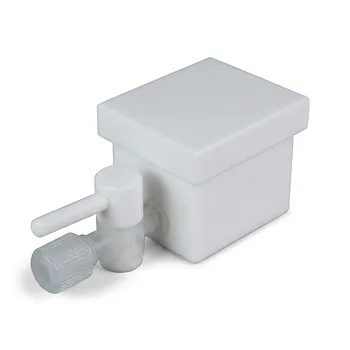
- Custom PTFE Laboratory Apparatus Corrosion Resistant Low Background Reaction Cells Precision CNC Fabrication
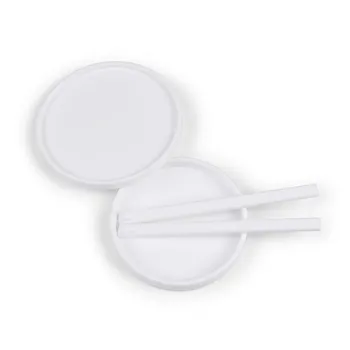
- Custom PTFE Petri Dish 30mm Corrosion Resistant Low Background Non Leaching Laboratory Ware
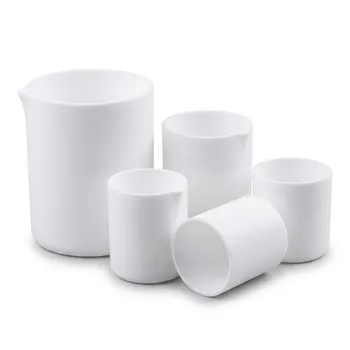
- Large Scale PTFE Beakers and Flasks for High Temperature Corrosion Resistant Laboratory Applications with Custom CNC Fabrication
- Custom PTFE Petri Dishes Corrosion Resistant High Purity Low Background Labware
People Also Ask
- Why are PTFE or PFA Petri dishes preferred for membrane casting? Ensure Damage-Free Recovery & Chemical Purity
- What role does wet reactor bead comminution play in maintaining high purity and color consistency in PTFE labware? Learn how it enhances quality.
- What types of labware or tools are commonly made from PTFE? Essential Chemically-Resistant Equipment for Your Lab
- What are the considerations for choosing PTFE or glass for Bi2O3/CeO2 synthesis? Ensure Purity and Precision.
- What are the key properties of PTFE that make it suitable for labware applications? Ensure Lab Integrity with Superior Material