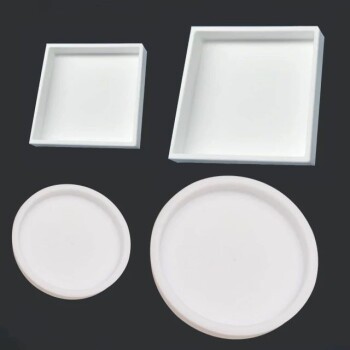
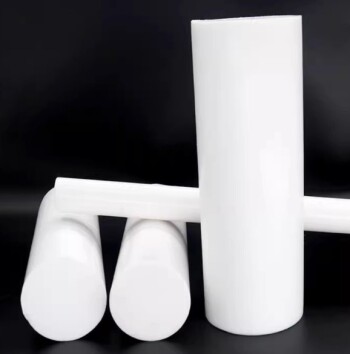
Mechanical-grade PTFE is usually the lower-cost choice, while specialty-grade PFA costs more when manufacturing flexibility, ultra-clean fluid handling, transparency, or trace-level purity is essential. Both provide exceptional chemical resistance and high-temperature performance, but their different processing methods, purity characteristics, mechanical behavior, and design capabilities strongly influence total equipment cost.
PTFE is generally the best value for standard seals, gaskets, machined labware, and low-friction components. PFA justifies its premium when a component must be melt-molded, highly transparent, void-free, or exceptionally resistant to trace-element contamination and fluid permeation.
What Drives the Cost Difference?
Fluoropolymer production is inherently expensive
Both materials cost more than commodity plastics because fluoropolymer production requires specialized capital equipment, costly fluorine chemistry, and tightly controlled polymerization environments.
The cost difference is therefore not simply a matter of brand or component size. It begins with the resin itself and continues through processing, quality control, machining, and validation.
PTFE resin is generally more economical
Mechanical-grade PTFE is commonly used where chemical resistance, thermal endurance, and low friction matter more than optical clarity or complex molded geometry.
Historical resin pricing places PTFE well below specialty PFA, although actual prices vary by supplier, grade, volume, certification, and market conditions. PTFE's relatively lower raw-material cost supports an attractive cost-to-performance ratio for general laboratory equipment.
PFA carries a specialty premium
PFA is a melt-processible, perfluorinated resin with characteristics suited to high-purity and complex fluid-control applications.
Its higher price reflects both the specialized resin and the ability to produce components with demanding purity, clarity, dimensional, and flow-path requirements. In high-consequence systems, the material premium may be smaller than the cost of contamination, rework, or failure.
How Processing Affects Total Component Cost
PTFE usually requires secondary machining
PTFE cannot be processed through conventional melt molding because of its extremely high melt viscosity. It is commonly compression-molded into stock shapes and then machined into the final component.
This makes PTFE practical for gaskets, seals, reaction vessels, electrochemical cell bodies, and other relatively simple or custom geometries. However, CNC machining adds labor, tooling, material waste, and dimensional-control costs.
PFA can be molded into complex shapes
PFA can be conventionally molded or extruded, enabling production of tubing, fittings, valves, vessels, and other intricate fluid-path components.
For repeated production, molding can reduce secondary operations and improve consistency. The economic advantage becomes more significant when a component has complex internal passages or would require extensive machining in PTFE.
Production volume changes the calculation
For a one-off custom component, PTFE may remain less expensive because it can be machined from readily available stock shapes without creating specialized molds.
For larger production runs, PFA's moldability can offset part of its higher resin price through lower labor, reduced waste, and repeatable manufacturing. The correct comparison is therefore finished-component cost, not resin price alone.
Which Material Characteristics Influence Selection?
Chemical resistance is strong in both materials
PTFE and PFA both provide near-universal chemical resistance and exceptional thermal endurance. They are suitable for demanding laboratory environments involving aggressive acids, solvents, reagents, and high-temperature processes.
This shared performance means chemical compatibility alone rarely determines the choice. The decision usually depends on purity, geometry, friction, mechanical loading, and manufacturing requirements.
PFA is favored for high-purity fluid paths
Specialty-grade PFA is preferred where ultra-low trace-element leachability, low permeation, and clean fluid handling are mandatory.
Melt-molded PFA can produce void-free components with consistent internal surfaces and fewer opportunities for trapped contaminants. These properties are valuable in trace-analysis instruments, ultra-pure chemical distribution, semiconductor-related fluid handling, and critical reagent storage.
Transparency can be operationally important
PFA can provide optical transparency or translucency that allows operators to inspect fluid presence, bubbles, particulates, and flow behavior.
PTFE is typically opaque. That is not a functional problem for many seals and machined vessels, but it can make inspection and troubleshooting more difficult in fluid-control equipment.
PTFE provides excellent low-friction performance
PTFE has the lowest coefficient of friction among the two materials and is especially effective for non-stick surfaces, sliding seals, stir bars, and low-force mechanical interfaces.
PFA also has a low coefficient of friction, but PTFE is usually selected when minimizing friction is the primary design objective.
PTFE is strong for cryogenic service
PTFE maintains structural integrity at extremely low temperatures, including cryogenic laboratory conditions.
Where low-temperature containment or thermal cycling is a dominant requirement, PTFE may be the more appropriate choice. The component design must still account for creep, dimensional stability, sealing load, and the specific grade being used.
PFA supports more consistent molded geometries
PFA's melt-processing capability enables seamless and repeatable production of fittings, valves, tubing, molded containers, and complex vessels.
That consistency can improve fluid-path reliability and reduce the variation associated with machining porous or intricate PTFE stock shapes.
Matching Material to Equipment Type
Seals, gaskets, and sliding components
Mechanical-grade PTFE is often the economical choice for standard gaskets, seals, non-stick surfaces, and sliding interfaces.
Its low friction and broad chemical resistance provide substantial performance without requiring the purity or molding capability of PFA.
Custom reaction vessels and machined apparatus
PTFE is well suited to custom-machined reaction vessels, microwave digestion components, and electrochemical cell bodies.
It is particularly attractive when the equipment is produced in low quantities or must be modified for a specific experiment.
Tubing, fittings, and valves
PFA is often preferable for complex fluid-control components, especially when the system requires clean molded flow paths, transparency, low contamination, or intricate valve and fitting geometries.
PTFE can still be appropriate for simpler fittings and robust seals, particularly when the system's purity requirements are moderate.
Trace-analysis and ultra-clean equipment
PFA is the stronger candidate for trace-analysis vessels, ultra-pure fluid transfer, and applications where ionic contamination or permeation could compromise results.
The premium is justified when measurement sensitivity makes material cleanliness part of the instrument's performance specification.
Understanding the Trade-offs
The lowest resin price may not produce the lowest installed cost
PTFE may have the lower kilogram price, but machining, scrap, inspection, and assembly can increase the finished cost.
Conversely, PFA's higher resin price may be partly offset by molding efficiency and reduced secondary processing in repeat production.
PFA is not automatically better for every application
PFA's purity, clarity, and processibility do not eliminate the reasons to use PTFE. PTFE remains highly valuable where low friction, custom machining, cryogenic capability, or flex-fatigue resistance is more important than optical clarity.
Selecting PFA for a simple gasket or a low-volume custom part can add cost without delivering a meaningful operational benefit.
PTFE creep must be considered
Standard PTFE can exhibit creep under sustained mechanical load, which may affect dimensional stability, sealing force, and long-term valve or fitting performance.
Modified PTFE grades can reduce creep and permeation while remaining more economical than PFA in some applications. The choice should therefore consider the exact grade rather than treating all PTFE as identical.
Temperature ratings require application-specific validation
Both materials support very high operating temperatures, with commonly cited continuous-use capability around 260°C, but actual limits depend on stress, pressure, chemical exposure, cycling, geometry, and grade.
Melting point is not the same as recommended continuous service temperature. Equipment should be evaluated using the manufacturer's temperature-pressure data and the real operating environment.
Purity claims depend on the complete component
A high-purity PFA resin does not by itself guarantee a clean fluid-control assembly.
Manufacturing environment, additives, processing equipment, surface condition, packaging, installation, and cleaning procedures can all affect contamination performance. The specification should cover the finished component and its supply chain.
Making the Right Choice for Your Goal
The best selection follows the performance requirement that would be most expensive or difficult to compromise.
- If your primary focus is minimizing equipment cost: Choose mechanical-grade PTFE for standard gaskets, seals, simple labware, and low-volume custom-machined components where extreme purity and transparency are unnecessary.
- If your primary focus is ultra-clean fluid handling: Choose specialty-grade PFA when trace-element leachability, low permeation, and contamination control are critical.
- If your primary focus is complex component geometry: Choose PFA when molding or extrusion can eliminate extensive machining, internal voids, or difficult secondary operations.
- If your primary focus is low friction and non-stick behavior: Choose PTFE for sliding seals, stir bars, and interfaces where its lower friction provides a direct functional advantage.
- If your primary focus is cryogenic or custom apparatus performance: Evaluate PTFE first, especially for machined containment and components exposed to very low temperatures.
- If your primary focus is transparent inspection: Choose PFA when observing bubbles, particulates, fluid levels, or flow behavior is operationally important.
The right decision is based on total lifecycle cost and required performance, not on resin price alone.
Summary Table:
| Factor | Mechanical-grade PTFE | Specialty-grade PFA |
|---|---|---|
| Cost | Lower resin cost; machining adds expense | Higher resin cost; molding can save on complex parts |
| Processing | Requires secondary machining | Melt-processible; can be molded or extruded |
| Purity | Adequate for standard use | Ultra-low trace-element leachability |
| Transparency | Opaque | Transparent |
| Friction | Lowest coefficient of friction | Low but higher than PTFE |
| Complex geometries | Difficult, costly machining | Easy molding |
| Best for | Gaskets, seals, custom machined parts | Tubing, fittings, valves, high-purity applications |
Need Help Choosing the Right Material?
At KINTEK, we specialize in high-performance fluoropolymers. Whether you need PTFE for economical seals and custom-machined labware, or PFA for ultra-clean fluid handling and transparent components, our experts can guide you to the best solution. We offer a wide range of PTFE and PFA labware, from basic beakers to complex electrochemical cells, all backed by our end-to-end CNC machining capabilities. Contact us today for a quote or consultation — let's find the perfect material for your application!
Get in touch with our specialists
Related Products
- Custom PTFE Filtration System Acid Resistant High Purity Semiconductor Grade Chemical Processing Filter
- High Corrosion Resistant PTFE Faucet Polytetrafluoroethylene Valve for Chemical Storage Drums and Fluid Transfer Systems Customizable Industrial Grade
- PTFE PFA Vacuum Filtration System Corrosion Resistant Customizable Shatterproof Laboratory Device
- PTFE Corrosion Resistant Filter with PFA Valve Connections and Integrated Sieve Plate
- High Temperature Chemical Resistant 50ml PTFE Syringe Customized Teflon Injector with Threaded Seal for Trace Analysis
People Also Ask
- What makes PTFE filtration systems advantageous for industrial and scientific use? Unmatched Chemical & Thermal Stability
- What sizes and pore options are available for PTFE filters? Choose the Right Filter for Your Application
- What steps are involved in selecting the proper PTFE filter? A 4-Step Guide to Optimal Filtration
- How does the hydrophobicity of PTFE filters benefit their use? Ensure Uninterrupted Gas Flow and Solvent Filtration
- What temperature resistance do PTFE filters offer? Unmatched Thermal Stability from -200°C to +260°C