Suspension polymerization and emulsion polymerization produce the same PTFE chemistry but different resin morphologies and processing behaviors. Suspension polymerization uses vigorous agitation and little or no surfactant, allowing PTFE to precipitate as relatively large, granular or fibrous reactor particles. Emulsion polymerization uses mild agitation with substantial surfactant and stabilizer, producing small PTFE particles that remain as an aqueous dispersion or are recovered as fine powder.
The key distinction is particle morphology: suspension polymerization produces granular resin for compression molding and machining, while emulsion polymerization produces dispersion or fine-powder resin for coatings, membranes, and paste-extruded products.
How the Polymerization Processes Differ
Suspension Polymerization Uses Precipitation
Suspension polymerization is conducted in high-purity water under vigorous agitation. It typically uses little or no surfactant, so the growing PTFE separates from the aqueous phase and precipitates into a polymer slurry.
The resin forms relatively large reactor beads with a granular or fibrous morphology. These particles are subsequently washed, dried, and often reduced in size to create a molding-grade powder.
Emulsion Polymerization Stabilizes Fine Particles
Emulsion, also called dispersion, polymerization uses mild agitation, a higher concentration of surfactant, and often a stabilizing aid. These ingredients keep the growing PTFE particles suspended in the water rather than allowing them to agglomerate immediately.
The resulting particles are much smaller, commonly sub-micron spherical particles. The product can be retained as a stable aqueous dispersion or coagulated, dried, and recovered as fine-powder PTFE.
The Polymer Chemistry Is Not the Main Difference
Both routes polymerize tetrafluoroethylene into PTFE. The major distinction is how the polymer particles form and are maintained during reaction, not the basic chemical identity of the polymer.
That difference in particle size, shape, and surface condition determines how the resin behaves during downstream fabrication.
How Resin Morphology Affects Fabrication
Granular Resin Supports Compression Molding
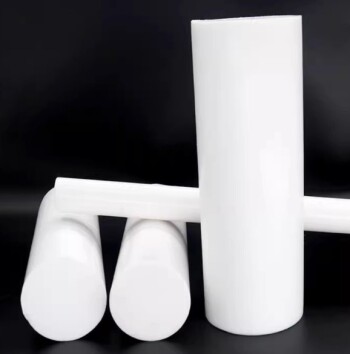
Suspension-polymerized granular PTFE is the primary feedstock for compression molding. It can be compacted into preforms, blocks, billets, rods, and heavy-walled shapes before sintering.
These solid forms are suitable for CNC machining into beakers, digestion vessels, valve bodies, fittings, and custom reaction vessels. The process is well suited to parts that require bulk density, dimensional stability, and substantial wall thickness.
Fine Powder Supports Paste Extrusion
Fine-powder PTFE made through emulsion polymerization is commonly processed by paste extrusion. An extrusion aid allows the powder to move through the die without melting the PTFE, which has extremely high melt viscosity.
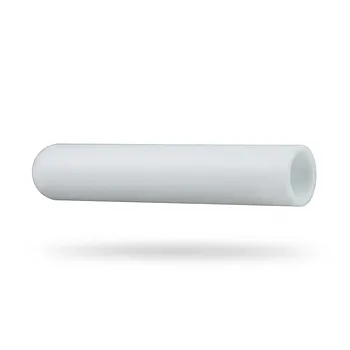
Paste extrusion is used for thin-walled products such as flexible fluid-transfer tubing, liners, and similar geometries that are difficult to produce from compression-molded billets.
Aqueous Dispersion Supports Coatings
PTFE dispersions can be applied directly in coating processes. After application, drying and sintering form a continuous fluoropolymer layer on the substrate.
Dispersion-grade PTFE is also used in specialized coatings and impregnated materials. Its small particle size is important because it allows the particles to form a uniform film during subsequent processing.
Particle Geometry Influences the Final Structure
Suspension resins can have granular or fibrous particles with different aspect ratios. Near-spherical molding powders tend to compact with relatively uniform particle orientation, while higher-aspect-ratio particles can introduce directional orientation during pressing.
That morphology affects density, surface smoothness, mechanical reliability, and the behavior of machined parts. Resin selection therefore needs to account for the intended geometry and manufacturing route, not only chemical resistance.
Comparing the Processing Conditions
Agitation
Suspension polymerization requires vigorous agitation to distribute TFE and control the precipitating polymer particles in the reactor.
Emulsion polymerization uses milder agitation because the surfactant and stabilizer system is intended to maintain a fine, stable particle population.
Surfactant Level
Suspension polymerization generally operates with minimal or no surfactant, although small amounts may be used in some formulations to regulate reaction behavior.
Emulsion polymerization depends much more heavily on surfactants and stabilizing agents to prevent the fine particles from rapidly coagulating during polymerization. Historically, fluorinated surfactants such as APFO, associated with PFOA, were used in these processes.
Product Recovery
Suspension polymerization produces a polymer slurry that is recovered as granular resin after washing and drying.
Emulsion polymerization produces either a liquid dispersion or a latex that is deliberately coagulated and dried to make fine powder. The recovery route therefore depends on whether the final application requires a dispersion or a dry powder.
Understanding the Trade-offs
Suspension Resin Is Not a Universal Molding Material
Granular PTFE is well suited to compression molding and machining, but it is not the preferred material for every thin-wall or continuous-profile product. Attempting to use it in applications designed for paste extrusion can produce poor processing control or unsuitable product geometry.
Fine Powder Requires Specialized Processing
Fine-powder PTFE is valuable for paste extrusion, but it requires careful control of powder handling, extrusion-aid content, preforming, and sintering. It is not simply an interchangeable substitute for compression-molding grades.
Surfactant History Matters for High-Purity Applications
Emulsion processing introduces a greater need to evaluate surfactant selection, residual levels, and purification. Historical fluorinated surfactants raise environmental and contamination concerns because some compounds are persistent and bioaccumulative.
For sensitive trace analysis, users should verify that the selected resin and finished component were produced using modern, compliant processing methods and meet the relevant contamination requirements. A product described only as “PTFE” does not by itself identify its polymerization route or processing history.
Morphology Can Affect Part Performance
Particle shape and aspect ratio influence compaction and orientation. A resin optimized for one fabrication process may produce different density, surface finish, or mechanical behavior when used in another process.
The correct comparison is therefore not simply suspension versus emulsion. It is resin morphology matched to the finished-part manufacturing method and purity requirements.
Making the Right Choice for Your Goal
The intended finished product should determine which resin type and polymerization route are appropriate.
- If your primary focus is compression-molded or CNC-machined laboratory equipment: Select granular suspension-polymerized PTFE designed for molding into dense preforms, blocks, rods, or billets.
- If your primary focus is flexible tubing, thin liners, or paste-extruded profiles: Select emulsion-polymerized fine-powder PTFE formulated for paste extrusion.
- If your primary focus is fluoropolymer coatings or impregnated materials: Select an aqueous PTFE dispersion with the required stability, particle characteristics, and coating performance.
- If your primary focus is trace analytical purity: Evaluate the complete processing history, including surfactant use and modern PFOA-free or otherwise compliant manufacturing controls.
Choosing PTFE by polymerization route and resin morphology ensures that the material can be processed reliably and deliver the required performance in the finished component.
Summary Table:
| Aspect | Suspension Polymerization | Emulsion Polymerization |
|---|---|---|
| Agitation | Vigorous | Mild |
| Surfactant | Minimal or none | Substantial, with stabilizers |
| Particle Size | Large, granular/fibrous | Small, sub-micron spherical |
| Product Form | Granular resin (slurry) | Aqueous dispersion or fine powder |
| Typical Processing | Compression molding, machining | Paste extrusion, coatings |
| Applications | Beakers, blocks, rods, fittings | Tubing, liners, coatings |
Need PTFE components matched to your application? Whether you require granular resin for CNC-machined labware or fine powder for paste-extruded tubing, KINTEK offers high-performance PTFE and PFA products backed by end-to-end custom CNC machining. From standard labware to complex reaction vessels, we deliver precision and purity. Contact us today to discuss your requirements!
Related Products
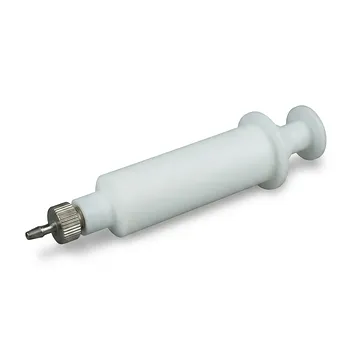
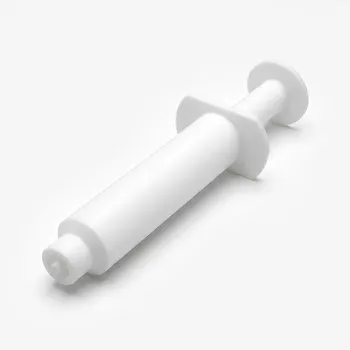
- High Temperature Chemical Resistant 50ml PTFE Syringe Customized Teflon Injector with Threaded Seal for Trace Analysis
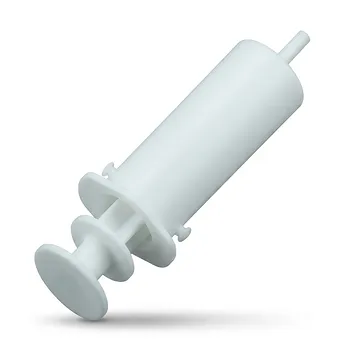
- Custom PTFE Corrosion Resistant White Syringe with Threaded Luer Connector Compatibility
- High Purity Laboratory Grade PTFE Syringe Chemical Resistant Fluoropolymer Injector for Trace Analysis
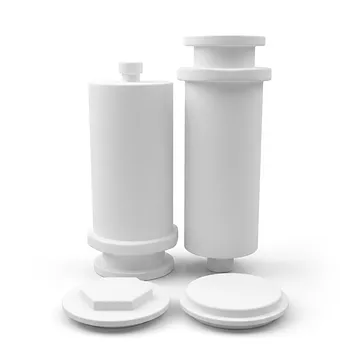
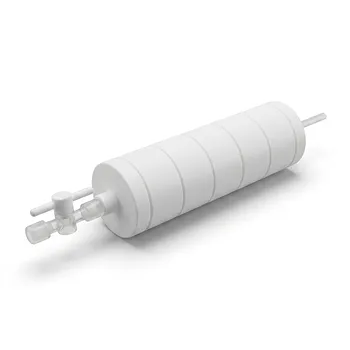
- Custom PTFE Filtration System Acid Resistant High Purity Semiconductor Grade Chemical Processing Filter
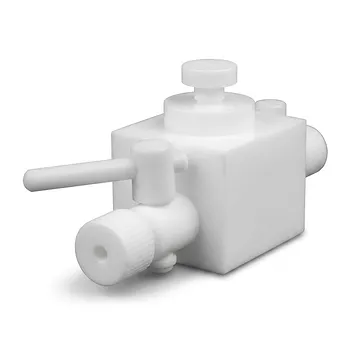
- PTFE Corrosion Resistant Filter with PFA Valve Connections and Integrated Sieve Plate
People Also Ask
- In what medical devices is PTFE commonly used? Essential Components for Safety and Reliability
- Is PTFE approved for food contact applications? Ensuring Food Safety with Compliant PTFE
- How chemically resistant is PTFE? Discover its near-total inertness to most chemicals
- Why is PTFE highly resistant to chemicals? Unmatched Inertness for Demanding Applications
- What is notable about the coefficient of friction of PTFE? Achieve Unmatched Low-Friction Performance