Granular PTFE is the grade for rigid, machinable laboratory equipment, while fine powder PTFE is the grade for flexible, thin-walled products. Granular resin is made by suspension polymerization and processed by compression molding and sintering into billets, blocks, or thick-walled shapes for CNC machining. Fine powder is made by dispersion polymerization and blended with a lubricant for paste extrusion into tubing, films, tapes, and other flexible geometries.
The key selection issue is not simply PTFE chemistry; it is resin morphology and processing behavior. Choose granular PTFE when the finished part must be structurally rigid and machined. Choose fine powder PTFE when it must be continuously extruded, thin-walled, flexible, or formed into a tape or porous structure.
How the Two PTFE Grades Differ
Granular PTFE: Coarse, molding-oriented resin
Granular PTFE is produced by suspension polymerization with vigorous agitation. This creates relatively coarse, stringy or fibrous resin particles that can be handled as molding powder.
The resin is compacted and then high-temperature sintered into solid billets, rods, sheets, or thick-walled tubes. These semifinished forms can be machined into precise laboratory components.
Fine powder PTFE: Fine, paste-extrusion-oriented resin
Fine powder PTFE is produced by dispersion polymerization, followed by coagulation and drying. It has much smaller, more uniform particles than granular PTFE.
The powder is blended with a hydrocarbon processing lubricant to make a paste. During extrusion, shear causes the particles to fibrillate, creating a coherent polymer structure before drying and sintering.
How Processing Determines the Finished Geometry
Granular PTFE supports rigid custom shapes
Compression molding allows granular PTFE to form thick sections and solid billets. Machining then produces complex parts with controlled dimensions and features.
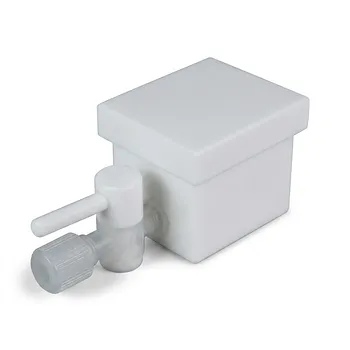
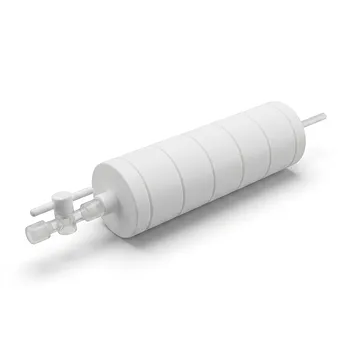
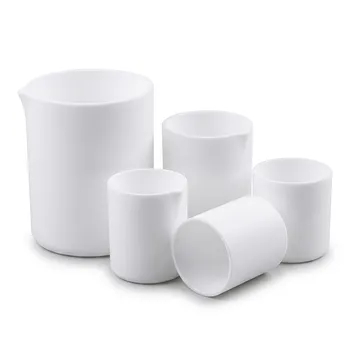
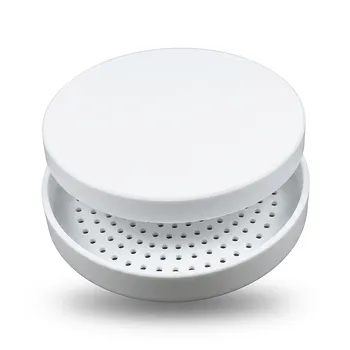
This route is appropriate for heavy-walled vessels, blocks, reaction cells, reagent bottles, crucibles, seals, and fluid-control components. It is particularly useful when the laboratory part is made in a custom shape or produced in relatively low volume.
Fine powder PTFE supports continuous flexible products
Paste extrusion is suited to continuous profiles and thin sections. It can produce flexible tubing, thin-walled hoses, tapes, films, and some membrane structures.
Fine powder is therefore appropriate for fluid-transfer lines, wire insulation, flexible linings, and similar products where bending and continuous manufacture matter more than bulk rigidity.
What the Structural Difference Means in Laboratory Use
Granular PTFE provides dimensional and mechanical stability
A molded and sintered granular PTFE billet provides a solid stock shape for machining. The resulting component is generally better suited to maintaining a rigid form under normal laboratory handling and containment requirements.
This makes granular PTFE the practical choice for apparatus that must stand, support fittings, retain a defined cavity, or integrate machined ports and channels.
Fine powder PTFE enables flexibility and thin walls
Fine powder processing creates a fibrillated structure during paste extrusion. That behavior is essential for producing continuous, flexible articles rather than solid machined blocks.
The resulting products are valuable where the equipment must route fluids around bends, fit over connections, or provide a thin barrier with low-friction PTFE surfaces.
Both grades still require controlled sintering
Neither resin is simply used in its polymerized particle form. The processed article must be dried or otherwise prepared as appropriate and sintered to develop the finished PTFE structure.
The critical difference is the forming route: granular PTFE is compacted and molded, while fine powder PTFE is lubricated, paste-extruded, and then sintered.
Which Grade Fits Common Laboratory Equipment?
Choose granular PTFE for machined labware
Granular PTFE is normally the stronger starting point when the item is a rigid, custom-machined component, such as:
- Heavy-walled vessels and reaction cells
- Custom blocks and manifolds
- Reagent bottles and crucibles
- Solid seals and stopcock components
- Machined fluid-control parts
- Structural supports or containment components
The primary design requirement is rigidity, bulk, and machinability.
Choose fine powder PTFE for flexible fluid paths
Fine powder PTFE is normally the better starting point for:
- Flexible fluid-transfer tubing
- Thin-walled hoses
- Sealing tape
- Thin films and linings
- Certain porous membrane structures
- Flexible insulation or barrier products
The primary design requirement is continuous extrusion, flexibility, or thin-wall formation.
Grade-Selection Metrics That Matter
For granular PTFE, evaluate molding and machining behavior
Granular grades may differ in molding behavior and apparent density. The appropriate grade must produce a billet or molded shape with the dimensional stability and quality required for machining.
For laboratory equipment, review the supplier’s data for molding conditions, shrinkage, density, mechanical properties, and machining suitability rather than selecting solely by the label “granular.”
For fine powder, evaluate extrusion behavior
For fine powder, the key processing variable is often the reduction ratio: the ratio between the extruder barrel cross-sectional area and the extrudate cross-sectional area.
The selected powder must support stable paste extrusion at the intended wall thickness and geometry. A mismatch can contribute to extrusion defects, inconsistent dimensions, or an unsuitable final structure.
Match the resin form to the production method
A granular grade should not be selected for a product that must be paste-extruded. Likewise, fine powder should not be treated as a direct substitute for granular resin in compression-molded, machined blocks.
The resin form is engineered around its processing route, so changing grades may require changing both the manufacturing process and the product design.
Understanding the Trade-offs
Granular PTFE is less suitable for flexible tubing
Granular resin is optimized for compaction and molding, not for forming a uniform paste that fibrillates during extrusion. Using it for thin, flexible tubing can therefore produce poor process stability or an unsuitable structure.
Its advantage is the opposite: it provides practical solid stock for rigid, machined equipment.
Fine powder is not the default choice for structural blocks
Fine powder’s strength is paste extrusion, not the production of thick, easily machined billets. Selecting it for a rigid laboratory block or heavy-walled vessel may add processing complexity without providing a functional benefit.
Processing can affect final performance
The final properties depend not only on polymerization route but also on compaction, extrusion, sintering, wall thickness, geometry, and machining. Grade selection should therefore be validated against the finished part, not made from resin morphology alone.
PTFE remains subject to application constraints
Both grades provide PTFE’s characteristic chemical resistance and low-friction surface, but neither automatically solves issues such as creep, dimensional change, pressure capability, or thermal design.
For pressure-containing or tightly toleranced equipment, confirm the finished component’s design limits and supplier-specific data.
How to Apply This to Your Project
Select the resin form based first on the required geometry and manufacturing process:
- If your primary focus is rigid custom labware: Choose granular PTFE for compression molding into machinable billets, blocks, or thick-walled forms.
- If your primary focus is flexible fluid transport: Choose fine powder PTFE designed for lubricated paste extrusion into tubing, hoses, or thin-wall products.
- If your primary focus is extrusion consistency: Compare fine-powder grades using reduction ratio and supplier extrusion guidance.
- If your primary focus is dimensional control in machined parts: Compare granular grades using molding behavior, shrinkage, density, and machining data.
Choose the PTFE grade whose particle structure is compatible with the way the laboratory component must be made.
Summary Table:
| Feature | Granular PTFE | Fine Powder PTFE |
|---|---|---|
| Production Method | Suspension polymerization | Dispersion polymerization |
| Particle Size | Coarse, stringy | Fine, uniform |
| Form | Molding powder | Lubricated paste |
| Primary Processing | Compression molding & sintering | Paste extrusion & sintering |
| Typical Products | Rigid machined parts (vessels, blocks, etc.) | Flexible tubing, tape, films |
| Key Advantages | Rigidity, dimensional stability | Flexibility, continuous extrusion |
| Considerations | Machinability, shrinkage | Reduction ratio, extrusion consistency |
Selecting the right PTFE grade is critical for your lab equipment's performance. At KINTEK, we specialize in high-performance fluoropolymers, providing custom CNC machining and a full range of PTFE/PFA labware. Whether you need rigid machined components or flexible tubing, our experts can guide you to the optimal solution. Contact us today to discuss your requirements and get a quote.
Related Products
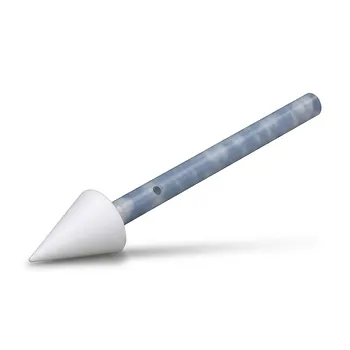
- High Temperature Resistant PTFE Solid Sampler Corrosion Resistant Non Leaching Reusable Biopharmaceutical White Powder Sampling Device
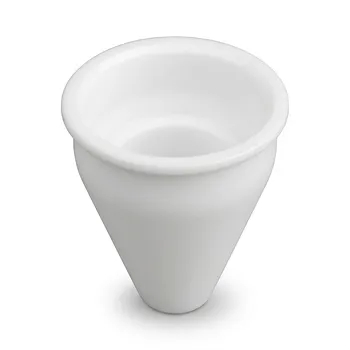
- Custom Machined PTFE Conical Sample Cell Corrosion Resistant Triangular Fluoropolymer Container for Trace Analysis
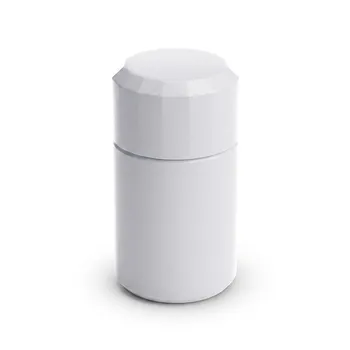
- Custom PTFE Ball Mill Grinding Jar 50ml Corrosion Resistant Low Background Lab Milling Vessel
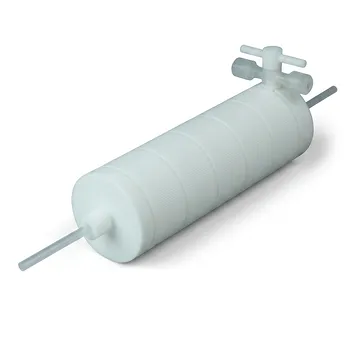
- Custom PTFE Filtration System Acid Resistant High Purity Semiconductor Grade Chemical Processing Filter
- High Purity PTFE Filter with PFA Valve Connections and Integrated Sieve Plate for Corrosive Fluid Processing
People Also Ask
- How does PTFE's electrical insulation property benefit electronic components? Ensure Reliability and Signal Integrity
- What process steps and conditions are critical during coagulation and drying of aqueous PTFE dispersions to ensure powder quality? Master key parameters for reliable downstream processing.
- What are the mechanical and safety advantages of using PTFE apparatus in a laboratory? Enhance Safety & Durability
- Why does PTFE require specialized powder processing techniques rather than standard melt-injection molding during component manufacturing? Unlock the secrets of PTFE processing.
- What are the benefits of using nickel foam as a current collector for Bi2MoO6 supercapacitors? Enhanced 3D Conductivity