High-quality PTFE fine powder depends on controlling two opposing phenomena: the dispersion must receive enough chemical destabilization and agitation to form uniform agglomerates, but the recovered wet powder must then be dried with minimal friction and thermal stress. In practice, dilute the dispersion to 10–20 wt% PTFE solids, maintain a neutral to basic pH, add a suitable coagulant under controlled vigorous agitation, separate the agglomerates efficiently, and dry them using vacuum, high-frequency, or heated-air methods without excessive fluidization or particle-on-particle shear.
The central principle is controlled destabilization followed by gentle drying. Coagulation should create uniform, filterable agglomerates; drying should remove moisture without allowing elevated-temperature friction to trigger premature fibrillation or damage the powder structure required for consistent downstream molding.
Establish Stable Starting Conditions
Dilute to the Correct Polymer Concentration
Adjust the raw aqueous dispersion to approximately 10–20 wt% polymer solids before coagulation. This concentration supports effective mixing and promotes the formation of manageable agglomerates rather than an uncontrolled mass of polymer.
Solids content should be measured rather than estimated, because variation changes the amount of coagulant required and affects the resulting powder morphology and bulk handling behavior.
Maintain a Neutral or Basic pH
The dispersion should be adjusted to a neutral or mildly basic condition before the coagulation step. Basic conditions help preserve dispersion stability during preparation and reduce the risk of uncontrolled souring or premature agglomeration.
A falling pH can indicate loss of stability or bacterial degradation of surfactants. Regular pH checks, and where appropriate conductivity monitoring, help identify changes before they affect powder quality.
Avoid Premature Coagulation
Before the intended coagulation step, protect the dispersion from freezing, excessive heat, acidic contamination, unapproved electrolytes, water-miscible solvents, and severe mechanical shear. These conditions can destabilize the negatively charged submicron PTFE particles before the process is ready.
Storage around 5–20°C and gentle periodic agitation help prevent settling while preserving the dispersion. Freezing must be avoided because it can cause irreversible coagulation.
Control the Coagulation Step
Select a Suitable Coagulant
Coagulation can be initiated with a water-soluble organic compound, such as methanol or acetone, or with an inorganic salt or acid, such as potassium nitrate or nitric acid. These agents reduce the electrostatic or surfactant-based stabilization that keeps the PTFE particles suspended.
The choice and quantity of coagulant should be established for the specific dispersion formulation. Surfactant content, solids content, particle size, and pH all influence the destabilization response.
Add the Coagulant Under Controlled Agitation
The coagulant should be introduced while the diluted dispersion is subjected to vigorous, controlled agitation. The objective is to distribute the destabilizing agent rapidly and form relatively uniform agglomerates from the submicron primary particles.
Agitation must be sufficient to produce consistent coagulation throughout the batch. Uncontrolled local concentrations or poorly mixed additions can create oversized lumps, broad particle-size distributions, or regions that remain insufficiently coagulated.
Stop Once the Desired Agglomeration Is Achieved
The high-shear condition is appropriate for inducing coagulation, but it should not continue unnecessarily after the agglomerates have formed. Excessive mechanical treatment can produce nonuniform particle structures and complicate separation.
The endpoint should be based on observable and measurable batch behavior, including the formation of filterable or skimmable PTFE agglomerates and the clarification of the liquid phase.
Separate the Polymer Without Damaging It
Remove the Liquid Phase Efficiently
After coagulation, separate the PTFE agglomerates from the aqueous phase by filtration or skimming. Efficient phase separation reduces the water load presented to the dryer and limits the time the wet powder remains exposed to residual chemicals and mechanical handling.
The recovered material should be handled as a wet, mechanically sensitive powder precursor. Unnecessary conveying, pumping, or vigorous mixing can alter the agglomerate structure before drying begins.
Check the Wet Cake or Agglomerate Uniformity
Uniformity at this stage is important because variations in agglomerate size and retained liquid lead to uneven drying. Large dense regions may retain moisture while smaller particles dry more rapidly and experience greater surface friction.
Useful incoming and intermediate checks include solids content, particle-size characteristics, pH, surfactant content, and the amount of polymer coagulated during handling. These properties provide a baseline for diagnosing downstream powder variation.
Dry the Powder Without Premature Fibrillation
Use a Low-Shear Drying Method
Suitable drying approaches include vacuum drying, high-frequency drying, and heated-air drying, provided the equipment and operating conditions do not excessively fluidize or mechanically abrade the wet powder.
The powder should not be subjected to aggressive tumbling, high-velocity recirculation, or other handling that creates intense particle-to-particle contact while the temperature is elevated.
Control Temperature and Friction Together
Temperature alone does not determine drying quality. Shear contact at elevated temperature can trigger premature fibrillation, causing the powder to lose the structure and processing behavior required for uniform molding.
Drying therefore requires simultaneous control of temperature, air movement, powder movement, residence time, and contact with dryer surfaces. The process should remove moisture steadily while preserving the agglomerate morphology.
Prevent Excessive Fluidization
Heated air can dry efficiently, but excessive gas velocity may suspend and collide particles repeatedly. That mechanical action can increase friction, generate fines, or promote premature structural changes as the powder warms.
Airflow should be sufficient for heat and moisture transfer without creating an unnecessarily abrasive powder circulation pattern. Vacuum or high-frequency methods may reduce mechanical movement when they can be applied uniformly.
Confirm Adequate Dryness Before Downstream Processing
Residual moisture can cause inconsistent bulk density, poor powder flow, voids, or molding defects. Dryness should therefore be verified using a defined endpoint rather than inferred only from elapsed time or surface appearance.
The endpoint should be correlated with the intended downstream operation, such as compression molding, machining stock production, or fabrication of fluid-transfer and reaction components.
Understand the Trade-offs
Coagulation Requires Shear, but Drying Requires Restraint
Vigorous agitation is useful during chemical destabilization because it distributes the coagulant and promotes uniform aggregation. The same level of mechanical energy becomes undesirable after the agglomerates have formed.
The process should therefore have a clear transition from high-energy coagulation to low-shear separation and drying.
Faster Drying Can Reduce Powder Quality
Higher temperature and stronger airflow can shorten drying time, but they also increase the risk of friction, particle collision, and premature fibrillation. A shorter cycle is not beneficial if it produces powder with inconsistent molding behavior.
The correct target is the shortest cycle that meets the moisture endpoint without exceeding the thermal and mechanical limits of the powder.
More Aggressive Coagulation Does Not Guarantee Better Powder
Excess acid, salt, solvent, or agitation can produce coarse lumps rather than uniform agglomerates. Such material may be difficult to separate, dry evenly, or feed consistently into downstream equipment.
Coagulant addition and agitation should be optimized for repeatable agglomerate formation, not simply for the fastest visible collapse of the dispersion.
Do Not Confuse Fine-Powder Drying With Coating Schedules
Thermal schedules used for PTFE coatings are a separate operation. Coated components may require gradual water removal below the boiling range, intermediate heating to remove surfactants, and sintering above the PTFE melting point, with suitable ventilation.
Those coating and sintering conditions should not be transferred directly to isolated fine powder without validating their effect on powder morphology and fibrillation behavior.
How to Apply This to Your Process
The practical controls should be connected to the final component requirements rather than managed as isolated batch settings.
- If your primary focus is uniform molding: Control solids concentration, coagulant distribution, agitation endpoint, agglomerate size, and drying friction to preserve consistent powder morphology and bulk density.
- If your primary focus is high mechanical strength: Prevent premature fibrillation and moisture-related voids during drying, then verify the isolated resin's relevant thermal and structural properties.
- If your primary focus is high-purity fluid-transfer or reaction components: Control pH, surfactant condition, contamination, phase separation, and drying off-gases so the powder does not carry avoidable chemical or particulate impurities.
- If your primary focus is process repeatability: Record solids content, pH, conductivity, surfactant content, particle-size data, coagulant addition, agitation conditions, drying temperature, airflow or vacuum, and final moisture.
- If your primary focus is storage stability before processing: Keep the dispersion at approximately 5–20°C, prevent freezing, use only gentle periodic agitation, and monitor pH and signs of bacterial degradation.
Reliable PTFE powder quality comes from treating coagulation as a controlled destabilization step and drying as a low-shear preservation step.
Summary Table:
| Stage | Critical Conditions | Impact on Powder Quality |
|---|---|---|
| Dispersion Preparation | - Dilute to 10–20 wt% solids - Maintain neutral/basic pH - Avoid freezing, contamination, shear |
Ensures uniform agglomerates; prevents premature coagulation |
| Coagulation | - Use suitable coagulant (e.g., methanol, KNO3) - Add under vigorous controlled agitation |
Forms uniform, filterable agglomerates; avoids lumps or fines |
| Separation | - Filter/skim efficiently - Check wet cake uniformity |
Reduces moisture load; prevents structural damage |
| Drying | - Use vacuum, high-frequency, or heated-air drying - Control temperature and airflow to minimize friction |
Prevents premature fibrillation; preserves powder morphology |
| Final Verification | - Confirm dryness via defined endpoint | Ensures consistent molding behavior and final component quality |
Ensure your PTFE powder quality meets exacting standards for high-performance components. KINTEK specializes in advanced PTFE and PFA labware and custom machined parts. Our expertise in material processing helps you achieve reliable results. Contact us today to discuss how our products and custom solutions can support your coagulation and drying processes, from high-purity beakers to specialized reaction vessels.
Related Products
- High Temperature Resistant PTFE Solid Sampler Corrosion Resistant Non Leaching Reusable Biopharmaceutical White Powder Sampling Device
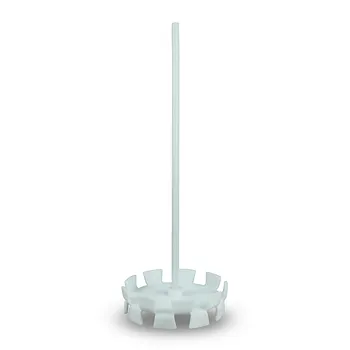
- PTFE Dispersion Disk Food Cosmetic Grade Non Stick Corrosion Resistant Large Stirring Paddle Customizable Impeller
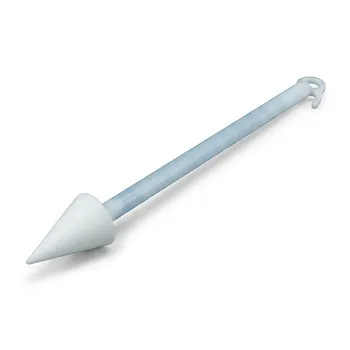
- Corrosion Resistant PTFE Laboratory Material Scoop for Biopharmaceutical Use Non Stick Easy Clean Fluoropolymer Shovel
- Custom PTFE Teflon Balls for Advanced Industrial Applications
- Custom Machined PTFE Conical Sample Cell Corrosion Resistant Triangular Fluoropolymer Container for Trace Analysis
People Also Ask
- How does PTFE's electrical insulation property benefit electronic components? Ensure Reliability and Signal Integrity
- What surface chemical species and binding energy signatures are detected on PTFE fluoropolymer sample holders during XPS analysis? Key insights for accurate calcium detection.
- What are the mechanical and safety advantages of using PTFE apparatus in a laboratory? Enhance Safety & Durability
- Why does PTFE require specialized powder processing techniques rather than standard melt-injection molding during component manufacturing? Unlock the secrets of PTFE processing.
- What are the benefits of using nickel foam as a current collector for Bi2MoO6 supercapacitors? Enhanced 3D Conductivity