PTFE requires specialized powder processing because it does not become a freely flowing liquid when heated. Unlike conventional thermoplastics, high-molecular-weight PTFE develops an exceptionally stiff, viscous gel above its melting point rather than a moldable melt. Its virtually nonexistent flow prevents standard injection molding and melt extrusion, so manufacturers use powder compaction, sintering, paste extrusion, and subsequent machining instead.
PTFE’s defining processing problem is its extremely high melt viscosity: heating it does not produce the liquid flow required to fill a conventional mold. The practical solution is to form the material from powder or paste and use heat, pressure, and machining to create the finished component.
Why Standard Melt Processing Fails
PTFE Does Not Flow Like Ordinary Thermoplastics
Most thermoplastics soften into a relatively mobile melt when heated. That flow allows injection pressure to push the material through a screw, nozzle, and mold cavity.
PTFE behaves differently. Above its melting point, it forms a stiff, clear gel with virtually no useful flow capacity.
Extremely High Molecular Weight Creates Extreme Viscosity
PTFE’s linear polymer chains have an exceptionally high molecular weight. As a result, its melt creep viscosity can reach approximately 10¹¹ poise, or about 10 GPa·s, near 380°C.
This is many orders of magnitude more viscous than ordinary melt-processable plastics. Injection pressure cannot move the material through the narrow passages of a conventional mold at practical manufacturing rates.
Melting Does Not Create a Conventional Processing Window
Heating PTFE above its melting point changes its physical state, but it does not provide the low-viscosity liquid needed for standard injection molding. The material therefore cannot reliably fill intricate cavities, flow around cores, or pass through conventional extrusion dies.
PTFE also cannot be dissolved in ordinary solvents, acids, or bases to create an alternative solution-processing route.
How Powder Processing Solves the Problem
Cold Compression Forms the Initial Shape
Manufacturers begin with granular or fine PTFE powder. The powder is compressed in a die to produce a preform, billet, rod, tube, or other approximate shape.
This approach creates the geometry through pressure on solid particles, rather than by forcing a liquid polymer into a mold.
Sintering Creates a Dense Polymer Structure
The compressed preform is heated to a controlled high temperature. During sintering, adjacent PTFE particles fuse and the material develops a continuous, consolidated structure.
Sintering must be carefully controlled because voids close gradually. Inadequate consolidation can leave microscopic porosity that contributes to chemical permeation, reduced flex life, or mechanical failure.
Paste Extrusion Handles Certain Geometries
Fine-powder PTFE can also be mixed with a lubricant and formed through paste extrusion. This method is used for shapes such as tubing and other continuous profiles.
Paste extrusion is fundamentally different from melt extrusion: the material is shaped as a lubricated powder compact and later processed to remove the lubricant and consolidate the polymer.
Machining Produces the Final Precision
Complex components are often manufactured from sintered PTFE stock shapes. CNC machining then produces exact dimensions, intricate features, and tight tolerances.
This route is common for laboratory vessels, liners, valves, fittings, fluid-transfer parts, and custom reaction components.
Why Material Properties Make This Route Necessary
High Crystallinity Limits Easy Deformation
Standard PTFE has very high crystallinity, commonly reported in the range of 92% to 98%. Its tightly packed carbon-fluorine structure contributes to chemical resistance and thermal performance, but it also reinforces the material’s resistance to melt flow.
Chemical Inertness Removes Common Alternatives
PTFE’s chemical inertness is valuable in service, but it limits manufacturing options. Since the polymer cannot be dissolved under ordinary conditions, manufacturers cannot use solution casting or solvent-based molding as a simple substitute for melt processing.
The Processing Method Preserves Performance
Compression molding and sintering allow manufacturers to retain PTFE’s high molecular weight and chemical purity. For demanding laboratory and fluid-handling applications, that consistency is often more important than the speed and low cost associated with conventional injection molding.
Understanding the Trade-offs
Powder Processing Is Slower and More Specialized
Compression, sintering, and controlled cooling require specialized equipment and process knowledge. Cycle times are generally longer than those of standard injection molding.
The process also requires close control of powder packing, temperature, pressure, and shrinkage.
Machining Can Generate Significant Waste
When a component is machined from a billet or molded block, material is removed to create the final shape. For complex geometries, this can produce substantial scrap and increase manufacturing cost.
Dimensional Control Requires Process Planning
PTFE can shrink and deform during consolidation and cooling. The final dimensions must therefore account for process-related changes, and machining allowances must be selected carefully.
Porosity Is a Serious Quality Risk
Incomplete particle fusion or poor sintering control can leave internal voids. These defects may be especially damaging in tubing, labware, sealing components, and fluid-transfer parts where leakage or chemical permeation is unacceptable.
Not Every PTFE Grade Has Identical Behavior
Standard high-molecular-weight PTFE is the primary reason conventional melt molding fails. Some modified or filled fluoropolymer grades may have different processing characteristics, but their suitability must be evaluated separately rather than assumed from the behavior of standard PTFE.
Making the Right Choice for Your Goal
The appropriate manufacturing route depends on the required geometry, tolerance, production volume, and service conditions.
- If your primary focus is complex custom geometry: Use sintered PTFE stock followed by precision CNC machining, because machining provides the dimensional control that powder forming alone usually cannot deliver.
- If your primary focus is tubing or continuous profiles: Evaluate paste extrusion, which forms PTFE powder into suitable continuous shapes without relying on melt flow.
- If your primary focus is repeatable near-net shapes: Use compression molding followed by sintering, while accounting for shrinkage, density, and void closure.
- If your primary focus is chemical and mechanical reliability: Prioritize controlled powder preparation and sintering, because residual porosity can compromise otherwise excellent PTFE performance.
PTFE is difficult to melt-process because its molecular structure prevents ordinary liquid flow, but specialized powder forming, sintering, and machining methods convert that limitation into reliable high-performance components.
Summary Table:
| Processing Method | Key Characteristics | Applications |
|---|---|---|
| Compression Molding + Sintering | Powder compacted, then heated; near-net shapes; slower cycles | Labware, liners, basic shapes |
| Paste Extrusion | Lubricated powder forced through die; continuous profiles | Tubing, continuous shapes |
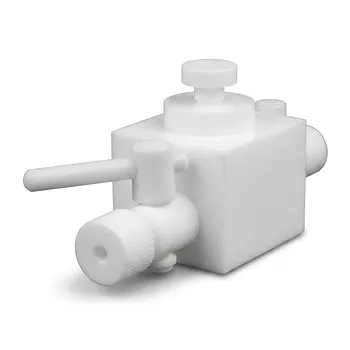
| CNC Machining | Precision from sintered stock; complex geometries; material waste | Valves, fittings, custom parts |
Need PTFE components that demand precision and reliability? At KINTEK, we specialize in high-performance fluoropolymers, offering everything from standard labware to custom CNC-machined parts. Our expertise ensures your components are manufactured with the right powder processing techniques. Contact us today to discuss your requirements and benefit from our end-to-end PTFE/PFA solutions! Get in touch
Related Products
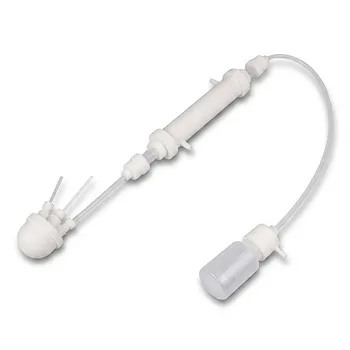
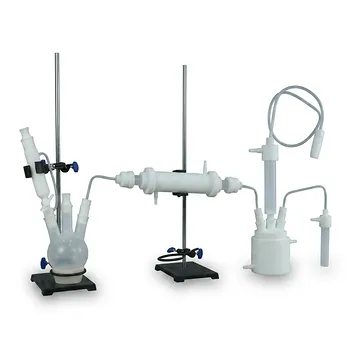
- Custom PTFE Condensation Reflux Apparatus with Serpentine Coil and Flask Collection System for Corrosive Chemical Processing
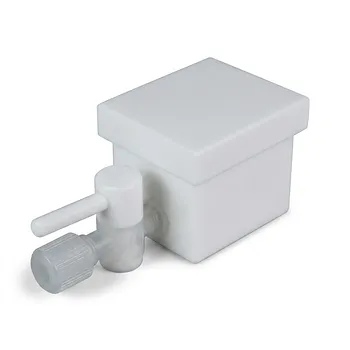
- Custom PTFE Laboratory Apparatus Corrosion Resistant Low Background Reaction Cells Precision CNC Fabrication
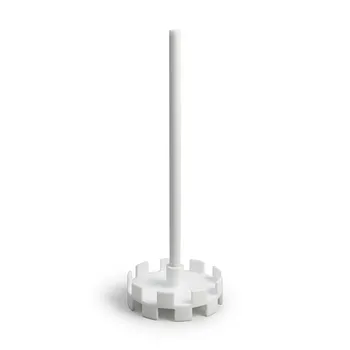
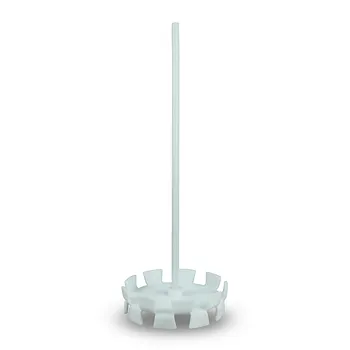
- Corrosion Resistant PTFE Stirring Impeller and Customizable Polytetrafluoroethylene Dispersion Disk
- Custom PTFE Wafer Handling Rack Corrosion Resistant High Temperature Semiconductor Polysilicon Processing Stand
- High Purity PTFE Square Membrane Cutter Equipartition Device for Trace Analysis and Disease Control Centers Clean Non Stick No Leaching
People Also Ask
- What are the mechanical and safety advantages of using PTFE apparatus in a laboratory? Enhance Safety & Durability
- What are the applications of PTFE in the chemical industry? A Guide to Superior Corrosion Resistance
- How does the low surface energy of PTFE benefit the condensation process? Boost Heat Transfer and Prevent Fouling
- What processing methods are typically used for PTFE? Mastering the Unique Path from Powder to Precision Part
- What are the challenges in processing PTFE? Overcoming High Melt Viscosity and Machining Difficulties