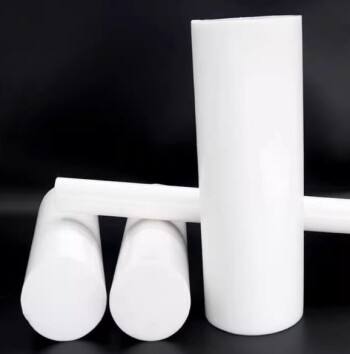
The key distinction is processing behavior, not merely particle size. Granular PTFE is a coarse molding resin for rigid, machinable labware; fine-powder PTFE is a fibrillating resin for paste-extruded tubing, tapes, films, and membranes; and PTFE dispersion is a liquid, typically aqueous formulation for coatings and impregnation. The correct choice depends on whether the finished part must provide structural rigidity, continuous flexibility, or a thin non-wetting protective surface.
Choose granular PTFE for rigid, custom-machined components; fine-powder PTFE for flexible or porous continuous forms; and aqueous PTFE dispersion for coatings and impregnated surfaces. Using the wrong form can make the material difficult or impossible to process into the required geometry.
How the Three PTFE Forms Differ Structurally
Granular PTFE: coarse molding resin
Granular PTFE is generally produced by suspension polymerization under vigorous agitation. It forms relatively coarse, often fibrous or stringy particles that can be compacted into a solid preform.
After compression molding and high-temperature sintering, the material becomes a dense billet, block, sheet, or thick-walled tube. These solid forms can then be machined using conventional CNC or precision machining methods.
Fine-powder PTFE: fibrillating extrusion resin
Fine-powder PTFE is produced through dispersion-type polymerization and consists of much smaller, more uniform particles. Its defining structural feature is the ability to fibrillate under shear.
The powder is blended with a hydrocarbon processing lubricant to create a paste. During paste extrusion, the particles form a coherent fibrillated structure that can be dried and sintered into thin, flexible shapes.
PTFE dispersion: stabilized liquid formulation
A PTFE dispersion is not simply another dry powder grade. It is a liquid system containing finely divided PTFE particles, usually stabilized in an aqueous medium with processing aids or surfactants.
The dispersion is applied as a coating or used to impregnate another material. Once the carrier is removed and the PTFE is fused, it produces a thin PTFE layer rather than a self-supporting bulk component.
How Each Form Is Processed
Granular PTFE uses molding and machining
Granular resin is compacted under pressure, sintered, and converted into solid stock. The resulting stock is then machined into the final geometry.
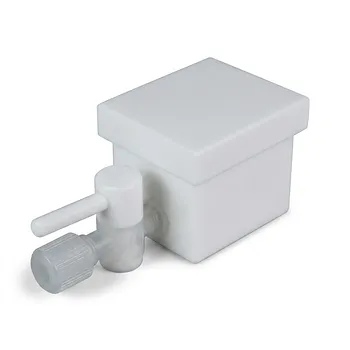
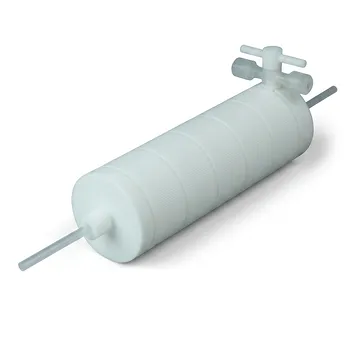
This route is well suited to thick walls, deep cavities, threaded features, ports, stopcock bodies, and custom reaction-cell geometries.
Fine powder PTFE uses paste extrusion
Fine powder is mixed with lubricant and forced through a die during paste extrusion. The extrudate is then dried and sintered.
This process efficiently produces thin-walled tubing, flexible hoses, sealing tape, films, and some porous membrane structures. It is particularly useful when a continuous length or flexible wall is required.
Dispersion PTFE uses coating or impregnation
A dispersion can be sprayed, brushed, dipped, or otherwise applied to a substrate, depending on the formulation and production method. Heating removes the liquid carrier and fuses the PTFE particles into a continuous layer.
This approach is suited to hydrophobic, non-wetting, low-friction, and corrosion-resistant surfaces, but it does not normally create a thick, structurally independent PTFE vessel.
Practical Selection for Labware
Choose granular PTFE for rigid labware
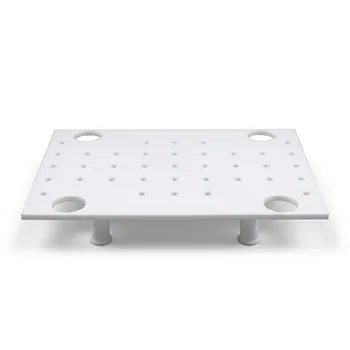
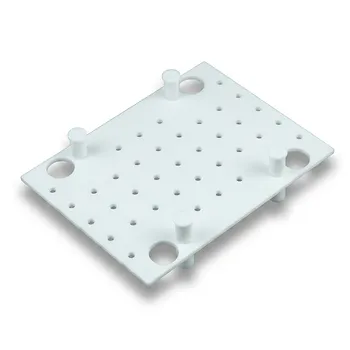
Granular PTFE is the practical choice for heavy-duty laboratory components that must retain their shape and contain fluids reliably. Typical examples include thick-walled vessels, beakers, reagent bottles, digestion vessels, crucibles, blocks, and custom reaction cells.
It is also the preferred starting form when the required geometry is unusual and must be produced by machining rather than by a standard extrusion profile.
Use fine powder for flexible fluid-transfer paths
Fine-powder PTFE is better suited to fluid-transfer tools that must bend, route through constrained spaces, or be manufactured continuously. Common examples include flexible tubing, thin-wall hoses, sealing tapes, and certain membrane or film products.
Paste extrusion can produce smooth, chemically resistant tubing with thin walls, but the finished product is not intended to provide the same structural stiffness as a machined, thick-walled component.
Use dispersion for surface functionality
PTFE dispersion is appropriate when the primary requirement is a PTFE surface rather than a bulk PTFE article. It can provide a non-wetting, low-friction, and chemically resistant coating on a compatible substrate.
For labware, this may be useful when a substrate supplies the mechanical strength and PTFE supplies the surface properties. For fluid-transfer equipment, dispersion may protect or modify a surface, but it is generally not the starting material for standalone tubing.
Comparing Mechanical and Functional Results
Rigidity and dimensional stability
Machined granular PTFE generally provides the strongest structural solution among these three product routes because it is used to create thick, dense sections. It is the logical choice for vessels, blocks, and fixtures that must remain dimensionally stable during handling.
Fine-powder products are intentionally formed into thinner, more flexible structures. Dispersion coatings are thinner still and depend heavily on the underlying substrate for strength.
Flexibility and continuous geometry
Fine-powder PTFE has the clearest advantage when flexibility and continuous extrusion are required. Its shear-induced fibrillation allows the paste to hold together during extrusion before final sintering.
Granular PTFE is not normally selected for flexible tubing because its molding route produces solid stock rather than an economical continuous thin-wall profile.
Surface and non-wetting properties
All properly processed PTFE products provide the characteristic chemical resistance and low surface energy associated with PTFE. Dispersion is especially valuable when those properties must be applied as a thin, conformal surface.
A coating, however, should not be treated as equivalent to a solid PTFE wall. Its performance depends on adhesion, coating thickness, substrate compatibility, and resistance to mechanical damage.
Understanding the Trade-offs
Granular PTFE is robust but less economical for thin forms
Granular PTFE supports custom machining and thick structural sections, but machining can generate waste and increase cost. It is also poorly matched to long, flexible, thin-walled geometries.
Choose it when rigidity, containment, and custom geometry matter more than continuous production efficiency.
Fine-powder PTFE enables flexibility but requires specialized processing
Fine-powder processing depends on careful lubricant blending, paste handling, extrusion, drying, and sintering. It is therefore less suitable for simple in-house machining or basic compression-molding workflows.
Its flexibility is an advantage for tubing, but thin walls may provide less mechanical support than a thick machined vessel and may require appropriate routing and external protection.
Dispersion provides a surface, not a structural body
A dispersion coating can be thin, efficient, and highly functional, but it cannot replace a structural PTFE component. Poor substrate preparation, inadequate fusion, or mechanical abrasion can compromise the coating even when the PTFE itself is chemically resistant.
For demanding fluid-contact applications, verify that the complete coated system—not only the PTFE—is compatible with the chemicals, temperature, pressure, and cleaning process.
“Fine powder” and “dispersion” should not be treated as identical
Both originate from dispersion-type polymerization routes and involve small PTFE particles, but they are supplied and processed differently. Fine powder is a dry resin for paste extrusion; dispersion is a liquid formulation for coating or impregnation.
That distinction is essential when specifying raw material, equipment, and finished-product performance.
Making the Right Choice for Your Goal
The best selection follows the required finished geometry and manufacturing process:
- If your primary focus is rigid custom labware: Select granular PTFE for compression molding followed by machining into thick-walled vessels, blocks, cells, or fluid-control components.
- If your primary focus is flexible fluid transfer: Select fine-powder PTFE for paste-extruded tubing, thin-wall hoses, sealing tapes, and related continuous forms.
- If your primary focus is a non-wetting or protective surface: Select aqueous PTFE dispersion for coating or impregnating a structurally capable substrate.
- If your primary focus is porous membrane construction: Evaluate fine-powder processing routes designed for fibrillated or expanded structures rather than assuming a conventional dispersion coating will provide the required porosity.
- If your primary focus is maximum structural stability: Favor dense, machined granular PTFE and size the wall thickness and geometry for the mechanical and thermal conditions of use.
Match the PTFE form to the manufacturing route first, then confirm the finished part’s chemical, mechanical, thermal, and fluid-transfer requirements.
Summary Table:
| Feature | Granular PTFE | Fine-powder PTFE | PTFE Dispersion |
|---|---|---|---|
| Form | Coarse resin | Fine powder | Liquid (aqueous) |
| Polymerization | Suspension | Dispersion | Dispersion |
| Processing | Compression molding & machining | Paste extrusion | Coating/impregnation |
| Typical Products | Rigid labware, custom machined parts | Tubing, tapes, films, membranes | Coatings, surface treatments |
| Key Properties | Structural rigidity, dimensional stability | Flexibility, continuous length | Non-wetting, low friction |
| Best For | Beakers, vessels, custom cells | Flexible fluid transfer, sealing | Protective/hydrophobic surfaces |
| Limitations | Not economical for thin forms | Requires specialized processing | Thin, not structural |
Need help selecting or manufacturing PTFE components? From custom machined parts to flexible tubing and surface coatings, KINTEK offers a full range of PTFE/PFA labware and fluid transfer solutions. Contact us today to discuss your application and benefit from our expertise and end-to-end machining capabilities. Get in touch!
Related Products
- Custom PTFE Filtration System Acid Resistant High Purity Semiconductor Grade Chemical Processing Filter
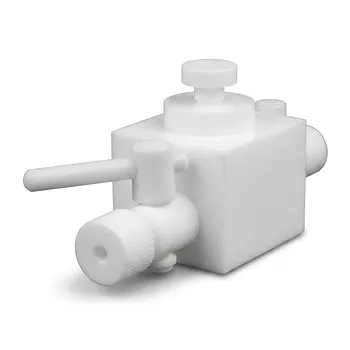
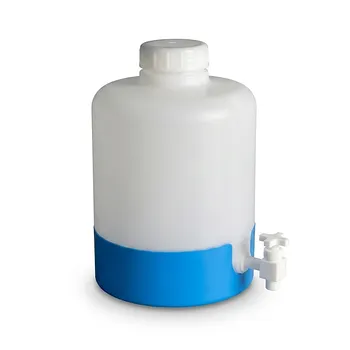
- High Corrosion Resistant PTFE Faucet Polytetrafluoroethylene Valve for Chemical Storage Drums and Fluid Transfer Systems Customizable Industrial Grade
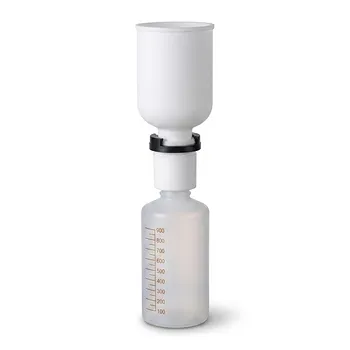
- PTFE PFA Vacuum Filtration System Corrosion Resistant Customizable Shatterproof Laboratory Device
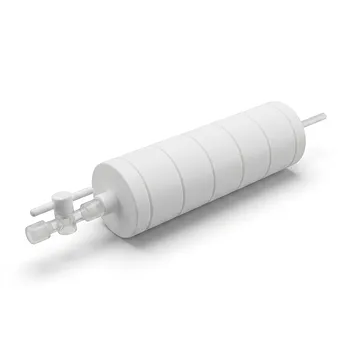
- PTFE Corrosion Resistant Filter with PFA Valve Connections and Integrated Sieve Plate
- High Temperature Chemical Resistant 50ml PTFE Syringe Customized Teflon Injector with Threaded Seal for Trace Analysis
People Also Ask
- What makes PTFE filtration systems advantageous for industrial and scientific use? Unmatched Chemical & Thermal Stability
- What sizes and pore options are available for PTFE filters? Choose the Right Filter for Your Application
- What steps are involved in selecting the proper PTFE filter? A 4-Step Guide to Optimal Filtration
- How does the hydrophobicity of PTFE filters benefit their use? Ensure Uninterrupted Gas Flow and Solvent Filtration
- What temperature resistance do PTFE filters offer? Unmatched Thermal Stability from -200°C to +260°C