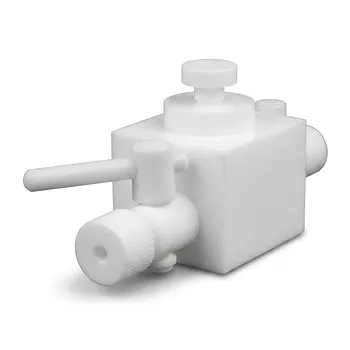
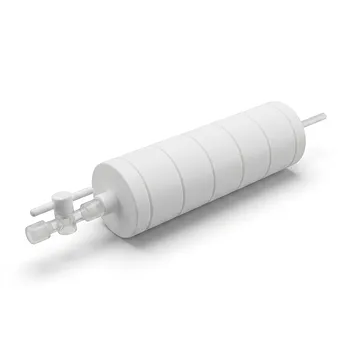
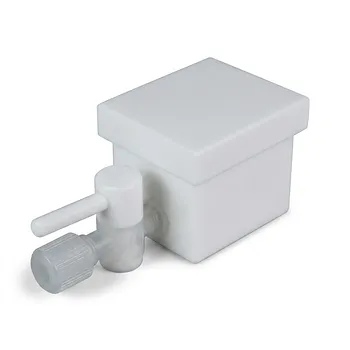
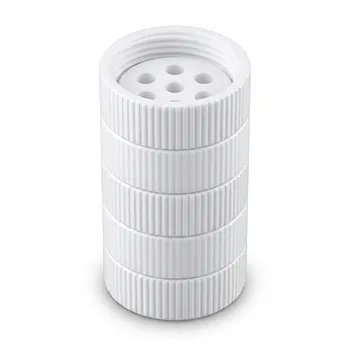
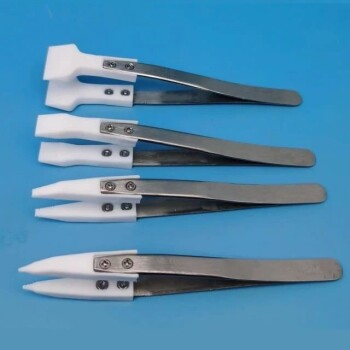
Traditional commodity fluoropolymers such as PTFE are defined by exceptional chemical and thermal performance, but their processing behavior is unusually demanding. They resist aggressive chemicals, solvents, thermal degradation, and electrical leakage, which makes them valuable for high-purity laboratory vessels, fluid-transfer components, and reaction apparatus. The principal trade-off is that PTFE’s high crystallinity and extremely high melt viscosity make conventional melt processing impractical, increasing manufacturing cost and often favoring compression molding, sintering, or precision CNC machining.
PTFE provides an unusually broad performance margin in corrosive, high-temperature, and high-purity environments, but that performance comes with manufacturing constraints. The right choice depends not only on chemical compatibility, but also on the required geometry, tolerance, transparency, sealing method, and production volume.
Why PTFE Performs Well in Demanding Laboratories
Chemical Resistance Protects Samples and Equipment
PTFE offers near-universal resistance to chemical attack across many aggressive acids, bases, solvents, and reactive reagents. This allows laboratory components to maintain their integrity where conventional plastics may swell, embrittle, dissolve, or contaminate the process.
That resistance is particularly valuable in semiconductor fabrication, pharmaceutical synthesis, chemical analysis, environmental testing, and trace-analysis workflows. The material helps reduce corrosion-related failure and limits the risk of extractables or sample contamination.
Thermal Stability Supports Severe Operating Conditions
PTFE has exceptionally high thermal stability and a continuous service capability commonly cited at approximately 260°C, subject to the specific product, design, and manufacturer’s limits. It is therefore suitable for heated reaction systems, digestion equipment, and other laboratory assemblies exposed to elevated temperatures.
Thermal resistance does not eliminate operating limits. Temperature, chemical exposure, pressure, mechanical loading, and duration must remain within the manufacturer’s specifications to preserve long-term integrity and user safety.
Electrical Insulation Benefits Specialized Equipment
PTFE provides strong dielectric insulation and low electrical conductivity. This makes it useful in electrochemical cells, electrical isolation components, analytical instruments, and laboratory systems where unwanted current paths could affect measurements or create safety risks.
Its electrical performance is complemented by broad chemical inertness, allowing insulating components to remain stable in chemically aggressive environments.
Low Friction and Non-Stick Surfaces Reduce Residue
PTFE has a very low coefficient of friction and low surface energy. Liquids tend to spread poorly or release readily from the surface, which can reduce droplet retention, sample adhesion, and residue on container walls.
In practical terms, this can help minimize sample loss and cross-contamination during decanting, liquid handling, digestion, and cleaning. These benefits are especially important in ultra-trace analysis, where small amounts of retained material can affect results.
Why PTFE Is Difficult to Process
High Crystallinity Raises Manufacturing Complexity
PTFE’s high crystallinity contributes to its thermal and chemical performance, but it also makes the material difficult to shape using ordinary thermoplastic methods. Unlike many commodity plastics, PTFE cannot simply be conventionally injection-molded or extruded after being heated.
The material is generally formed from powder through compression molding and sintering, or supplied as stock shapes for subsequent machining. These additional steps increase equipment requirements, cycle times, and manufacturing cost.
Extreme Melt Viscosity Prevents Conventional Melt Molding
At processing temperatures, PTFE exhibits extremely high melt viscosity. The supplementary reference characterizes this viscosity as approximately 10^10 to 10^12 poise at 380°C, which prevents practical flow through conventional molding equipment.
This is the central processing limitation: PTFE can soften and sinter, but it does not behave like a typical melt-processible thermoplastic. Complex geometries may therefore require specialized forming methods or extensive machining from solid stock.
CNC Machining Enables Precision but Adds Cost
Precision CNC machining from PTFE stock is well suited to custom reaction vessels, electrochemical cell bodies, microwave digestion components, and other low-volume laboratory parts. It supports tight dimensional control and makes prototypes or specialized geometries feasible.
The trade-off is material waste, machining time, tooling requirements, and higher per-part cost. This approach is most defensible when performance and customization matter more than high-volume production efficiency.
Specialized Molding Works Better at Appropriate Volumes
Compression molding and sintering can be more efficient for repeatable components and larger production runs. However, tooling, process development, dimensional shrinkage, and post-processing still require careful control.
The manufacturing route must be selected alongside the design. A shape that is easy to machine may be inefficient to mold, while a repeated geometry may justify specialized tooling.
PTFE Versus Melt-Processible Fluoropolymers
PFA Preserves Many Performance Advantages
PFA is a melt-processible perfluorinated copolymer that provides high chemical resistance, low friction, strong dielectric properties, and high-temperature capability comparable to PTFE in many laboratory applications. Its continuous use temperature is commonly identified as approximately 260°C, with the same need to follow product-specific limits.
Unlike PTFE, PFA can be conventionally molded or melt-extruded. This makes it more suitable for intricate tubing, fittings, valves, sealed vessels, and other components requiring integrated or melt-sealed geometries.
Geometry and Clarity Can Determine the Choice
PFA is often preferred when a component requires transparency or translucency, smooth internal surfaces, low micro-porosity, weldability, or a complex molded shape. These characteristics are valuable in high-purity fluid handling and trace-analysis vessels.
Solid PTFE remains attractive for heavy-duty labware, custom-machined apparatus, and components where maximum resistance and low friction are more important than transparency or efficient melt processing.
Material Selection Is More Than a Chemical-Resistance Question
PTFE and PFA may offer similar resistance and temperature capability, but they do not offer the same manufacturing flexibility. The appropriate choice depends on whether the component must be machined, molded, extruded, welded, inspected visually, or produced repeatedly at scale.
Part geometry and manufacturing method should be considered during design rather than after the material has already been selected.
Understanding the Trade-offs
Higher Raw Material and Processing Costs
Fluoropolymers generally cost more than standard non-fluorinated thermoplastics. PTFE adds further expense through specialized powder processing, sintering, machining, or post-processing.
The cost can be justified when equipment failure, contamination, corrosion, or premature replacement would be more expensive than the original component. It should not be assumed that PTFE is automatically the most economical choice for every laboratory part.
Mechanical Performance May Not Be the Primary Strength
Perfluoropolymers such as PTFE and PFA prioritize chemical inertness, thermal stability, and low friction. Partially fluorinated materials such as ETFE and ECTFE generally provide greater mechanical strength and structural toughness, but with reduced chemical resistance and lower temperature capability.
Where wear resistance or structural toughness dominates, an alternative fluoropolymer may be more appropriate. Where corrosive containment and purity dominate, PTFE or PFA is usually better aligned with the application.
Operating Limits Still Matter
Chemical resistance is not absolute under every combination of concentration, temperature, pressure, and exposure time. Elevated temperature and mechanical stress can change how a material behaves even when the chemical itself is nominally compatible.
Laboratory users should verify compatibility and thermal limits against the manufacturer’s data, especially for pressurized systems, heated vessels, and long-duration exposure.
Low Surface Energy Can Affect Sealing and Joining
The same low surface energy that produces non-stick behavior can make bonding, coating, and some joining operations difficult. Designers may need to use mechanical seals, specialized surface treatments, compatible fluoropolymer welding methods, or a material such as PFA when melt sealing is required.
This is a design consideration, not merely a fabrication detail. The joining strategy should be established before finalizing the material and component geometry.
Making the Right Choice for Your Goal
The best material and process depend on the laboratory component’s most important constraint.
- If your primary focus is maximum chemical resistance: Use PTFE or PFA after verifying the exact chemical, temperature, pressure, and exposure conditions against manufacturer data.
- If your primary focus is custom, low-volume laboratory apparatus: Consider PTFE stock shapes with precision CNC machining for reaction vessels, electrochemical cells, and specialized digestion components.
- If your primary focus is complex molded or extruded geometries: Favor PFA when the design requires tubing, fittings, valves, translucent vessels, or melt-sealed features.
- If your primary focus is mechanical toughness or wear resistance: Evaluate ETFE or ECTFE, accepting their lower chemical resistance and temperature capability relative to perfluoropolymers.
- If your primary focus is high-purity fluid handling: Prioritize low extractables, smooth surfaces, low porosity, appropriate joining methods, and verified operating limits alongside chemical compatibility.
PTFE is most valuable when its exceptional environmental resistance outweighs the cost and complexity of processing it correctly.
Summary Table:
| Characteristic | PTFE Performance | Processing Trade-off |
|---|---|---|
| Chemical Resistance | Exceptional resistance to acids, bases, solvents | None – but compatibility must be verified per conditions |
| Thermal Stability | Continuous use up to ~260°C | Requires specialized processing due to high crystallinity |
| Melt Viscosity | Extremely high (10^10–10^12 poise) | Cannot be conventionally molded; requires compression molding or machining |
| Machining | Precision CNC machining possible for custom parts | Material waste and higher per-part cost |
| Surface Properties | Low friction, non-stick, low surface energy | Difficult to bond or seal; may need mechanical fasteners or PFA for welding |
Ready to optimize your lab's fluoropolymer components? At KINTEK, we specialize in high-performance PTFE and PFA labware, custom CNC machining, and bespoke solutions. Whether you need corrosion-resistant vessels, precision-machined parts, or high-purity fluid handling systems, our experts can guide you to the right material and manufacturing process for your application. Contact us today to discuss your requirements and get a tailored solution.
Related Products
- Custom PTFE Filtration System Acid Resistant High Purity Semiconductor Grade Chemical Processing Filter
- High Corrosion Resistant PTFE Faucet Polytetrafluoroethylene Valve for Chemical Storage Drums and Fluid Transfer Systems Customizable Industrial Grade
- PTFE PFA Vacuum Filtration System Corrosion Resistant Customizable Shatterproof Laboratory Device
- PTFE Corrosion Resistant Filter with PFA Valve Connections and Integrated Sieve Plate
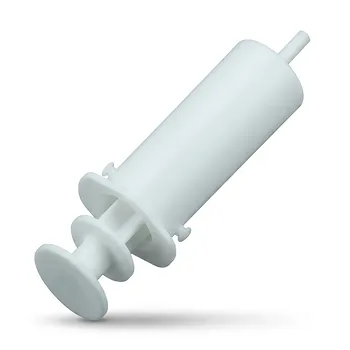
- High Temperature Chemical Resistant 50ml PTFE Syringe Customized Teflon Injector with Threaded Seal for Trace Analysis
People Also Ask
- What makes PTFE filtration systems advantageous for industrial and scientific use? Unmatched Chemical & Thermal Stability
- What sizes and pore options are available for PTFE filters? Choose the Right Filter for Your Application
- What steps are involved in selecting the proper PTFE filter? A 4-Step Guide to Optimal Filtration
- How does the hydrophobicity of PTFE filters benefit their use? Ensure Uninterrupted Gas Flow and Solvent Filtration
- What temperature resistance do PTFE filters offer? Unmatched Thermal Stability from -200°C to +260°C