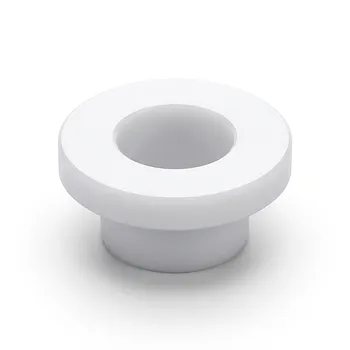
Polytetrafluoroethylene (PTFE) gaskets are defined by their near-universal chemical inertness and an extraordinary thermal range. These materials remain stable from cryogenic temperatures as low as -268°C up to +260°C while maintaining a non-contaminating, low-friction surface. This combination of properties makes PTFE the primary choice for sealing applications involving aggressive chemicals, high-purity processes, and extreme environmental conditions.
PTFE gaskets succeed by combining extreme chemical resistance with broad thermal stability and a non-stick surface. While virgin PTFE offers the highest purity, its performance in high-pressure sealing is often optimized through fillers or expansion to address mechanical limitations like "cold flow."
The Foundations of PTFE Performance
Unrivaled Chemical Resistance
The most significant characteristic of PTFE is its near-universal inertness to acids, alkalis, and solvents. This makes it a "safe-bet" material for industrial processes where the specific chemical composition of the fluid may vary or be highly aggressive. Because the material does not react with its environment, it avoids the degradation and embrittlement common in standard elastomers.
Extreme Thermal Versatility
PTFE gaskets operate reliably across a massive temperature spectrum, ranging from cryogenic levels at -268°C to heat levels reaching +260°C. This stability ensures that the material does not become brittle in extreme cold or melt in high-heat applications. This range is far wider than most synthetic rubbers, providing a critical safety margin in volatile environments.
Low Friction and Non-Adhesive Surface
With a coefficient of friction between 0.05 and 0.10 against steel, PTFE is one of the "slipperiest" solids known. This non-stick nature prevents other materials from adhering to the gasket, which simplifies maintenance and prevents "stick-slip" behavior. Additionally, its non-wetting properties ensure that fluids do not soak into the material, maintaining seal integrity over time.
Enhancing Mechanical Integrity
Managing Material "Cold Flow"
While virgin PTFE is chemically superior, it is susceptible to "cold flow," which is the tendency of the material to slowly deform under a constant mechanical load. In a gasket application, this can lead to a loss of bolt torque and a subsequent leak. Understanding this behavior is essential for choosing the right form of PTFE for high-pressure systems.
The Role of Fillers and Expansion
To combat cold flow, engineers often use filled PTFE or expanded PTFE (ePTFE). Filled PTFE incorporates materials like glass or carbon to improve creep resistance and mechanical strength. ePTFE, on the other hand, uses a multi-directional fibrous structure to provide high conformability, allowing the gasket to seal even against irregular or damaged flange surfaces.
Purity and Non-Contamination
PTFE is inherently non-contaminating and does not leach additives or "plasticizers" into the process stream. This makes it an ideal choice for the food, beverage, and pharmaceutical industries where purity is a regulatory requirement. Its low moisture absorption and resistance to aging ensure that the material remains stable during long-term service.
Navigating Mechanical Trade-offs
The Challenge of Load Retention
The primary trade-off with virgin PTFE is its poor "compression rebound" compared to traditional rubber gaskets. Once the material deforms under pressure, it does not easily return to its original shape. This makes it less suitable for applications with significant vibration or thermal cycling where the seal needs to "breathe."
Thermal Expansion Risks
PTFE has a high coefficient of thermal expansion, meaning it expands and contracts significantly as temperatures change. If the flange bolts are not properly torqued or if the system experiences rapid thermal shocks, the gasket may thin out during the heat cycle and leave a gap when the system cools. Using ePTFE or filled variants is the standard method to mitigate this risk.
Selecting the Right PTFE Variant for Your Goal
How to Apply This to Your Project
Selecting the correct PTFE gasket requires balancing chemical needs with mechanical reality. Use the following guidelines to match the material to your specific application:
- If your primary focus is maximum chemical purity: Use Virgin PTFE, as it contains no fillers that could potentially react with ultra-pure process fluids.
- If your primary focus is high-pressure load retention: Choose Filled PTFE (e.g., Silica or Barium Sulfate fillers) to minimize creep and prevent the gasket from "squeezing out" of the flange.
- If your primary focus is sealing irregular or fragile flanges: Opt for Expanded PTFE (ePTFE), which is soft and highly conformable, requiring lower bolt torque to create a tight seal.
- If your primary focus is electrical or thermal insulation: Leverage Virgin PTFE for its high insulation resistance and low dielectric constant of 2.0.
By matching these specific material characteristics to your operational environment, you ensure a long-lasting, leak-free seal in even the most demanding industrial applications.
Summary Table:
| Characteristic | Performance Benefit | Ideal Application |
|---|---|---|
| Chemical Inertness | Resists acids, alkalis, and solvents | Aggressive chemical processing |
| Thermal Range | Stable from -268°C to +260°C | Cryogenic and high-heat systems |
| Low Friction | Non-stick surface (0.05-0.10 coefficient) | Easy maintenance and non-wetting seals |
| Purity | Non-contaminating, no plasticizers | Food, pharma, and semiconductor labs |
| Mechanical Adaptability | Fillers/Expansion reduce cold flow | High-pressure and irregular flanges |
Elevate Your Lab Performance with KINTEK’s Fluoropolymer Expertise
From everyday basic labware (beakers, measuring cylinders, crucibles, dishes, reagent/wash bottles, centrifuge and digestion tubes), high-purity trace analysis instruments, and cleaning/storage tanks, to comprehensive fluid transfer components (tubing, fittings, valves), sample prep and filtration tools (separatory funnels, burettes, filters, pipettes, tweezers, spatulas), and general consumables (stirring bars, O-rings, gaskets, seal tapes, caps, septa), extending all the way to advanced derivative and reaction apparatus like standard or custom electrochemical cells, battery testing fixtures, electrode accessories, hydrothermal synthesis liners, microwave digestion vessels, microchannel reactors, and condensation/reflux devices, KINTEK manufactures virtually all imaginable laboratory supplies crafted from PTFE and PFA.
Backed by end-to-end custom CNC fabrication, we are equipped to deliver absolutely everything from complex non-standard machined parts and bespoke laboratory setups to high-volume orders, maintaining an exclusive and absolute focus on high-performance fluoropolymer materials.
Ready to secure your process with the ultimate sealing solutions? Contact us today to discuss your custom project!
Related Products
- Customizable High Temperature Resistant Anti Static PTFE Insulating Gaskets Flame Retardant Corrosion Proof Industrial Seals
- Custom PTFE Insulating Gaskets Corrosion Resistant Teflon Seals Tailored Engineering Plastic Components
- Custom PTFE Insulating Gaskets and Corrosion Resistant Fluoropolymer Seals for Industrial Electrical Applications
- High Corrosion Resistant PTFE Faucet Polytetrafluoroethylene Valve for Chemical Storage Drums and Fluid Transfer Systems Customizable Industrial Grade
- Custom PTFE Acid Resistant Support Rack Multi Hole PFA Hydrogen Absorption System Bracket
People Also Ask
- Why is PTFE an ideal material choice for sealing gaskets, valves, and fluid transfer tubing exposed to extremely aggressive chemicals? Discover Its Superior Chemical Resistance and Reliability
- How is PTFE utilized in seals and gaskets? Leverage Its Chemical & Temperature Resistance
- What are the key properties of PTFE that make it suitable for seals and gaskets? Unlock Superior Sealing Performance
- What are the best applications for standard PTFE gaskets? Ideal for Chemical & High-Temp Sealing
- What are the different types of PTFE gaskets? A Guide to Choosing the Right Seal