Choosing ETFE over PTFE or PFA trades some chemical and thermal performance for substantially better mechanical durability. ETFE generally provides higher tensile strength, stiffness, hardness, cut-through resistance, impact resistance, and abrasion resistance than PTFE or PFA. In exchange, it has a lower continuous-use temperature, reduced resistance to the most aggressive chemicals, and a higher coefficient of friction.
ETFE is the stronger structural material; PTFE and PFA are the more chemically and thermally resistant materials. Choose ETFE when a custom component must tolerate mechanical stress, impact, wear, or pressure at moderate temperatures. Choose PTFE or PFA when chemical inertness, low friction, high-temperature service, or ultra-pure fluid handling is the priority.
Where ETFE Provides a Performance Advantage
Higher strength and stiffness
ETFE’s hydrogen-containing polymer structure gives it greater mechanical strength and stiffness than fully fluorinated polymers.
Indicative values show ETFE tensile strength around 45 MPa, compared with approximately 31 MPa for PFA and roughly 35 MPa for PTFE, depending on grade and test method. Its flexural modulus is also substantially higher than PTFE’s.
This makes ETFE better suited to load-bearing fittings, pump components, valve parts, supports, and structural fluid-handling hardware that must resist deformation.
Better resistance to physical damage
ETFE generally offers higher hardness, impact resistance, cut-through resistance, and abrasion resistance than PTFE or PFA.
That advantage matters when components experience repeated assembly, clamping, vibration, mechanical shock, scraping, or high-pressure loading. ETFE is less likely to be damaged by handling or local mechanical contact.
Lower component weight
ETFE has a lower specific gravity than PFA—approximately 1.70 compared with 2.16 for PFA in the referenced data.
For large custom components or assemblies with many fittings, this can reduce total weight while retaining useful structural strength.
More practical for complex custom fabrication
ETFE is a melt-processable thermoplastic, so it can be molded, extruded, or formed into certain complex geometries.
This can be advantageous for custom tubing, fittings, and molded components. PTFE is not conventionally melt-processable and is commonly supplied as stock shapes for machining, while PFA is melt-processable and better suited to molded or extruded fluid components.
Where PTFE and PFA Remain Superior
Higher continuous-use temperature
The central thermal disadvantage of ETFE is its lower service-temperature ceiling.
A conservative comparison is approximately 150°C continuous use for ETFE, versus up to 260°C for PTFE and PFA, subject to the specific grade, stress level, geometry, and manufacturer rating. Some ETFE grades are rated higher, so the datasheet for the exact material must control the design.
This difference is decisive for high-temperature chemical transfer, digestion systems, heated reaction equipment, and sterilization environments.
Broader chemical resistance
PTFE and PFA provide near-universal chemical resistance and are generally more reliable against aggressive solvents and highly corrosive media.
ETFE still resists many chemicals effectively, but its partially fluorinated structure makes it more vulnerable to certain aggressive solvents and chemical environments than fully fluorinated PTFE or PFA.
For fluid components, this is not merely a material-selection detail. Chemical attack can reduce strength, change dimensions, contaminate the fluid, or cause premature leakage.
Lower friction
PTFE has an exceptionally low coefficient of friction, and PFA also performs better than ETFE in low-friction applications.
ETFE’s higher friction can increase sliding resistance and affect the performance of seals, valve interfaces, bearings, plungers, and moving pump components. It may therefore require a different geometry, surface finish, or component material when low actuation force is important.
Greater suitability for ultra-pure fluid service
PFA is particularly valuable when the component must combine complex geometry with high chemical purity and thermal resistance.
PTFE and PFA are generally the safer choices for ultra-pure laboratory fluid paths, corrosive chemical containment, trace-analysis equipment, and high-temperature chemical processing.
How the Trade-Off Changes Component Selection
For pressure-bearing and structural parts
ETFE is often the stronger candidate when the main failure risk is mechanical deformation, cracking from impact, cut-through, or wear.
Its higher modulus and toughness can provide a more durable component than PTFE or PFA under moderate-temperature mechanical loading. However, pressure and temperature must be evaluated together rather than separately.
For seals and sliding interfaces
ETFE’s mechanical hardness can be useful where a component must resist extrusion or surface damage.
Its higher friction can be a disadvantage in dynamic sealing or sliding applications, where PTFE’s low friction may produce lower operating forces and less interface resistance. The correct choice depends on whether mechanical durability or low-friction motion is the dominant requirement.
For high-temperature fluid paths
PTFE or PFA is usually the better choice when the fluid path will operate close to ETFE’s thermal limit.
PFA is especially useful when the design requires a melt-processable perfluoropolymer for tubing, valves, fittings, or complex vessels. PTFE remains valuable for machined components and stock-shape fabrication where its thermal and chemical performance justify the manufacturing approach.
For radiation-exposed components
ETFE can offer an important advantage in high-energy radiation environments while retaining strong mechanical toughness.
The referenced data identify resistance to substantial cobalt-60 radiation exposure, including levels up to approximately 200 Mrad. This can make ETFE attractive for specialized structural or fluid-handling components where radiation durability and mechanical strength are both important.
Understanding the Trade-Offs
ETFE is not a universal replacement
ETFE’s stronger mechanical performance does not compensate for every loss in chemical or thermal capability.
Replacing PTFE or PFA with ETFE in a high-temperature or chemically aggressive application can reduce the safety margin even if the ETFE part is mechanically stronger.
Temperature, stress, and chemical exposure interact
A component operating at moderate temperature in a chemically compatible fluid may perform well in ETFE.
The same component may have a much shorter service life when exposed simultaneously to elevated temperature, sustained pressure, cyclic loading, and an aggressive solvent. Material ratings should therefore be reviewed under the actual combined conditions.
Published values are grade-dependent
Tensile strength, modulus, friction, temperature limits, and chemical compatibility vary with resin grade, processing method, fillers, geometry, and test conditions.
Values such as 150°C, 260°C, 45 MPa, or 31 MPa are useful for comparing material families, not substitutes for the selected manufacturer’s data sheet and qualification testing.
Higher strength does not eliminate design concerns
ETFE’s improved strength and stiffness make it more robust, but they do not remove the need to check pressure ratings, dimensional stability, sealing loads, tolerances, and long-term mechanical behavior.
Custom components should be evaluated for their actual load cases rather than selected from tensile strength alone.
Making the Right Choice for Your Goal
The most reliable selection process starts by identifying the dominant failure mode: mechanical damage, chemical attack, thermal exposure, friction, or contamination.
- If your primary focus is mechanical strength and wear resistance: Choose ETFE for custom fittings, structural parts, pump components, and fluid-handling hardware exposed to impact, abrasion, cut-through, or moderate-temperature pressure.
- If your primary focus is maximum chemical resistance: Choose PTFE or PFA, particularly for aggressive solvents, corrosive chemicals, and demanding containment applications.
- If your primary focus is high-temperature service: Prefer PTFE or PFA because their continuous-use temperature capability is substantially higher than ETFE’s.
- If your primary focus is low friction: Prefer PTFE or, where suitable, PFA for sliding interfaces, dynamic seals, and components requiring low actuation resistance.
- If your primary focus is complex molded or extruded fluid components: Compare ETFE with PFA, using ETFE when mechanical toughness dominates and PFA when chemical purity and thermal endurance dominate.
- If your primary focus is radiation durability with mechanical toughness: Consider ETFE, provided the operating temperature and chemical environment remain within its qualified limits.
The right choice is not the polymer with the highest headline performance, but the one whose weaknesses remain outside your component’s actual operating conditions.
Summary Table:
| Property | ETFE | PTFE | PFA |
|---|---|---|---|
| Tensile Strength | ~45 MPa | ~35 MPa | ~31 MPa |
| Continuous Use Temp. | ~150°C | up to 260°C | up to 260°C |
| Chemical Resistance | Good, but less than PTFE/PFA | Excellent, near-universal | Excellent, near-universal |
| Friction Coefficient | Higher | Very low | Low |
| Abrasion/Wear Resistance | Higher | Lower | Moderate |
| Melt Processability | Yes | No (machined) | Yes |
| Best For | Mechanical parts | High-temp/chem | High-purity fluid systems |
Need help selecting the right polymer for your custom component? At KINTEK, we specialize in high-performance fluoropolymers, offering expert guidance and precision CNC machining for PTFE and PFA. Our team can help you balance mechanical strength, chemical resistance, and thermal performance to meet your exact specifications. From custom machined parts to complete laboratory setups, we provide tailored solutions backed by end-to-end support. Contact us today to discuss your project and discover how we can enhance your operations.
Related Products
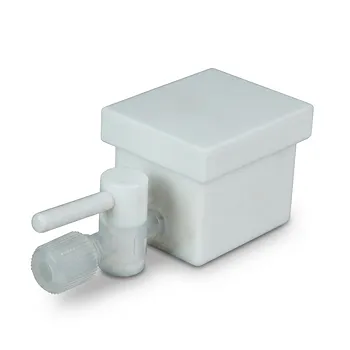
- Custom PTFE Corrosion Resistant Insulating Electrophoresis Reaction Cell with Septum and Valves for Low Background Trace Analysis
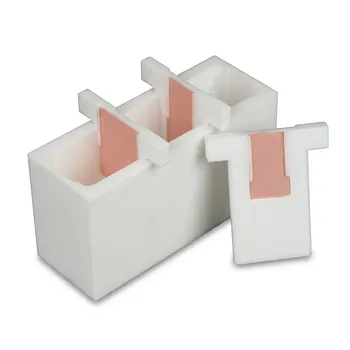
- White PTFE Electrolytic Cell with Movable Slider and Insulated Lid for Fluorine Corrosion Resistance
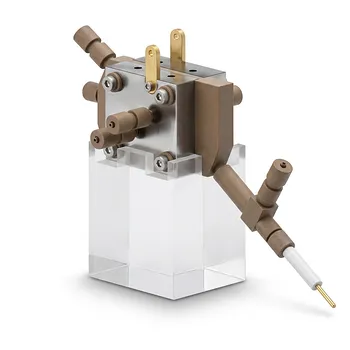
- Multi Functional Gas Diffusion Electrochemical Cell for CO2 Reduction and Solid State Membrane Electrode Assembly Electrolysis
- PTFE Anti Scald Heat Insulation Sleeve Hot Plate Support Feet Laboratory Benchtop Protection Customizable Thermal Barrier
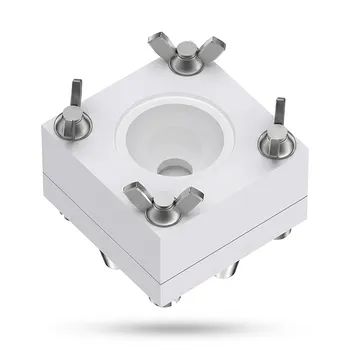
- PTFE Flat Plate Working Electrode Electrochemical Cell for Sheet Samples Corrosion Testing and SEM Sample Preparation
People Also Ask
- What industries use custom PTFE parts and for what purposes? Solve Critical Challenges with High-Performance Materials
- What industries benefit most from custom PTFE parts? Solve Extreme Environment Challenges
- What design considerations are important for custom PTFE parts? Design for Performance & Reliability
- What advantages do custom PTFE parts offer for industrial efficiency? Boost Uptime & Cut Costs
- What are the key properties of Teflon (PTFE) used in custom parts? | Achieve Peak Performance