Tetrafluoroethylene (TFE) monomer handling requires controls for both oxygen-driven polymerization and oxygen-independent explosive decomposition. TFE can violently deflagrate into carbon tetrafluoride and solid carbon even without air, releasing approximately 57–62 kcal/mol of heat. The risk increases with temperature and pressure, while trace oxygen above approximately 20 ppm can initiate rapid autopolymerization, generating localized hot spots that may ignite or decompose the monomer.
The central safety principle is to prevent ignition conditions from developing: keep oxygen below the validated limit, control temperature and pressure continuously, prevent hot spots, and design containment and relief systems for credible decomposition and polymerization scenarios.
Why TFE Handling Is Unusually Hazardous
TFE Can Decompose Without Air
Many flammable gases require an external oxygen supply to burn. TFE is different: it can undergo violent self-decomposition into carbon tetrafluoride and carbon in the absence of air.
This reaction releases substantial heat, with an energy output comparable to that associated with black powder. Therefore, simply excluding atmospheric oxygen does not eliminate the need for explosion protection.
Pressure and Temperature Increase the Risk
TFE explosivity increases as pressure and temperature rise. A system that appears stable at one operating condition can become much more hazardous during compression, heating, blocked flow, or loss of cooling.
Storage vessels, transfer lines, compressors, and polymerization reactors must therefore be evaluated as a connected pressure system rather than as isolated pieces of equipment.
Trace Oxygen Can Initiate Autopolymerization
Oxygen concentrations above approximately 20 ppm can initiate or accelerate unwanted polymerization. The reaction is exothermic, and TFE's low thermal conductivity and the insulating nature of fluoropolymer deposits can allow heat to accumulate locally.
These localized hot spots can trigger further polymerization, vapor ignition, or explosive monomer decomposition. Oxygen ingress can occur through leaks, inadequate purging, contaminated equipment, or improperly prepared vessels.
How to Control the Monomer Hazard
Maintain a Strict Oxygen Specification
TFE storage and processing equipment should be purged with a suitable inert gas, commonly nitrogen, and verified to meet the site's established oxygen limit before introducing monomer.
The below-20-ppm target described in the references should not be treated as a substitute for a formal process safety basis. Actual limits, analyzer accuracy, sampling locations, purge cycles, and alarm settings must be established and validated for the specific equipment and operating envelope.
Use Validated Oxygen Scavengers Where Appropriate
Terpene-based inhibitors, including alpha-pinene and d-limonene, are identified as oxygen scavengers that can help suppress oxygen-initiated autopolymerization.
They should be used only when their compatibility, concentration, impact on polymer quality, decomposition behavior, and downstream removal requirements have been demonstrated. An additive is not a replacement for leak prevention, inerting, oxygen monitoring, or pressure relief.
Control Temperature and Pressure Continuously
Temperature and pressure control are primary safeguards. Systems should provide reliable cooling, high-temperature and high-pressure alarms, automatic protective actions where appropriate, and independent shutdown or isolation functions for credible deviations.
Particular attention is required during compression, startup, shutdown, transfer, and upset conditions. These transient states can create rapid changes in temperature, pressure, composition, or residence time.
Prevent Polymerization Hot Spots
TFE polymerization is highly exothermic. Poor mixing, stagnant zones, polymer deposits, inadequate heat transfer, and blocked passages can concentrate heat and create conditions for runaway reaction or decomposition.
Equipment design should address agitation, heat removal, deposit formation, dead legs, flow distribution, and inspection access. Polymerization conditions should be selected and controlled to avoid local temperatures that could initiate hazardous side reactions.
Protection for Fluoropolymer Processing
Use Inert Dilution Only After Process Validation
The references identify carbon dioxide dilution as a way to reduce or eliminate TFE vapor flammability under specified conditions. Such a method can be useful, but its effectiveness depends on pressure, temperature, composition, phase behavior, and contamination control.
The dilution envelope must be established experimentally or through a validated engineering basis. It must also account for separation, recycling, vent treatment, and the possibility that composition changes during storage or transfer.
Treat HCl-Based Mixtures With Caution
The primary reference mentions forming an azeotrope with hydrochloric acid as a way to eliminate vapor flammability. This is not a general-purpose handling recommendation: HCl introduces serious corrosion, toxicity, materials-compatibility, and process-control concerns.
Any HCl/TFE process would require specific phase-equilibrium data, corrosion testing, containment analysis, and an approved process hazard assessment. It should not be adopted merely because an azeotropic mixture is described as nonflammable.
Provide Engineered Explosion Protection
TFE systems require specialized containment and protection, which may include:
- Pressure relief devices sized for credible decomposition and polymerization scenarios.
- Rupture disks where rapid pressure relief or isolation from fouling is required.
- Protective barricades and remote operation for high-consequence equipment.
- Flame or detonation protection where appropriate to the system configuration.
- Leak-tight valves, fittings, and transfer connections.
- Compatible materials selected to limit corrosion, contamination, and catalytic side reactions.
- Instrumentation that remains reliable under the expected pressure, temperature, and chemical conditions.
The correct protection scheme must be determined by a qualified process safety review. A generic flame arrestor or rupture disk cannot be assumed to protect against every TFE decomposition scenario.
Additional Hazards After Polymerization
High-Temperature Fluoropolymer Processing
Fluoropolymers can begin slow thermal decomposition above approximately 300°C, producing fine particulates and gaseous effluents. The exact hazard depends on the polymer, additives, temperature, residence time, and ventilation conditions.
Heating equipment should be controlled to remain within the validated processing range, and local exhaust ventilation should capture fumes at the source.
Polymer Fume Fever
Inhalation of fluoropolymer decomposition products can cause polymer fume fever, a temporary flu-like illness involving symptoms such as fever, chills, and coughing.
Smoking or using tobacco products in areas contaminated with fluoropolymer dust creates an additional inhalation hazard because heated particles can decompose and produce hazardous fumes.
Understanding the Trade-offs
Lower Temperature and Pressure Reduce Risk but Affect Production
Reducing temperature and pressure generally improves the safety margin, but it can change polymerization rate, productivity, molecular weight, heat removal requirements, and product properties.
Operating conditions must therefore be optimized within a documented safe envelope rather than minimized without regard to process performance.
Inhibitors Improve Stability but Add Process Variables
Oxygen scavengers can reduce the likelihood of oxygen-triggered autopolymerization. However, they introduce additional material-handling, compatibility, product-purity, and waste-management requirements.
Their use should be supported by testing and controlled dosing, with clear limits for concentration and residual content.
Inerting Does Not Address Every Failure Mode
Nitrogen purging reduces oxygen-related risks, but it does not eliminate oxygen-independent TFE decomposition. Pressure, temperature, residence time, hot spots, contamination, and equipment geometry remain critical hazards.
A complete safety strategy must combine inerting with thermal control, pressure protection, equipment design, monitoring, and emergency procedures.
Product Quality and Safety Are Linked
Polymer deposits, contamination, and poor heat transfer can simultaneously degrade resin quality and increase explosion risk. Preventing defects therefore requires many of the same controls used to prevent unsafe process conditions.
Routine inspection, cleaning, maintenance, and controlled startup and shutdown procedures are part of both product-quality assurance and hazard prevention.
Making the Right Choice for Your Goal
Select controls based on the consequence you are trying to manage and the operating conditions of the process.
- If your primary focus is preventing monomer deflagration: Maintain validated low-oxygen conditions, control temperature and pressure, eliminate hot spots, and provide engineered relief and containment for decomposition scenarios.
- If your primary focus is safe TFE storage and transfer: Use compatible, leak-tight equipment with verified inert-gas purging, continuous or frequent oxygen monitoring, pressure protection, and controlled transfer procedures.
- If your primary focus is reliable fluoropolymer production: Combine thermal management and mixing with deposit control, validated inhibitor use, contamination prevention, and documented operating limits.
- If your primary focus is high-temperature fabrication of fluoropolymer parts: Use source-capture ventilation, calibrated temperature controls, equipment-cleaning procedures, and strict controls on tobacco products and contaminated dust.
- If your primary focus is selecting an alternative mitigation method: Treat CO2 dilution or specialized chemical mixtures as process-specific designs requiring compatibility, phase-behavior, relief, and hazard validation before implementation.
Safe TFE processing depends on controlling the entire system's energy, oxygen, heat-transfer, and pressure behavior rather than relying on any single safeguard.
Summary Table:
| Hazard | Risk | Mitigation |
|---|---|---|
| Oxygen-independent decomposition | Explosive deflagration (57-62 kcal/mol) | Control temp/pressure, relief systems, inerting |
| Trace oxygen (>20 ppm) | Autopolymerization, hot spots | Maintain <20 ppm O2, use validated scavengers |
| High temp/pressure | Increased explosivity | Monitor and control, avoid transient upsets |
| Polymerization hot spots | Runaway reaction | Mixing, heat removal, deposit control |
| High-temp processing >300°C | Decomposition, polymer fume fever | Source ventilation, temp control, no smoking |
Ensure safe and efficient fluoropolymer processing with KINTEK's high-quality PTFE/PFA labware and custom solutions. Our robust products withstand demanding conditions, helping you maintain strict safety and quality standards. From basic beakers to complex reaction vessels, trust KINTEK for reliability and performance. Contact us today to discuss your application and get expert support!
Related Products
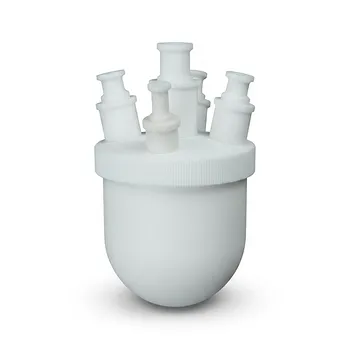
- High Purity Large Capacity PTFE Flask Custom Multi Neck Chemical Reaction Vessel for Corrosive Laboratory Synthesis and Industrial Processing
- High Performance Customizable PTFE Reaction Vessel and Corrosion Resistant Polytetrafluoroethylene Flask for Chemical Laboratory Use
- Custom PTFE Flask 250ml High Purity Fluoropolymer Laboratory Vessel for Chemical Research
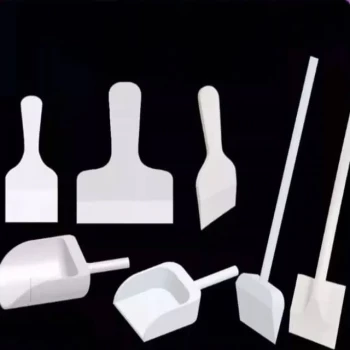
- Customizable PTFE Scrapers and Shovels for Demanding Applications
- High Purity Custom PTFE Reaction Cell Electrolytic Tank for Semiconductor and Polysilicon Industrial Applications
People Also Ask
- What are the technical advantages of using high-pressure PTFE reaction vessels during metal digestion? Expert Insights.
- Why are custom PTFE laboratory vessels and complex apparatus manufactured via sintering and CNC machining rather than conventional melt-injection molding?
- Why are high chemical resistance reaction vessels required in 4-SBD synthesis? Ensure High-Purity Material Inertness
- Why use PFA or PTFE for WO3-x acidification? Ensure high-purity nanocrystals and prevent metallic contamination.
- Why are high-performance pressure-resistant reaction vessels required for oxygen-assisted hydrothermal conversion at 150 °C?