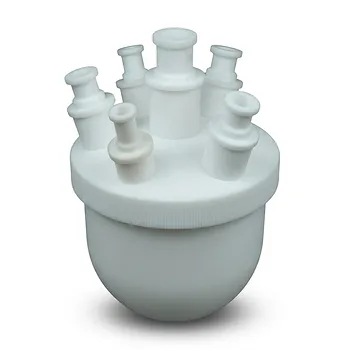
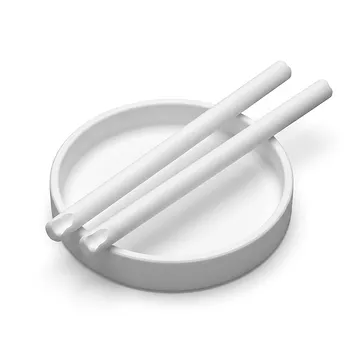
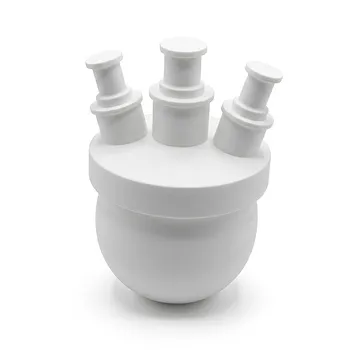
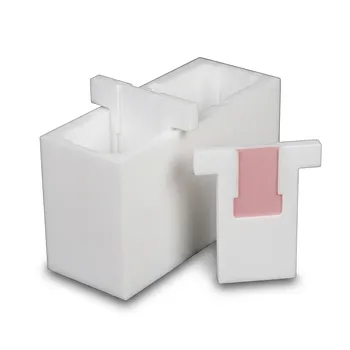
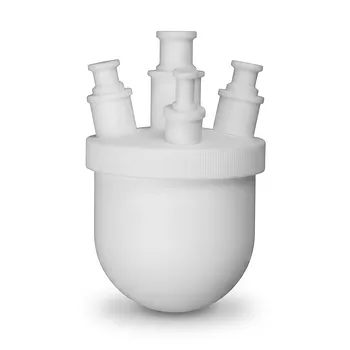
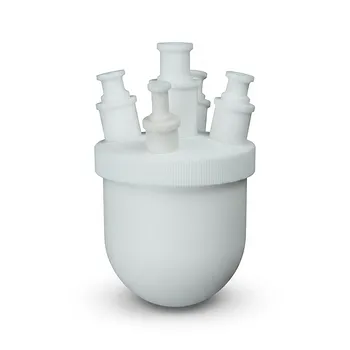
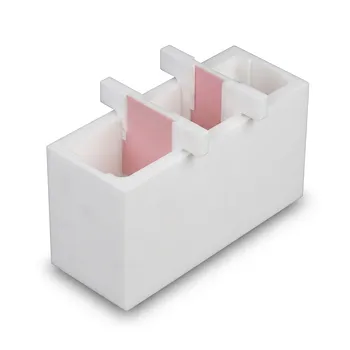
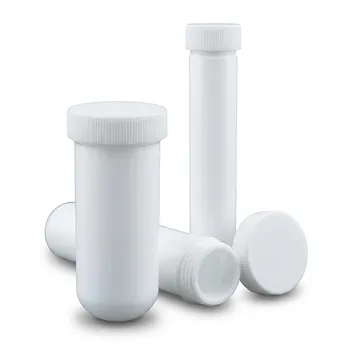
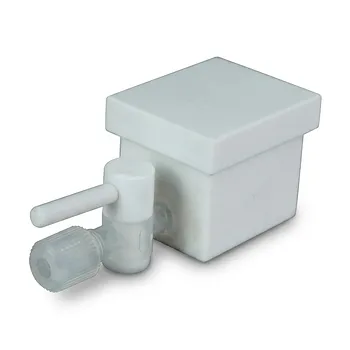
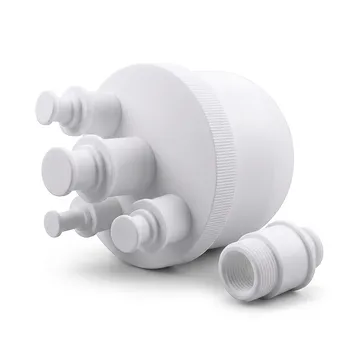
Custom PTFE laboratory vessels are not usually injection-molded because PTFE does not become a freely flowing liquid when heated. Its exceptionally high molecular weight, linear molecular structure, and crystallinity produce an extreme melt viscosity above its melting point, around 327 °C. Instead, manufacturers cold-compress PTFE powder, sinter it into a dense solid, and use precision CNC machining to create the final vessel or apparatus.
PTFE behaves more like a high-performance powder that must be consolidated than like a conventional melt-processable plastic. Sintering creates the solid billet, while CNC machining provides the dimensional accuracy and complex geometry required for specialized laboratory components.
Why Conventional Injection Molding Fails
PTFE Has an Exceptionally High Molecular Weight
Standard, unmodified PTFE has a molecular weight that can exceed 10,000,000. Its long, unbranched molecular chains become highly entangled, making movement under heat extremely difficult.
Most thermoplastics become low-viscosity melts that can be pushed through a nozzle and into a mold. PTFE remains an extremely stiff, high-viscosity material even above its melting point.
Fluorine Atoms Shield the Polymer Backbone
PTFE's carbon backbone is tightly surrounded by electronegative fluorine atoms. This structure gives PTFE its outstanding chemical resistance, low friction, and thermal stability, but it also restricts molecular mobility.
As a result, heating PTFE does not produce the type of fluid flow required for standard injection molding. The material softens and forms a viscous gel rather than behaving like a conventional liquid polymer.
Melting Does Not Create Practical Flow
The critical distinction is between melting and flowing. PTFE can undergo a crystalline phase transition above its melting point, but its melt viscosity remains so high that ordinary injection pressures cannot move it through runners, gates, and thin mold cavities.
This is why conventional melt extrusion and injection molding are unsuitable for high-molecular-weight PTFE. The issue is not simply that PTFE requires a higher processing temperature; its rheology is fundamentally different.
How Sintering Produces the PTFE Starting Form
Powder Is Compressed Before Heating
PTFE resin is supplied as granular or fine powder rather than as a conventional injection-molding pellet. Manufacturers first cold-compress the powder at room temperature into a preform, billet, tube, or other near-net shape.
Compression gives the loose particles sufficient contact and mechanical stability for the subsequent thermal process. It does not make the PTFE flow like a melt.
Heat Fuses the Particles
During sintering, the compressed preform is heated above PTFE's melting point under a controlled thermal cycle. The individual particles fuse and coalesce into a continuous, dense polymer structure.
The process is comparable in principle to powder consolidation methods used for other difficult-to-melt materials. Proper sintering is essential for strength, leak tightness, surface quality, and resistance to chemical penetration.
The Result Is a Machinable Billet
After cooling, the result is a solid PTFE block, rod, tube, or molded blank. This stock retains the material characteristics that make PTFE valuable in laboratory service, including high chemical resistance, thermal endurance, and low surface reactivity.
The preform may have a useful basic shape, but it generally does not contain the intricate details or tight tolerances of the finished apparatus.
Why CNC Machining Is Used for Custom Apparatus
Custom Laboratory Geometry Is Often Non-Standard
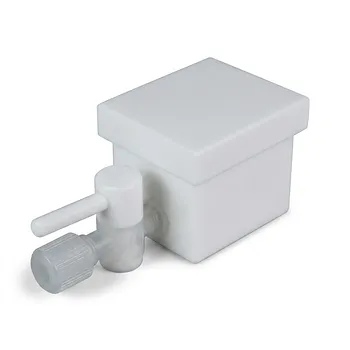
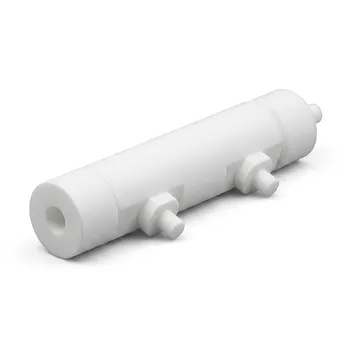
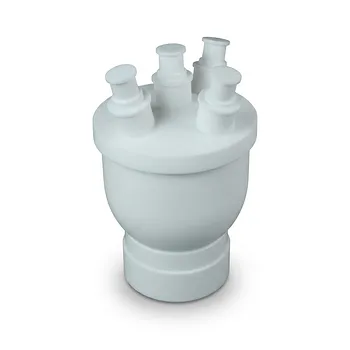
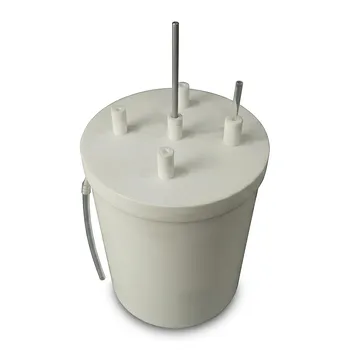
Specialized laboratory equipment may include reaction vessels, electrochemical cells, digestion vessel liners, custom valves, transfer fittings, and unusual fixtures. These parts are often produced in low volumes and may be designed for a particular experiment or instrument.
Creating a dedicated injection mold for every variation would be costly and slow. CNC machining can produce different geometries directly from sintered PTFE stock without requiring a specialized mold for each design.
Machining Provides Dimensional Control
CNC equipment can create controlled bores, threads, sealing faces, pockets, channels, mounting features, and other detailed geometries. It also allows manufacturers to hold the tolerances required for mating components and leak-resistant fluid paths.
For laboratory apparatus, dimensional accuracy is often more important than achieving the lowest possible production cost. A poorly controlled interface can cause leakage, contamination, or unreliable experimental results.
Machining Protects the Material's Functional Role
PTFE is often used as the chemically resistant or low-contamination surface in contact with reagents, samples, gases, or solvents. Starting from properly sintered stock and machining the final geometry helps preserve a dense, homogeneous material structure.
Machining also avoids forcing the polymer through narrow injection gates or complex flow paths, where conventional processing would be impractical for high-molecular-weight PTFE.
Why the Manufacturing Route Fits Laboratory Needs
Low-Volume Production Is Economically Rational
Injection molding is most efficient when many identical parts are required. The mold, tooling, setup, and validation costs can be distributed across a large production run.
Custom laboratory vessels are often made in small quantities. Compression, sintering, and CNC machining usually provide a more practical route for prototypes, one-off parts, replacement components, and specialized research equipment.
Complex Parts Can Be Modified More Easily
Research designs frequently change after testing. A machined PTFE component can be revised by adjusting the CNC program or using a different billet size.
An injection-molded design would generally require mold modification or entirely new tooling, increasing both lead time and cost.
PTFE Supports Demanding Chemical Service
Sintered and machined PTFE is selected where resistance to aggressive chemicals, low friction, thermal stability, and low surface interaction are important. These properties are particularly valuable in vessels, liners, fittings, and components exposed to corrosive laboratory environments.
The manufacturing method therefore supports the application: it makes difficult geometries possible while retaining the properties that motivated the choice of PTFE.
Understanding the Trade-offs
Machining Produces Material Waste
CNC machining removes material from a larger sintered blank. Complex parts can therefore generate substantial chips and scrap, especially when the final geometry differs significantly from the starting billet.
This is less material-efficient than molding near-net-shape parts. The additional waste is often accepted because custom PTFE components are produced in limited quantities and require specialized geometry.
Production Can Be Slower
Sintering requires controlled heating and cooling, and CNC machining adds programming, setup, inspection, and finishing steps. The complete process is generally slower than molding a high-volume part from a melt-processable plastic.
The trade-off is greater design flexibility and the ability to manufacture parts that conventional molding cannot produce.
Dimensional Changes Must Be Managed
PTFE can undergo dimensional change during sintering and may exhibit creep or deformation under sustained load and elevated temperature. Manufacturers must account for material behavior during preform design, thermal processing, machining, and service.
Critical applications may require careful tolerance planning, appropriate support, and inspection after machining.
Injection Molding Is Not Always Impossible for Every PTFE-Based Material
The limitation applies primarily to high-molecular-weight, unmodified PTFE homopolymer. Certain modified fluoropolymers or lower-molecular-weight PTFE-related materials may be processed using different techniques.
Those materials should not be treated as interchangeable with standard PTFE. The selected resin must still meet the application's chemical, thermal, purity, and mechanical requirements.
Making the Right Choice for Your Goal
The correct manufacturing route depends on the material grade, production volume, geometry, and required performance.
- If your primary focus is chemical resistance and material purity: Use properly sintered PTFE stock and controlled machining to preserve a dense, chemically resistant contact surface.
- If your primary focus is complex, low-volume geometry: Choose CNC machining from a sintered billet because it avoids the cost and inflexibility of dedicated injection tooling.
- If your primary focus is high-volume production: Evaluate modified fluoropolymers or other melt-processable materials, provided they satisfy the application's performance requirements.
- If your primary focus is dimensional reliability: Specify the sintering process, machining tolerances, thermal conditions, and post-machining inspection together rather than treating CNC accuracy as the only controlling factor.
Understanding PTFE's melt behavior makes the manufacturing choice clear: sintering creates the usable solid form, and CNC machining turns that form into a precise laboratory instrument.
Summary Table:
| Aspect | Sintering + CNC Machining | Conventional Injection Molding |
|---|---|---|
| Material Behavior | PTFE powder is compressed and fused; no free flow. | PTFE does not flow like a melt; impractical. |
| Production Volume | Ideal for low-volume, custom parts. | Best for high-volume, identical parts. |
| Design Flexibility | High; easy to modify via CNC programs. | Low; requires new molds for changes. |
| Tolerances | Excellent; precise machining. | Good but limited by melt flow. |
| Cost for Custom Parts | Lower for small quantities. | High due to mold costs. |
Need custom PTFE labware? KINTEK specializes in high-performance fluoropolymers, offering precision CNC machining and sintering. From standard vessels to complex apparatus, we deliver tailored solutions for your lab. Contact us today for a quote!
Related Products
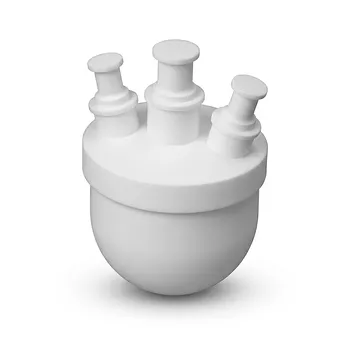
- Custom PTFE Flask Large Volume 18L Corrosion Resistant Low Background High Purity Chemical Vessel
- High Performance Customizable PTFE Reaction Vessel and Corrosion Resistant Polytetrafluoroethylene Flask for Chemical Laboratory Use
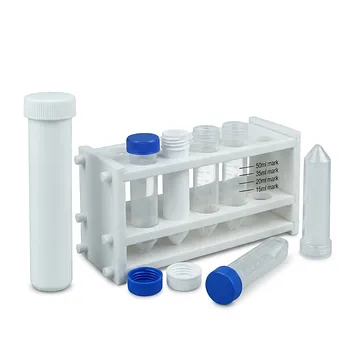
- Custom PTFE Digestion Tubes and High Purity Polytetrafluoroethylene Centrifuge Vessels 60ml for Trace Analysis
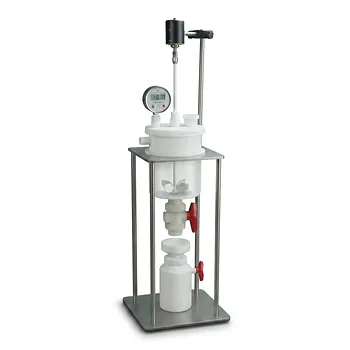
- Customizable PTFE Reaction Vessel with Electric Stirring Paddle and Buchner Funnel Vacuum Filtration System
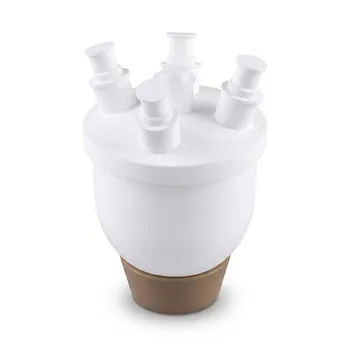
- Custom Multi Neck PTFE Flask 18L Laboratory Chemical Reactor Vessel for High Purity Synthesis and Stirring Applications
People Also Ask
- Why is fluorination via PTFE degradation thermally different from oxide formation when processing reactive metal formulations in custom PTFE vessels? Key safety insights for high-risk reactions
- How do hydrogen-containing and halogenated solvents differ in their ability to cause swelling in PTFE laboratory vessels? Key Differences Explained
- Why do PTFE fluoropolymer laboratory vessels and containers exhibit superior chemical resistance against harsh solvents and corrosive acids compared to standard plastic labware? Discover the molecular secrets
- How do Polytetrafluoroethylene (PTFE) containers perform regarding gas permeation? Expert Insights on Solvent Absorption
- What are the key steps for structural integrity in molded PTFE lab reaction vessels? Master fine powder processing.