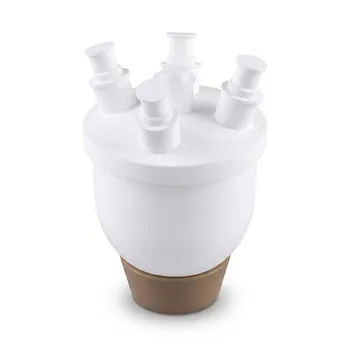
PTFE fluoropolymer labware resists harsh chemicals because its molecular structure is exceptionally difficult to break or penetrate. PTFE has a fully fluorinated carbon backbone, with strong carbon-fluorine bonds that require substantially more energy to break than the carbon-hydrogen bonds common in conventional plastics. Fluorine atoms also form a protective sheath around the carbon chain, limiting access by concentrated acids, aggressive solvents, and other reagents.
The key advantage is molecular protection: strong C-F bonds provide a chemically stable backbone, while tightly arranged fluorine atoms shield that backbone from attack. This makes PTFE and related fluoropolymers far less likely than standard plastic labware to dissolve, swell, leach, or degrade.
Why PTFE Resists Chemical Attack
Strong Carbon-Fluorine Bonds
Fluorine is the most electronegative element, with a Pauling electronegativity of approximately 4.0. Its bond with carbon is highly polarized and has a bond energy of roughly 116 kcal/mol, or about 507 kJ/mol.
That bond is considerably stronger than the carbon-hydrogen bonds prevalent in materials such as polyethylene and polypropylene. Because chemical degradation often begins by breaking or rearranging polymer bonds, PTFE's backbone is unusually resistant to these reactions.
A Protective Fluorine Sheath
In PTFE, fluorine atoms surround the carbon backbone in a tightly packed arrangement. This creates both electronic and steric protection: chemical species encounter the fluorinated outer surface before they can reach the underlying carbon chain.
The result is similar to placing a durable protective coating around a structural core, except the protection is built into the polymer's molecular architecture. Reagents have limited ability to penetrate the chain or abstract fluorine atoms under ordinary laboratory conditions.
Low Surface Energy
PTFE is strongly hydrophobic and oleophobic, giving it very low surface energy. Liquids generally do not wet, adhere to, or readily penetrate the material's surface.
This property helps reduce chemical absorption and sample carryover. It also contributes to PTFE's resistance to swelling and contamination when used for vessels, liners, fittings, and transfer components.
Why Standard Plastic Labware Performs Differently
Hydrocarbon Backbones Are More Vulnerable
Many standard plastics are built primarily from carbon-hydrogen or carbon-carbon frameworks. These polymers can perform well with routine laboratory chemicals, but their bonds and molecular structures are more susceptible to oxidation, solvent penetration, swelling, and chain degradation.
Harsh acids, strong oxidizers, and organic solvents can attack vulnerable sites in those materials. Once the polymer chain is disrupted, the labware may soften, crack, discolor, deform, or release extractable substances into the sample.
Solvent Resistance Depends on Polymer Compatibility
A plastic does not need to visibly dissolve to be chemically unsuitable. Solvent uptake can cause swelling, dimensional changes, loss of strength, or contamination even when the container remains intact.
PTFE's tightly fluorinated structure gives aggressive solvents fewer opportunities to interact with the polymer. This is why PTFE vessels are commonly selected for chemical storage, digestion, trace analysis, and fluid handling where ordinary plastics may change dimension or compromise sample purity.
Greater Protection Against Leaching
PTFE is highly nonreactive and has very low extractability under many laboratory conditions. It is therefore less likely to contribute contaminants or absorb sample constituents than more chemically interactive plastics.
This advantage is especially important in trace analysis, where a small amount of leached material or absorbed analyte can affect the result. Chemical inertness protects both the equipment and the integrity of the sample.
How Fluoropolymer Structure Supports Thermal Stability
Stable Performance at Elevated Temperatures
The same strong C-F bonds that resist chemical attack also help PTFE withstand demanding thermal environments. PTFE products are often used for heated digestion and aggressive reagent handling because they retain useful chemical stability at temperatures where many commodity plastics soften or degrade.
Typical continuous-use limits are application-dependent, and approximately 260°C is commonly cited for PTFE service. Actual limits depend on load, pressure, exposure time, product design, and the specific chemical environment.
Reduced Risk of Chemical Decomposition
At elevated temperature, reaction rates generally increase and polymer chains become more vulnerable to oxidation or rearrangement. PTFE's fluorinated backbone provides greater resistance to these processes than the hydrocarbon backbones of many conventional plastics.
This does not make PTFE indestructible. Thermal decomposition, particularly at excessive temperatures, can produce hazardous fumes, so manufacturer limits and appropriate ventilation remain essential.
PTFE, PFA, and Related Fluoropolymers
Shared Chemical Advantages
PTFE and PFA are both perfluorinated fluoropolymers with extensive fluorine coverage around the carbon backbone. They therefore provide strong resistance to many acids, bases, oxidizing agents, reducing agents, and organic solvents.
Their low surface energy and chemical nonreactivity also make them useful for vessels, liners, tubing, fittings, crucibles, and digestion containers.
Important Differences in Use
PTFE generally offers outstanding chemical and temperature resistance, while PFA is often chosen when greater melt-processability, transparency, or fabricated geometry is important. The correct choice depends on the vessel's temperature, pressure, mechanical requirements, chemical exposure, and analytical demands.
Chemical resistance should therefore be evaluated for the exact fluoropolymer grade and operating conditions rather than assumed from the word “fluoropolymer” alone.
Understanding the Trade-offs
PTFE Is Not Resistant to Every Chemical
PTFE resists most laboratory chemicals, but exceptions exist. Elemental fluorine, certain highly reactive fluorinating agents, molten alkali metals, and some specialized high-temperature conditions can attack or damage it.
Compatibility charts should be consulted for the exact reagent, concentration, temperature, exposure duration, and pressure.
Mechanical Properties Still Matter
Chemical inertness does not eliminate mechanical limitations. PTFE can creep under sustained load, has relatively low stiffness compared with some engineering plastics, and may deform if used outside its intended temperature or pressure range.
A chemically compatible vessel can still fail if it is mechanically overloaded or exposed to rapid thermal cycling.
Fabrication Can Affect Performance
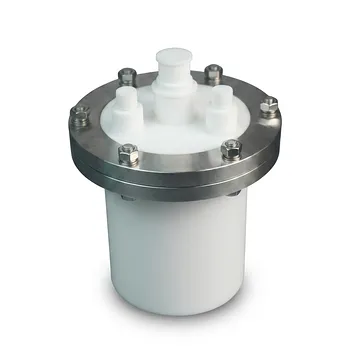
Seals, caps, valves, welds, reinforcing structures, and other non-PTFE components may determine the practical chemical resistance of an assembly. A PTFE-lined vessel, for example, may include hardware made from a less resistant material.
The complete product construction must be reviewed, not only the material named in the product description.
Making the Right Choice for Your Goal
Material selection should consider the entire operating environment, not only the identity of the reagent.
- If your primary focus is maximum resistance to acids and aggressive solvents: Choose a suitable PTFE or PFA product after checking compatibility at the intended concentration and temperature.
- If your primary focus is trace analytical purity: Prefer low-extractable fluoropolymer labware and verify that caps, seals, fittings, and other contacting parts are also chemically compatible.
- If your primary focus is heated digestion or high-temperature handling: Confirm the product's temperature, pressure, and mechanical-load limits in addition to its chemical-resistance rating.
- If your primary focus is long-term chemical storage: Evaluate permeation, closure materials, dimensional stability, and exposure duration rather than relying solely on PTFE's general inertness.
PTFE's superior chemical resistance comes from a strong, tightly shielded fluorinated backbone that protects laboratory vessels from the chemical and thermal conditions that degrade ordinary plastics.
Summary Table:
| Property | PTFE Fluoropolymer Labware | Standard Plastic Labware |
|---|---|---|
| Chemical Resistance | Exceptional against most acids, bases, and solvents | Limited; may swell, leach, or degrade |
| C-F Bond Strength | ~116 kcal/mol (507 kJ/mol) | Weaker C-H bonds |
| Molecular Protection | Fluorine sheath shields backbone | Vulnerable hydrocarbon backbone |
| Surface Energy | Very low (hydrophobic & oleophobic) | Higher, allows wetting/absorption |
| Thermal Stability | Up to ~260°C continuous use | Lower heat tolerance |
| Leaching/Extractables | Very low, ideal for trace analysis | Higher risk of contaminating samples |
| Representative Polymers | PTFE, PFA | Polyethylene, polypropylene |
Upgrade your lab with KINTEK's high-performance PTFE and PFA labware. Our products withstand even the harshest chemicals, ensuring reliable results and long-lasting durability. Whether you need beakers, digestion vessels, or custom-machined parts, our expert team is ready to assist. Contact us today to discuss your requirements and experience the KINTEK difference. Contact us now
Related Products
- Custom PTFE Flask Large Volume 18L Corrosion Resistant Low Background High Purity Chemical Vessel
- Custom PTFE Flask 250ml High Purity Fluoropolymer Laboratory Vessel for Chemical Research
- High Purity Opaque White PTFE Chemical Storage Barrels and Customizable Fluoropolymer Reaction Sampling Vessels
- Custom PTFE Continuous Reaction Bottles Virgin Fluoropolymer High Purity Low Background Synthesis Vessels
- Laboratory PTFE Three Neck Reaction Flask Corrosion Resistant 2000ml Low Background Fluoropolymer Vessel
People Also Ask
- How do hydrogen-containing and halogenated solvents differ in their ability to cause swelling in PTFE laboratory vessels? Key Differences Explained
- How do Polytetrafluoroethylene (PTFE) containers perform regarding gas permeation? Expert Insights on Solvent Absorption
- What are the key steps for structural integrity in molded PTFE lab reaction vessels? Master fine powder processing.
- What key inherent material properties make PTFE fluoropolymers suitable for demanding lab applications? Discover chemical inertness, thermal stability, and more for reliable storage and reactions.
- Are PTFE Laboratory Containers and Fluid Fittings Resistant to All Chemical Solvents? Discover Key Exceptions and Safe Handling Tips