Fluorination through PTFE degradation is thermally more aggressive because the reaction product does not remain as a stable, protective solid layer. Aluminum oxidation produces aluminum oxide, which forms a persistent passivation layer and slows further oxygen transport. When reactive aluminum instead consumes fluorine-containing species generated from degrading PTFE, aluminum trifluoride forms and can sublime at a much lower temperature, removing that barrier and enabling rapid, self-heating reactions that may exceed 3000 °C.
The key difference is product behavior: oxide formation builds a thermally persistent diffusion barrier, while fluorination can convert the barrier into a volatile fluoride. In a PTFE vessel, this creates a reaction pathway that can overwhelm the polymer's approximately 260 °C continuous-use limit.
Why Oxidation Usually Becomes Self-Limiting
Oxide formation creates a physical barrier
Reactive metals such as aluminum rapidly form aluminum oxide when exposed to oxygen. The resulting layer separates the remaining metal from the oxidizing environment and makes continued diffusion increasingly difficult.
This is the basis of passivation. As the oxide thickens, oxygen and metal ions must travel farther through a relatively stable solid before the reaction can continue.
Aluminum oxide remains thermally persistent
Aluminum oxide has a boiling point near 2977 °C. Its high-temperature stability helps it remain present as a solid reaction product over a broad range of processing conditions.
The oxide therefore tends to retain the reaction products at the metal surface rather than continuously removing them. Although oxidation is exothermic and can become very hot, the growing layer commonly limits the rate at which fresh metal is exposed.
Heat is absorbed without eliminating the barrier
At sufficiently high temperatures, energy can be consumed in heating and eventually vaporizing reaction products. However, the important kinetic effect is that aluminum oxide remains a condensed, stable barrier through much of the reaction.
The reaction therefore has a built-in mechanism for slowing itself: the more oxide forms, the harder it becomes for oxygen to reach unreacted aluminum.
Why PTFE-Related Fluorination Behaves Differently
PTFE degradation supplies reactive fluorine-containing species
PTFE is highly stable under normal laboratory use, but heating beyond its operating envelope can cause thermal decomposition. In the presence of an active metal, fluorine-containing decomposition products can be consumed by the metal rather than remaining in the gas phase.
This should not be interpreted as PTFE simply releasing a large reservoir of free molecular fluorine. The relevant process is the reaction between the metal and reactive fluorocarbon or fluorine-containing fragments generated during polymer degradation.
Aluminum trifluoride is comparatively volatile
For aluminum, the corresponding fluoride is aluminum trifluoride, AlF3. The primary reference identifies a sublimation temperature near 1291 °C, substantially below the approximately 2977 °C boiling point of aluminum oxide.
As AlF3 leaves the reaction interface by sublimation, it does not remain as a thick, mechanically continuous solid coating. The metal surface can therefore remain exposed to additional fluorine-containing species.
Removing the barrier accelerates heat release
The reaction can proceed faster when the product is continuously removed from the interface. Faster conversion exposes more reactive metal, which releases more heat and produces more decomposition products from the surrounding PTFE.
This creates a positive thermal feedback loop: reaction heat drives polymer degradation, degradation supplies additional reactive fluorine-containing species, and fluoride volatilization prevents effective passivation.
The resulting temperatures exceed the vessel's design envelope
Once the reaction becomes self-sustaining, local temperatures can rise above 3000 °C, even though the PTFE vessel itself is intended for continuous service only near 260 °C.
That difference is central to the hazard. A fluoropolymer vessel may be chemically excellent for ordinary synthesis or digestion, yet be unsuitable for a reactive metal-fluoropolymer mixture capable of generating a localized high-temperature event.
Why Vessel Ratings Do Not Predict This Reaction
Continuous-use temperature is an application limit
The approximately 260 °C maximum continuous-use rating for PTFE and PFA describes sustained service under specified mechanical, chemical, and environmental conditions. It is not a guarantee that the material will contain an internally generated reaction at several thousand degrees.
A vessel can remain intact during ordinary heating while still failing rapidly if a reactive mixture creates a concentrated hot spot.
Melting and degradation are separate concerns
PTFE melts around 320–340 °C, but its extreme melt viscosity means it does not flow like a conventional thermoplastic. It becomes an intractable gel rather than a readily processable melt.
Thermal decomposition is a further limit. The supplementary reference indicates that PTFE remains relatively stable into the several-hundred-degree range, with gross decomposition occurring above approximately 525 °C under the cited conditions. A fluorination reaction can exceed that range by a wide margin.
PFA offers different fabrication advantages, not immunity
PFA melts at approximately 302–310 °C and is melt-processable, which makes it useful for intricate molded laboratory components. It shares the approximately 260 °C continuous-use rating, however, so its processing advantages do not make it inherently suitable for uncontrolled metal-fluoropolymer reactions.
The distinction is between manufacturing and service properties. A material may be easier to fabricate while having the same fundamental limitation when exposed to a highly exothermic reaction.
Understanding the Trade-offs
Oxide passivation is not an absolute safety mechanism
Oxidation can still become violent when the metal is finely divided, the surface area is high, or heat removal is inadequate. A passivation layer reduces reaction rate; it does not eliminate the possibility of runaway combustion or thermite-like behavior.
The comparison with fluorination concerns the expected behavior of the reaction product, not a claim that oxidation is always benign.
Fluoride volatility depends on conditions
The precise rate and temperature profile depend on metal particle size, PTFE-to-metal ratio, mixing, confinement, pressure, heat transfer, atmosphere, and the chemistry of the decomposition products.
The approximate AlF3 sublimation temperature should therefore be treated as a thermodynamic reference, not as a guaranteed onset temperature for every formulation.
Confinement can increase the consequences
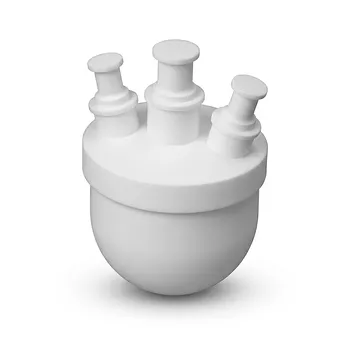
A custom PTFE vessel can retain gases and reaction products long enough for pressure and temperature to rise together. The fluoropolymer may then soften, decompose, rupture, or become a source of additional fuel for the reaction.
Machined or compression-sintered PTFE components can provide excellent purity and chemical containment for intended applications, but fabrication quality does not change the polymer's thermal decomposition chemistry.
Ordinary compatibility data are insufficient
Chemical compatibility charts generally address corrosion, permeation, swelling, and routine temperature exposure. They do not necessarily evaluate a reactive metal acting as a chemical reductant toward the fluoropolymer itself.
For active-metal formulations, compatibility must include reaction energetics, product volatility, gas generation, heat transfer, pressure relief, and credible runaway scenarios.
How to Apply This to Your Project
The correct design decision depends on whether the formulation can chemically attack the fluoropolymer, not merely whether the vessel is compatible with the solvent.
- If your primary focus is routine synthesis or digestion below the rated temperature: PTFE or PFA can provide strong chemical containment, provided the formulation does not contain an active metal capable of reducing the polymer.
- If your primary focus is reactive metal processing: Treat PTFE as a potential reactant and evaluate the metal-fluoropolymer pair for exothermic fluorination, volatile fluoride formation, pressure generation, and localized temperatures.
- If your primary focus is vessel selection: Use the continuous-use rating as an upper service boundary, not as evidence that the vessel can contain a reaction whose products can drive temperatures above 3000 °C.
- If your primary focus is experimental validation: Start with a formal reaction-hazard assessment and small-scale, remotely operated testing using materials and containment designed for the credible maximum temperature and pressure.
The governing principle is simple: a fluoropolymer vessel is a container only while the chemistry remains within its thermal and chemical service envelope; with reactive metals, PTFE can become part of the reaction itself.
Summary Table:
| Aspect | Oxide Formation | PTFE-Related Fluorination |
|---|---|---|
| Reaction product | Stable oxide layer | Volatile fluoride (e.g., AlF3) |
| Product stability | Persistent at high temps | Sublimes ~1291°C (AlF3) |
| Barrier effect | Passivation slows reaction | No durable barrier; accelerates |
| Temperature potential | Limited by passivation | Can exceed 3000°C |
| Vessel risk | Within design ratings | May exceed PTFE limits (~260°C) |
| Reaction control | Self-limiting | Uncontrolled positive feedback |
Ensure the safety and integrity of your high-temperature processes with KINTEK's expert engineering solutions. Our PTFE and PFA labware, custom-machined to your exact specifications, is designed for high-performance fluoropolymer applications. Contact our specialists today at #ContactForm to discuss your requirements and get a tailored consultation.
Related Products
- Custom PTFE Flask Large Volume 18L Corrosion Resistant Low Background High Purity Chemical Vessel
- High Purity PTFE Corrosion Resistant Reaction Vessel with Luer Fittings and Caps for Trace Analysis
- High Purity PTFE Reaction Vessel with Electric Stirring System and Customizable 5L Tank including Buchner Funnel Filtration Assembly
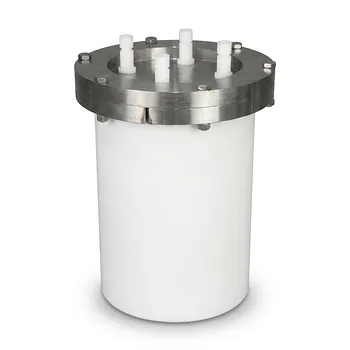
- PTFE Hydrofluoric Acid Dilutor and Corrosion Resistant Reaction Vessel with Flange Sealing White PTFE Raw Material Storage Barrel
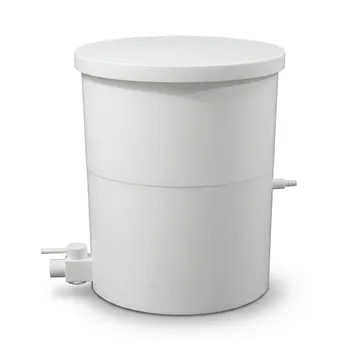
- Large Scale PTFE Double Layer Reaction Tank with Integrated Filter Plate High Purity Polytetrafluoroethylene Chemical Vessel 25L
People Also Ask
- How do hydrogen-containing and halogenated solvents differ in their ability to cause swelling in PTFE laboratory vessels? Key Differences Explained
- Why do PTFE fluoropolymer laboratory vessels and containers exhibit superior chemical resistance against harsh solvents and corrosive acids compared to standard plastic labware? Discover the molecular secrets
- How do Polytetrafluoroethylene (PTFE) containers perform regarding gas permeation? Expert Insights on Solvent Absorption
- What are the key steps for structural integrity in molded PTFE lab reaction vessels? Master fine powder processing.
- What key inherent material properties make PTFE fluoropolymers suitable for demanding lab applications? Discover chemical inertness, thermal stability, and more for reliable storage and reactions.