The node-and-fibril network is the performance engine of an ePTFE membrane. Dense PTFE nodes provide structural stability, while fine fibrils connect them into a three-dimensional porous web. The spacing between nodes and the geometry of the fibrils govern effective pore size, porosity, permeability, particle retention, and resistance to clogging—while the PTFE chemistry supplies exceptional inertness for aggressive reagents and high-purity samples.
Core takeaway: ePTFE performance is a balance between open volume and controlled restriction. Larger or more widely spaced structures generally increase flow, while finer spacing improves retention; selecting the correct microstructure is therefore essential for reproducible filtration without excessive pressure drop, extractables, or sample contamination.
How the Node-and-Fibril Structure Controls Filtration
Nodes provide the structural framework
The nodes are relatively dense agglomerations of PTFE crystallites. They act as the load-bearing elements of the membrane and prevent the porous network from collapsing under handling, pressure, or thermal stress.
The nodes do not form a continuous solid sheet. Instead, they are separated by open regions and linked by fibrils, creating a membrane that combines mechanical integrity with substantial void volume.
Fibrils create the connected flow path
The fibrils are thin, oriented PTFE strands extending between nodes. Together, they form the continuous pathways through which liquid or gas travels.
Because the pathways are not straight channels, contaminants encounter repeated changes in direction and constrictions. This tortuous path supports particle capture while preserving much higher flow than a dense, nonporous PTFE structure could provide.
Internodal distance influences effective pore size
The distance between adjacent nodes—often called the internodal distance—is a major structural parameter affecting the membrane’s effective pore size and retention behavior.
A finer node spacing generally creates smaller openings and stronger particle retention. A more open structure generally lowers flow resistance, but may permit larger particles or droplets to pass unless the fibril arrangement provides sufficient interception.
Expansion determines network uniformity
Mechanical expansion creates the node-and-fibril architecture. The expansion conditions influence node shape, fibril orientation, internodal distance, and overall void fraction.
Uniaxial and biaxial expansion can produce different orientations within the porous matrix. Properly controlled expansion helps produce a more uniform structure, which is important for consistent retention and predictable pressure drop across the membrane.
Why This Matters in High-Purity Filtration
Retention is controlled by geometry, not only by nominal pore size
A membrane’s nominal pore rating is useful, but it does not describe every aspect of particle capture. The three-dimensional arrangement of nodes and fibrils determines how particles interact with the membrane surface and internal pathways.
This is why two membranes with similar stated pore ratings can differ in flow, fouling tendency, or recovery. The underlying network geometry affects the practical separation performance.
ePTFE supports surface-dominated filtration
In many microporous ePTFE applications, particles larger than the effective openings are retained primarily near the upstream surface. Solids can accumulate into a filter cake rather than penetrating deeply into the membrane matrix.
This behavior can improve particle recovery and simplify cake removal. It also helps limit irreversible entrapment, which is valuable when the retained material or filtrate must be analyzed.
Porosity enables high throughput
The open volume within the node-and-fibril network allows substantial fluid or gas transport. High porosity reduces the amount of solid polymer that the fluid must traverse, supporting high flow rates at relatively low pressure differentials.
The practical result is faster sample preparation, shorter processing times, and reduced stress on pumps or pressure-driven equipment—provided the membrane grade is matched to the contaminant load.
The structure helps manage clogging
A controlled and uniform pore network distributes incoming particles more predictably. This can delay localized blockage compared with a less uniform porous medium.
However, no microstructure eliminates fouling. High particle concentrations, poorly dispersed solids, or particles near the membrane’s retention range can still form a surface cake and increase pressure drop.
Why ePTFE Is Valuable for Aggressive Samples
The porous network retains PTFE’s chemical resistance
Expansion introduces pores without changing the fundamental chemical identity of the PTFE polymer. The resulting membrane retains PTFE’s broad resistance to solvents, acids, and other aggressive chemicals.
This makes ePTFE suitable for demanding sample-preparation workflows where cellulose, nylon, or other less resistant media may swell, degrade, or contribute extractables. Compatibility should still be confirmed for the specific chemical, concentration, temperature, pressure, and exposure time.
Low contamination is as important as retention
High-purity filtration is not successful if the membrane introduces particles, extractables, or reactive contaminants. Properly manufactured ePTFE media are valued for low particle shedding and low extractables, helping preserve sample integrity.
The node-and-fibril structure contributes to efficient separation, while the chemically inert PTFE matrix minimizes interaction with the sample. Both properties are necessary for reliable analytical results.
Hydrophobicity affects liquid handling
ePTFE is intrinsically highly hydrophobic. This is advantageous for venting applications because it can allow air or gas passage while resisting liquid water and droplets.
For aqueous liquid filtration, hydrophobicity can also make wetting difficult. A compatible wetting liquid, membrane treatment, or a purpose-designed hydrophilic ePTFE product may be required to achieve stable liquid flow.
Performance in Gas Filtration and Venting
Gas passes while particulates are intercepted
The open fibril network permits air and other gases to move through the membrane while restricting fine particulates. In vent filters, it can also help block liquid droplets when the liquid does not readily wet the hydrophobic PTFE surface.
This combination is useful for protecting containers, sensors, analytical equipment, and sterile or high-purity process environments from airborne contamination.
Flow depends on more than porosity
Gas permeability is influenced by void volume, pore geometry, membrane thickness, fibril orientation, and pressure conditions. A highly porous membrane may still exhibit significant resistance if its pathways are narrow, long, or poorly connected.
Accordingly, permeability and retention must be evaluated together rather than inferred from porosity alone.
Understanding the Trade-offs
Finer structures improve retention but can reduce flow
Reducing internodal spacing and opening dimensions generally improves capture of small particles. The penalty is higher pressure drop and a greater risk that the membrane will foul rapidly under a high contaminant load.
The best design is not necessarily the membrane with the smallest pores. It is the one that achieves the required retention while maintaining usable throughput and service life.
Higher porosity improves throughput but reduces structural margin
A more open network can provide excellent permeability and low pressure drop. Excessive openness, however, may reduce mechanical robustness or weaken retention for particles near the upper end of the target range.
Manufacturing control is therefore critical: the membrane must be open enough to flow but sufficiently supported by nodes and fibrils to withstand handling and operation.
Hydrophobicity can help or hinder
Hydrophobicity supports liquid rejection in gas-venting applications and reduces water uptake. In direct aqueous filtration, it can delay wetting or produce unstable flow.
This is an application-selection issue, not an inherent defect. The membrane surface condition and intended fluid must be considered together.
Chemical inertness is broad, not unlimited
PTFE is exceptionally resistant to many aggressive chemicals, but “chemically inert” should not be treated as a universal guarantee. Temperature, pressure, mechanical loading, contaminants, and the specific chemical system can change performance.
Critical processes should use supplier compatibility data and, where necessary, confirm extractables, recovery, and flow behavior under actual operating conditions.
Making the Right Choice for Your Goal
The correct ePTFE grade should be selected by balancing retention, permeability, chemistry, wetting behavior, and contamination control.
- If your primary focus is maximum particle retention: Choose a finer, tightly controlled node-and-fibril structure, accepting that pressure drop and fouling may increase.
- If your primary focus is high throughput: Select a more open, higher-permeability structure that still meets the required particle-retention specification.
- If your primary focus is aggressive chemical compatibility: Use ePTFE and verify compatibility under the actual concentration, temperature, pressure, and exposure conditions.
- If your primary focus is aqueous sample preparation: Confirm that the membrane is suitably wettable or use an appropriate wetting strategy before evaluating flow and recovery.
- If your primary focus is gas venting or droplet rejection: Use the intrinsic hydrophobicity of ePTFE to pass gas while restricting liquid ingress and airborne particulates.
- If your primary focus is analytical sample recovery: Favor uniform surface filtration and low-extractables media that minimize deep particle entrapment and contamination.
When the node-and-fibril geometry is matched to the fluid and contaminant, ePTFE provides a controlled combination of purity, retention, durability, and flow.
Summary Table:
| Aspect | Influence on Performance | Key Trade-off |
|---|---|---|
| Nodes | Provide mechanical stability and prevent collapse | Dense nodes reduce porosity but enhance durability |
| Fibrils | Form tortuous flow paths for particle capture | Long fibrils may increase pressure drop |
| Internodal distance | Determines effective pore size and retention | Smaller spacing improves retention but reduces flow |
| Porosity | Enables high throughput and low pressure drop | High porosity may compromise mechanical strength |
| Surface filtration | Retains particles on surface, reducing deep clogging | Requires careful operation to avoid cake buildup |
| Chemical inertness | Ensures compatibility with aggressive reagents | Confirm under actual conditions (temperature, pressure) |
Optimize your filtration with precision-engineered ePTFE membranes from KINTEK. Our PTFE and PFA labware, including filtration membranes and sample prep tools, are designed for high-purity applications, ensuring low extractables and reliable performance. Whether you need custom porous components or standard filtration devices, our end-to-end CNC machining and expert support help you achieve reproducible results. Contact us today to discuss your specific requirements and enhance your lab's efficiency!
Related Products
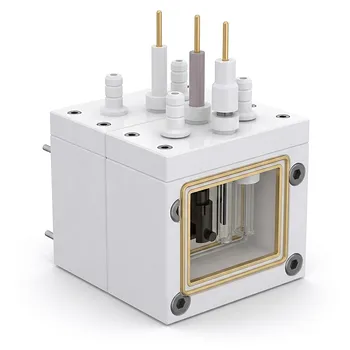
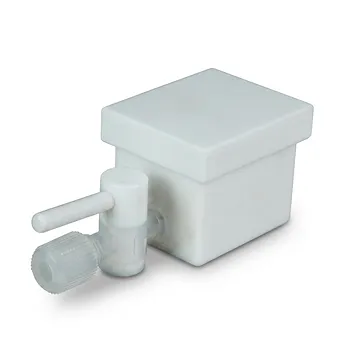
- All PTFE Exchangeable Membrane Electrochemical Cell Dual Chamber Three Electrode Photoelectrochemical Cell for Laboratory Trace Analysis
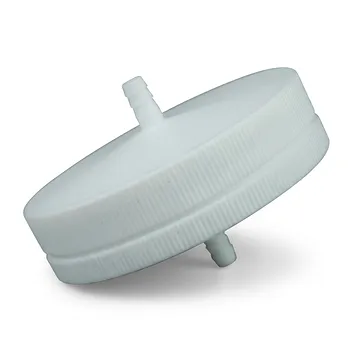
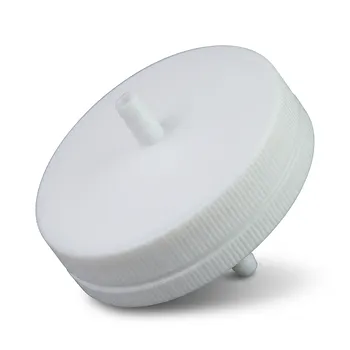
- PTFE Membrane Filter Holder for Aerosol Environmental Monitoring and Low Concentration Particulate Matter Sampling Chemical Resistant Air Quality Analysis Component
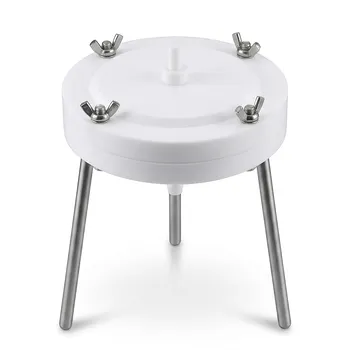
- PTFE Filter Membrane Holder for Hydrogen Chloride and Water Filtration 90mm Environmental Sampling Clamp Customizable
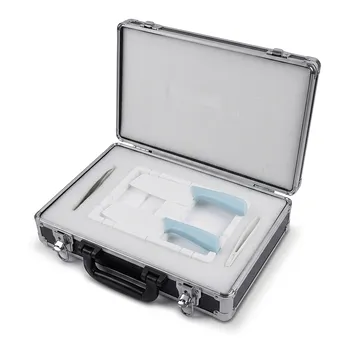
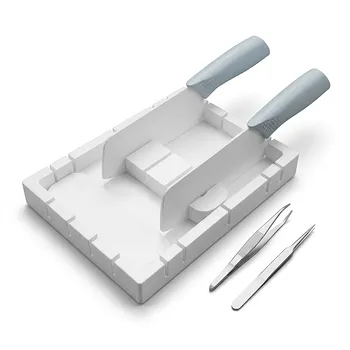
- High Purity PTFE Square Membrane Cutter Equipartition Device for Trace Analysis and Disease Control Centers Clean Non Stick No Leaching
- PTFE Filter Membrane Holder 47mm Leak Proof Corrosion Resistant Environmental Sampling Unit Customizable
People Also Ask
- What makes PTFE an ideal construction material for custom electrochemical cells and electronic analytical instrumentation housings? Discover superior chemical resistance and electrical insulation
- Why are high-performance fluoropolymers like PTFE and PFA preferred for electrochemical cells and sensitive analytical instrumentation? Achieve Reliable, Contamination-Free Measurements
- How is cyclic voltammetry performed on fluoropolymer-modified electrodes within electrochemical cells, and what factors affect energy bandgap calculations?
- What role does backbone fluorination play in modulating the solid-state microstructure and electron mobility of n-type conjugated polymers, and how are custom PTFE/PFA electrochemical cells utilized to characterize these redox-active materials?
- What material properties allow fluoropolymers to withstand extreme heat and corrosion? Discover how PTFE and PFA ensure inertness, stability, and purity for demanding lab applications.