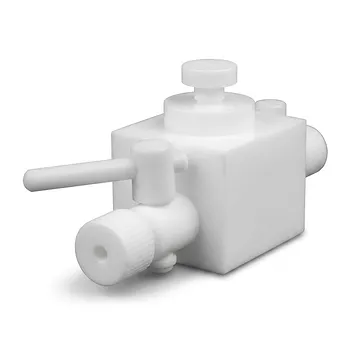
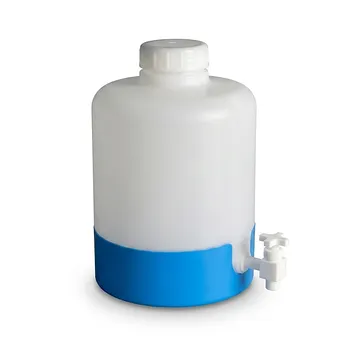
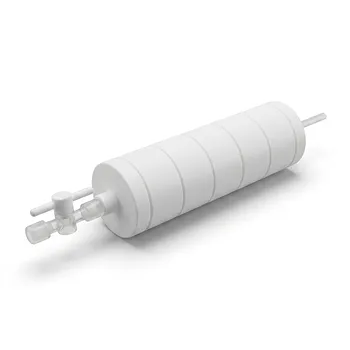
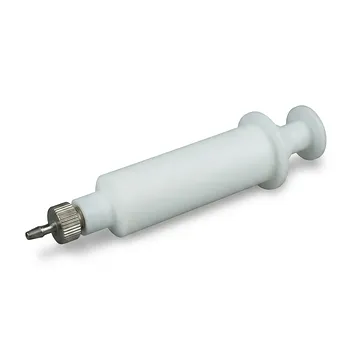
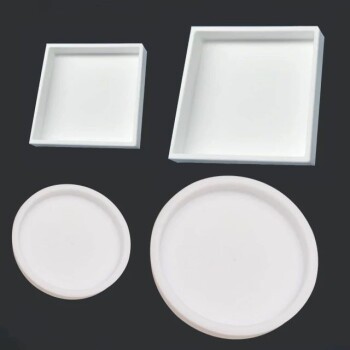
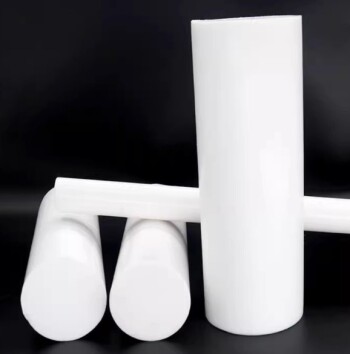
The polymerization route affects both PTFE’s form and its contamination profile. Suspension polymerization typically produces granular, high-molecular-weight PTFE with little or no surfactant, making it suitable for compression molding and CNC machining of beakers, digestion vessels, valves, and fittings. Emulsion—or dispersion—polymerization uses fluorinated surfactants to create fine powders or aqueous dispersions, enabling thin tubing, films, coatings, and other specialized forms but requiring tighter control of residual processing chemicals.
For laboratory equipment, the choice is not simply about polymer performance: it determines the resin morphology, downstream manufacturing method, and potential for extractables. Modern, compliant materials should be selected based on both the polymerization route and documented purification, processing, and regulatory controls.
How the Two Polymerization Routes Differ
Suspension polymerization produces granular resin
In suspension polymerization, TFE is reacted in water under vigorous agitation with minimal or no dispersing surfactant. The PTFE precipitates as a granular resin rather than remaining as a fine colloidal dispersion.
This resin is well suited to compression molding, billet production, and machining. Manufacturers can convert it into thick-walled laboratory vessels, blocks, valve bodies, fittings, and custom analytical components.
Emulsion polymerization produces fine particles or dispersions
Emulsion, often called dispersion polymerization in PTFE manufacturing, uses fluorinated surfactants and comparatively mild agitation. The surfactants stabilize very small PTFE particles in water.
The resulting dispersion can be concentrated for coatings or coagulated into fine powder. Fine-powder grades are commonly used in paste extrusion, while dispersions support thin films, liners, impregnated materials, and protective coatings.
How the Route Changes Laboratory Equipment
It determines the manufacturing options
Suspension-derived granular PTFE is the practical choice when the final part must be a solid, thick, dimensionally stable component. It supports machining tolerances and robust geometries that are difficult to obtain from fine-powder or dispersion grades.
Emulsion-derived materials are more appropriate when the product requires thin walls, flexible structures, films, or coatings. These forms are useful for tubing, liners, membrane-like structures, and coated laboratory surfaces.
It affects material morphology and performance
Both routes can produce high-molecular-weight PTFE, but they create different particle structures and processing behaviors. Suspension resin forms larger, granular particles; dispersion polymerization creates submicron particles that can be processed into fine powders or liquid coatings.
Consequently, the polymerization route does not automatically make one PTFE chemically superior in every application. It primarily determines how the resin can be converted into the required laboratory component.
It influences potential extractables
Emulsion polymerization historically relied on fluorinated surfactants such as ammonium perfluorooctanoate, associated with PFOA. Residual surfactants, ionic species, initiator residues, or processing aids can create concerns about leachables if they are not adequately controlled.
Suspension polymerization generally uses far less surfactant, reducing one potential source of contamination. However, “surfactant-free” does not mean automatically contaminant-free: initiators, equipment contact, post-processing, machining fluids, cleaning, and handling can also affect extractables.
Why This Matters in Trace Laboratory Work
Background contamination can compromise sensitive analysis
Trace analysis often measures analytes at very low concentrations. Even small quantities of ionic, organic, or fluorinated residues released from a vessel or fluid-contact component can increase blanks or interfere with results.
For this reason, the resin route should be considered alongside extractables testing, cleaning validation, lot controls, and documented manufacturing conditions.
High-temperature use increases the need for qualification
PTFE is valued for chemical resistance and broad temperature capability, but elevated temperature can increase the migration or degradation risk of residual low-molecular-weight species.
Applications such as microwave digestion, aggressive reagent handling, and heated fluid transfer therefore require more than a generic “PTFE” designation. The supplier should provide application-relevant purity and thermal-use information.
The finished part matters as much as the resin
A clean resin can still become contaminated during molding, sintering, machining, assembly, or packaging. CNC-machined parts may be exposed to lubricants or metal-contact residues, while coated components may contain additives unrelated to the PTFE polymer itself.
Laboratory users should evaluate the complete component, not only the polymerization method stated on a material datasheet.
Selecting PTFE for Common Laboratory Components
Beakers and digestion vessels
For thick-walled beakers, digestion vessels, and custom reaction chambers, suspension-polymerized granular PTFE is generally the better manufacturing feedstock. It supports compression molding and machining of solid shapes with minimal reliance on fluorinated surfactants.
For trace work, specify low-extractables production and require cleaning and blank-testing information where appropriate.
Tubing and flexible fluid-transfer components
Fine-powder PTFE from dispersion polymerization is useful for paste extrusion of thin-walled tubing. The route enables geometries and wall thicknesses that are not normally produced from granular molding resin.
The key controls are residual processing aids, post-extrusion cleaning, and validation of the tubing under the actual chemicals and temperatures used.
Liners, films, and coatings
Aqueous PTFE dispersions are suitable for coatings, impregnated materials, and thin protective layers. These products may provide excellent chemical resistance, but the final formulation can include surfactants, binders, pigments, or other additives.
For analytical applications, verify the composition and extractables of the coating system, rather than assuming that a PTFE label guarantees high purity.
Understanding the Trade-offs
Suspension polymerization reduces one contamination pathway
Its low-surfactant process can be advantageous for high-purity solid labware because it reduces the likelihood of fluorinated emulsifier residues in the starting resin.
Its limitation is manufacturing flexibility. Granular resin is not the preferred feedstock for every thin-walled, flexible, or coated product.
Emulsion polymerization enables specialized products
Dispersion processing is essential for fine powders, coatings, films, and thin tubing. It offers product forms that suspension resin cannot conveniently provide.
The trade-off is a greater need to control and remove surfactants, dispersion aids, ionic residues, and other processing chemicals. Historical use of PFOA-related surfactants also makes modern regulatory and supply-chain verification important.
A polymerization route is not a purity certificate
The route provides useful insight into potential residues, but it does not replace testing. Suppliers should be able to distinguish the resin’s chemistry from the manufacturing history of the finished part.
Look for documentation covering surfactant status, regulatory compliance, extractables, thermal history, cleaning, and lot traceability.
“PFOA-free” requires careful interpretation
A product described as PFOA-free may still contain other processing aids or fluorinated substances, depending on the manufacturer’s definition and documentation. It is reasonable to ask whether the claim applies to intentional additives, detectable residues, the resin, or the complete finished component.
For regulated or highly sensitive work, obtain a written material declaration and use application-specific extractables or blank testing.
Making the Right Choice for Your Goal
The best route depends on the required product form and the acceptable contamination risk.
- If your primary focus is thick-walled, machined laboratory equipment: Prefer appropriately qualified suspension-polymerized granular PTFE, with documented cleaning and extractables controls for the finished part.
- If your primary focus is thin tubing, films, or coatings: Use a qualified dispersion-derived grade, but verify residual surfactants, processing aids, additives, and post-processing cleanliness.
- If your primary focus is trace analysis or ultra-low blanks: Select modern, compliant fluoropolymer materials based on finished-component testing and supplier documentation—not polymerization route alone.
- If your primary focus is regulatory assurance: Confirm current fluorinated-surfactant controls, including the specific meaning of any PFOA- or PFAS-related claims.
The most reliable choice combines the correct PTFE morphology with documented control of residues throughout the entire manufacturing chain.
Summary Table:
| Aspect | Suspension Polymerization | Emulsion Polymerization |
|---|---|---|
| Resin Form | Granular, high molecular weight | Fine powder or aqueous dispersion |
| Surfactant Use | Minimal or none | Requires fluorinated surfactants |
| Typical Products | Solid labware (beakers, digestion vessels, CNC-machined parts) | Thin tubing, films, coatings, flexible components |
| Manufacturing Routes | Compression molding, billet, machining | Paste extrusion, coating, impregnation |
| Contamination Risk | Lower risk of surfactant residues, but still need process control | Higher risk of residual processing aids; strict cleaning needed |
| Purity Considerations | Potential for initiator or machining contaminants | Must verify removal of surfactants and additives |
| Best For | Thick-walled, high-purity solid components | Thin-walled or coated products where flexibility is key |
Choose the right PTFE for your lab with confidence. KINTEK offers a comprehensive range of PTFE and PFA labware, from granular resin-based beakers and digestion vessels to fine-powder tubing and coatings. Our materials are selected for minimal extractables, and we provide detailed documentation on purity and processing. Need custom machined parts? We specialize in custom CNC machining from high-quality suspension-polymerized PTFE. Contact our experts today to ensure your labware meets your exact purity and performance requirements. Talk to us now.
Related Products
- Custom PTFE Filtration System Acid Resistant High Purity Semiconductor Grade Chemical Processing Filter
- High Corrosion Resistant PTFE Faucet Polytetrafluoroethylene Valve for Chemical Storage Drums and Fluid Transfer Systems Customizable Industrial Grade
- PTFE PFA Vacuum Filtration System Corrosion Resistant Customizable Shatterproof Laboratory Device
- PTFE Corrosion Resistant Filter with PFA Valve Connections and Integrated Sieve Plate
- High Temperature Chemical Resistant 50ml PTFE Syringe Customized Teflon Injector with Threaded Seal for Trace Analysis
People Also Ask
- What makes PTFE filtration systems advantageous for industrial and scientific use? Unmatched Chemical & Thermal Stability
- What steps are involved in selecting the proper PTFE filter? A 4-Step Guide to Optimal Filtration
- What sizes and pore options are available for PTFE filters? Choose the Right Filter for Your Application
- What temperature resistance do PTFE filters offer? Unmatched Thermal Stability from -200°C to +260°C
- How does the hydrophobicity of PTFE filters benefit their use? Ensure Uninterrupted Gas Flow and Solvent Filtration