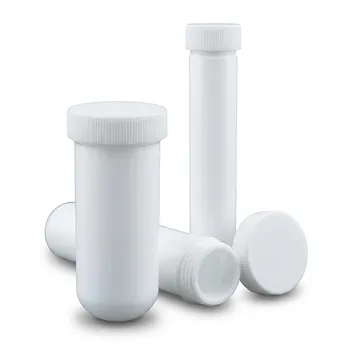
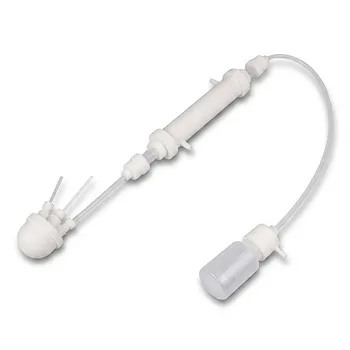
Adding a small amount of perfluoropropyl vinyl ether (PPVE) improves PTFE labware mainly by changing how the polymer processes and solidifies, not by replacing its inherent fluoropolymer chemistry. PPVE disrupts PTFE’s rigid crystalline structure and slightly lowers its melt viscosity, helping the material close residual voids more completely during sintering. The result is denser labware with lower chemical permeation, better flex-fatigue resistance, less contaminant absorption, and improved resistance to creep under load.
The central benefit of PPVE-modified PTFE is improved structural integrity without sacrificing the chemical inertness and high-temperature performance that make PTFE valuable in the first place.
Why Pure PTFE Can Have Processing Limitations
High crystallinity restricts processing
Pure PTFE has a highly ordered molecular structure and extremely high melt viscosity. Unlike many thermoplastics, it does not readily flow during conventional melt processing.
Labware is therefore commonly formed through processes such as compression molding, sintering, extrusion, or machining from semifinished stock.
Sintering can leave residual voids
During sintering, PTFE particles fuse into a solid structure. Because the material flows only minimally, a small amount of residual void volume can remain if particle boundaries do not close completely.
These microscopic voids can increase permeability, provide sites for trace chemical retention, and reduce resistance to repeated flexing.
The problem becomes important in critical labware
For ordinary handling, minor porosity may have limited practical impact. In trace analysis vessels, fluid-handling valves, tubing, and high-integrity seals, however, even small defects can affect cleanliness, leak resistance, and service life.
The material must resist both the external chemical environment and the mechanical demands created by pressure, cycling, and thermal exposure.
How PPVE Changes the Polymer Structure
Comonomers disrupt rigid chain packing
PPVE introduces a small number of bulky perfluoroalkoxy side chains into the PTFE molecular structure. These side chains interrupt the regular packing of PTFE chains and reduce excessive recrystallization.
The modified structure remains predominantly fluorinated, so the polymer retains the chemical resistance associated with PTFE while becoming less rigidly crystalline.
Lower melt viscosity improves consolidation
The modification slightly reduces melt and creep viscosity during processing. This allows the polymer structure to consolidate more effectively during sintering and related forming operations.
More complete consolidation means fewer microvoids and a denser finished component.
The amount of modification is deliberately small
PPVE is generally used at a low concentration, often below 0.5% by weight and commonly described more broadly as below 1%, depending on the resin and product classification.
The objective is to improve processing and mechanical behavior while preserving PTFE-like chemical and thermal performance.
How Modified PTFE Improves Labware Performance
Lower permeability protects against aggressive chemicals
A denser, less porous structure provides fewer pathways for chemicals to migrate through the material. This reduces permeation in vessels, valves, tubing, seals, and other fluid-contact components.
Lower permeability is particularly important when the contents are volatile, highly reactive, or held for long periods.
Reduced absorption supports trace analysis
Micropores and rough internal features can retain small amounts of chemicals after cleaning. Modified PTFE’s improved consolidation and smoother surfaces reduce opportunities for trace contaminant absorption.
This supports more reliable results in high-purity analytical workflows, where carryover can be more significant than visible contamination.
Improved flex life supports repeated cycling
PPVE-modified PTFE generally provides greater resistance to flex fatigue. This matters in flexible diaphragms, valve components, tubing, and seals that repeatedly bend or deform during operation.
The improved performance comes from reducing structural flaws and improving the polymer’s resistance to damage under repeated mechanical movement.
Better creep resistance limits cold flow
PTFE can slowly deform under sustained load, a behavior commonly called creep or cold flow. In a loaded seal or valve seat, this can reduce contact pressure and eventually compromise dimensional accuracy or leak integrity.
The modified molecular structure improves resistance to this deformation compared with conventional PTFE, helping components maintain their shape under pressure and temperature.
Processing defects are reduced
Modified PTFE can require lower paste-extrusion pressure, with reductions reported in the range of 20% to 50% for relevant formulations and processes. Lower processing stress can reduce microscopic flaws in extruded tubing, insulation, and flexible components.
Fewer defects contribute directly to better leak resistance and longer service life.
Why Chemical and Thermal Resistance Are Retained
Fluorinated chemistry remains the foundation
PPVE does not remove the highly fluorinated character responsible for PTFE’s broad chemical resistance. Properly formulated modified PTFE therefore continues to resist aggressive acids, bases, solvents, and other demanding laboratory chemicals.
Compatibility must still be checked against the specific chemical, concentration, temperature, pressure, and exposure duration.
High-temperature capability remains strong
PPVE modification is intended to improve processing and mechanical behavior without materially reducing the continuous-use temperature associated with PTFE. A commonly cited continuous-use limit for PTFE-based materials is approximately 260°C, subject to the specific grade and operating conditions.
Thermal cycling and mechanical load can still reduce practical service limits, so the nominal temperature rating should not be treated as a universal operating target.
Modified PTFE is not automatically the same as PFA
Small-comonomer modifications can produce improved sintering and mechanical performance while retaining a PTFE-like processing profile. At different composition levels and through different polymerization routes, PPVE-containing fluoropolymers may instead be classified as perfluoroalkoxy (PFA).
PFA is melt-processable, whereas conventional PTFE and many modified-PTFE grades remain non-melt-processable. The correct material choice depends on the resin grade and the manufacturing method required.
Why This Matters for Laboratory Design
Dense material improves containment
Non-porous or highly dense labware is less likely to allow chemical permeation or retain residues. This improves containment in digestion vessels, reaction vessels, fluid-transfer fittings, and high-purity process components.
The benefit is structural as well as chemical: fewer internal defects also reduce pathways for crack initiation and leakage.
Complex components can be produced more reliably
Improved processing behavior supports more consistent molding, extrusion, sintering, and finishing. Where a melt-processable PFA grade is selected, it can enable precision molding of intricate fittings, valves, and vessels.
For modified PTFE that is still processed by conventional PTFE methods, the primary benefit is better consolidation and more reliable semifinished stock for machining.
Surface quality supports cleaning and purity
Reduced microporosity and smoother surfaces make it harder for residues to lodge in the material. This can simplify cleaning and reduce the risk of cross-contamination between chemical batches.
Surface finish still depends on tooling, machining, sintering conditions, and post-processing; the resin modification does not eliminate manufacturing requirements.
Understanding the Trade-offs
Modification does not solve every compatibility problem
PTFE-based materials are highly resistant, but no fluoropolymer is universally immune to every chemical and condition. Elevated temperature, pressure, radiation, mechanical stress, and long exposure times can change performance.
A compatibility decision should evaluate the actual operating envelope rather than rely only on the material name.
More processability is not always the design priority
If a component requires conventional PTFE behavior, selecting a PFA or another melt-processable fluoropolymer may change stiffness, dimensional behavior, fabrication methods, and cost.
The material should be selected according to the required combination of permeability, creep resistance, flexibility, temperature capability, and manufacturing process.
Fillers can alter purity and compatibility
Fillers may improve wear resistance, stiffness, dimensional stability, or other properties, but they can also introduce extractables, reduce chemical compatibility, or compromise purity.
For trace analysis and aggressive chemical service, an unfilled modified grade may be preferable unless a specific filler is proven suitable.
Processing quality remains decisive
Comonomer modification reduces the likelihood of voids and defects, but it cannot compensate for poor sintering, unsuitable extrusion conditions, contaminated tooling, or inadequate machining.
Material selection and manufacturing controls must be considered together.
How to Apply This to Your Project
Choose the material by matching the resin’s modification level and manufacturing route to the component’s actual requirements.
- If your primary focus is chemical purity and low permeation: Select a dense, low-porosity modified PTFE or suitable PFA grade, and validate cleaning, extractables, and chemical compatibility for the intended service.
- If your primary focus is repeated flexing or sealing reliability: Favor a grade with demonstrated flex-fatigue and creep resistance, then verify performance under the actual pressure, temperature, and cycling conditions.
- If your primary focus is complex molded geometry: Consider a melt-processable PFA formulation when the design requires precision molding, while confirming that its mechanical and thermal properties meet the application.
- If your primary focus is custom-machined labware: Use a qualified modified-PTFE semifinished stock with controlled density and surface quality, because machining accuracy and material consolidation jointly determine final integrity.
PPVE modification gives PTFE-based labware a more consolidated, mechanically durable structure while preserving the chemical and thermal resistance required for harsh laboratory environments.
Summary Table:
| Property | Pure PTFE | PPVE-Modified PTFE |
|---|---|---|
| Crystallinity | High | Reduced (disrupted chain packing) |
| Melt Viscosity | Very high | Slightly lower (easier flow) |
| Consolidation | May have residual voids | Denser, fewer voids |
| Permeability | Higher | Lower (better chemical resistance) |
| Flex Fatigue | Lower | Improved |
| Creep Resistance | Lower | Better (less cold flow) |
| Chemical Resistance | Excellent | Retained |
| Temperature Limit | ~260°C | ~260°C (maintained) |
Ready to upgrade your labware with high-performance PTFE/PFA solutions? At KINTEK, we specialize in manufacturing precision labware from modified PTFE and PFA, ensuring superior chemical resistance, low permeation, and durability. Whether you need standard beakers, custom electrochemical cells, or high-volume orders, our CNC machining capabilities and expertise deliver exactly what you need. Contact us today to discuss your requirements and get a quote tailored to your application.
Related Products
- Customizable PTFE Reaction Vessel with Electric Stirring Paddle and Buchner Funnel Vacuum Filtration System
- High Purity Custom PTFE Reaction Cell Electrolytic Tank for Semiconductor and Polysilicon Industrial Applications
- Custom PTFE Electrolytic Cell Corrosion Resistant Low Background Reaction Vessel with Inlet Outlet Ports
- Corrosion Resistant PTFE Evaporation Cell Electrophoresis Tank 400ml Flame Retardant Insulated Reaction Vessel Customizable
- High Purity PTFE Microwave Digestion Vessel Replacement for GT-400 Systems Acid Reflux and Sample Preparation
People Also Ask
- Why are fluoroplastic (PTFE) reaction vessels recommended for Methylene Blue (MB) adsorption kinetic experiments?
- What reaction vessel and fluid handling considerations are necessary for living cationic polymerization of fluorinated monomers involving Lewis acid catalysts? Key design and safety tips
- Why are high-purity PTFE or PFA reaction vessels recommended for the synthesis of PANI-TiC hybrid materials? - Guide
- Why is a high-quality PTFE reaction vessel required for the etching preparation of Ti3C2Tx MXene? Ensure Pure Synthesis.
- How do perfluorinated solvent environments influence the selection of reaction vessels and fluid handling components in nonaqueous emulsion polymerizations? Choose fluoropolymer materials.