Paste-extruded expanded PTFE (ePTFE) generally provides more than twice the tensile strength and substantially lower thermal shrinkage than matrix-spun PTFE. Matrix-spun PTFE typically reaches about 1–2 g/denier tensile strength and exhibits approximately 10–20% thermal shrinkage. Paste extrusion followed by controlled expansion can raise tensile strength to more than 4 g/denier while reducing shrinkage to roughly 3–5%.
The key difference is the oriented node-and-microfibril structure created during ePTFE expansion. This structure improves load transfer and dimensional stability, although the resulting material is softer and more compressible than dense PTFE.
Why the Manufacturing Process Matters
Matrix-spun PTFE is non-expanded
Matrix spinning uses a cellulose binder to support the PTFE during processing. The binder is later volatilized, leaving a relatively non-expanded PTFE structure with lower tensile performance.
This process produces a useful fluoropolymer fiber, but it does not create the highly oriented fibril network associated with ePTFE.
Paste extrusion creates a fibril network
In paste extrusion, PTFE is formed into a paste, extruded, and then mechanically expanded under controlled conditions. The expansion process separates the material into nodes connected by highly oriented microfibrils.
These fibrils act as reinforcing elements. Their alignment improves the material’s ability to carry tensile loads and helps limit dimensional change when temperature increases.
Comparing Tensile Strength
Matrix-spun PTFE
Matrix-spun PTFE typically has a tensile strength of approximately 1–2 g/denier. Its lower strength is associated with the absence of the dense, oriented node-and-fibril architecture found in expanded materials.
The exact result depends on fiber dimensions, processing conditions, binder removal, and the test method.
Paste-extruded ePTFE
Paste-extruded ePTFE can achieve tensile strength of more than 4 g/denier, representing a substantial improvement over typical matrix-spun values.
Supplementary data also reports ePTFE bulk tensile strength near 69 MPa, with much higher strength when normalized to the solid material framework. These figures should not be compared directly with g/denier values without confirming the test basis, density, sample geometry, and orientation.
Why the strength improves
The fibrils in ePTFE are oriented along the direction of expansion. Closely spaced nodes and a dense fibril network distribute tensile forces efficiently through the material.
Expansion conditions matter significantly. Higher expansion temperatures and rapid strain rates can produce smaller nodes and more tightly spaced fibrils, influencing the final tensile performance.
Comparing Thermal Shrinkage
Matrix-spun PTFE
Matrix-spun PTFE generally exhibits 10–20% thermal shrinkage. This level of shrinkage can create dimensional changes during heating, especially in thin fibers, tapes, or components exposed to repeated thermal cycling.
For laboratory consumables and engineering parts, that change may affect fit, tension, sealing geometry, or alignment.
Paste-extruded ePTFE
Paste-extruded ePTFE typically shows only 3–5% thermal shrinkage. The lower value reflects the stability of the oriented fibril structure created during controlled expansion.
Lower shrinkage improves dimensional predictability under thermal stress. It is particularly valuable when a material must retain its length, shape, or sealing position across changing temperatures.
What This Means in Practical Use
Dimensional stability
ePTFE is generally the better choice when thermal exposure could cause unacceptable contraction. Its lower shrinkage helps maintain component dimensions and reduces the need to compensate for thermal movement in the design.
This benefit is important for tapes, cords, membranes, tubing, and other thin or flexible components.
Mechanical durability
The oriented fibrils give ePTFE strong tensile resilience despite its low density and high porosity. Expanded material can contain approximately 90% porosity while still providing substantial tensile performance.
That combination supports applications requiring flexibility, permeability, and resistance to handling or repeated deformation.
Sealing and conformability
ePTFE retains PTFE’s chemical resistance and thermal capability while adding softness and compressibility. These characteristics allow ePTFE gaskets and sealants to conform to irregular surfaces and maintain effective sealing under demanding chemical conditions.
Its lower stiffness can be advantageous for sealing, but it is not automatically an advantage for load-bearing or pressure-retaining components.
Understanding the Trade-offs
Higher tensile strength does not mean higher rigidity
Although ePTFE has higher tensile strength than matrix-spun PTFE in the stated comparison, it is also soft, flexible, and compressible. Its porous structure makes it less rigid than dense molded, extruded, or calendared PTFE.
A design requiring structural stiffness or resistance to compression may therefore favor standard PTFE.
Strength depends on direction and test conditions
ePTFE is anisotropic because expansion orients its fibrils. Tensile strength may differ substantially in the expansion direction, transverse direction, and thickness direction.
Comparisons should use the same test standard, specimen geometry, strain rate, temperature, density, and orientation. Values reported in g/denier and MPa describe different measurement bases and should not be treated as interchangeable.
Thermal shrinkage is process-dependent
The typical 3–5% ePTFE shrinkage range is not a universal material constant. Expansion ratio, heating history, strain rate, orientation, and post-processing can all influence dimensional change.
Applications with tight dimensional tolerances should use data from the specific grade and manufacturing process being considered.
Porosity changes the engineering behavior
The microporous structure gives ePTFE air permeability, low density, flexibility, and a lower dielectric constant. It also means the material behaves differently from solid PTFE under compression, pressure, creep, and fluid exposure.
ePTFE may be unsuitable where high rigidity or high-pressure dimensional support is the primary requirement.
Making the Right Choice for Your Goal
The appropriate material depends on whether tensile performance, thermal stability, rigidity, or conformability is the controlling requirement.
- If your primary focus is tensile strength: Choose paste-extruded ePTFE when the application benefits from its oriented node-and-microfibril structure and tensile strength above 4 g/denier.
- If your primary focus is low thermal shrinkage: Choose paste-extruded ePTFE, which typically shrinks about 3–5% compared with 10–20% for matrix-spun PTFE.
- If your primary focus is rigidity under pressure: Evaluate dense standard PTFE or a reinforced construction, because ePTFE is softer and more compressible despite its high tensile resilience.
- If your primary focus is flexible sealing or permeability: ePTFE is usually better suited because its porous fibril network provides conformability, flexibility, and air permeability.
For applications exposed to heat and mechanical loading, paste-extruded ePTFE offers the stronger combination of tensile performance and dimensional stability, provided its softness and directional behavior are included in the design.
Summary Table:
| Property | Paste-Extruded ePTFE | Matrix-Spun PTFE |
|---|---|---|
| Tensile Strength | >4 g/denier | 1–2 g/denier |
| Thermal Shrinkage | 3–5% | 10–20% |
| Structure | Oriented node-and-microfibril | Non-expanded, less oriented |
| Porosity | ~90% | Lower |
| Dimensional Stability | High | Moderate |
| Flexibility/Conformability | High | Lower |
Optimize your high-performance applications with KINTEK's precision PTFE and PFA products. Our advanced paste-extruded ePTFE delivers superior tensile strength and minimal thermal shrinkage, ensuring reliability in demanding conditions. Whether you need custom components, labware, or sealing solutions, our PTFE/PFA expertise and CNC machining capabilities provide exactly what you need. Contact us today to discuss your requirements and experience the KINTEK advantage. Get in touch with our team.
Related Products
- Customizable PTFE Rods for Advanced Industrial Applications
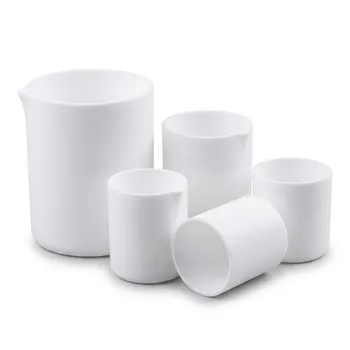
- Large Scale PTFE Beakers and Flasks for High Temperature Corrosion Resistant Laboratory Applications with Custom CNC Fabrication
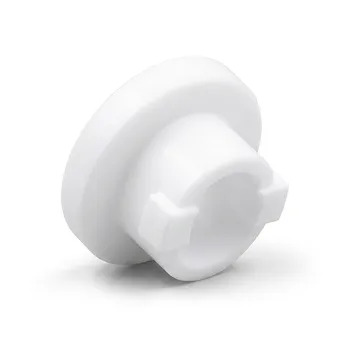
- Custom PTFE Insulating Gaskets Corrosion Resistant Teflon Seals Tailored Engineering Plastic Components
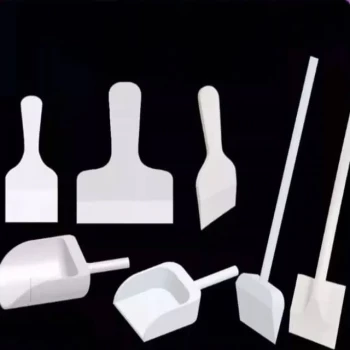
- Customizable PTFE Scrapers and Shovels for Demanding Applications
- Custom Graphite Filled PTFE Rods for Advanced Industrial Applications
People Also Ask
- How do PTFE rods contribute to energy efficiency in industrial applications? Reduce Friction & Power Consumption
- What are the different types of PTFE rods available based on manufacturing technology? Choose the Right Type for Your Project
- What are PTFE rods and how are they manufactured? A Guide to Their Properties and Production
- How are Teflon rods applied in the automotive and aerospace industries? Solve Friction, Heat, and Chemical Challenges
- Why are PTFE rods suitable for medical applications? Unmatched Safety and Sterilization Performance