Low surface energy is a central reason PTFE and PFA perform well in high-purity fluid handling. Fluorinated chains preferentially orient toward interfaces, placing fluorine-rich groups at the boundary between the polymer and the surrounding liquid or air. This produces chemically resistant, weakly interacting surfaces that resist wetting, adhesion, residue buildup, and sample loss. In tubing, fittings, valves, dishes, and reaction vessels, the result is improved sample recovery, easier cleaning, and lower carryover risk.
The key performance benefit is interfacial control: PTFE and PFA present low-energy, non-porous surfaces that minimize liquid and analyte interaction with the component wall. This supports cleaner fluid transfer, more complete drainage, and more reliable results in trace and high-purity applications.
Why Fluorinated Surfaces Resist Interaction
Fluorinated chains concentrate at interfaces
Fluorinated polymer chains contain highly fluorinated segments with low polarizability and weak intermolecular attraction. These segments tend to segregate toward interfaces, including the boundary between the polymer surface and a liquid, gas, or adjacent material.
The interface therefore behaves differently from a more easily wetted polymer surface. It presents a chemically inert, low-energy barrier that reduces the tendency of liquids, residues, and biological materials to spread across or bond to the component.
Low surface energy reduces wetting
Wetting describes how readily a liquid spreads across a solid. Because PTFE and PFA have very low surface energy, many aqueous and organic liquids form relatively high contact angles instead of spreading into a continuous film.
In practical terms, fluids are less likely to coat tubing walls, vessel surfaces, or fitting interiors. However, low surface energy does not mean that every liquid will bead perfectly or that complete drainage is guaranteed; geometry, surface finish, pressure, viscosity, temperature, and fluid chemistry also determine discharge behavior.
The surface is non-porous and chemically resistant
Low surface energy works together with the dense, non-porous structure of PTFE and PFA. The surface does not readily provide sites for chemical bonding, mechanical anchoring, or penetration by many laboratory fluids.
This combination limits both surface adsorption and fluid retention. It is especially valuable where small quantities of active ingredients, trace analytes, or organic compounds must be recovered accurately.
Effects on PTFE and PFA Fluid Transfer Components
Tubing and internal flow paths retain less material
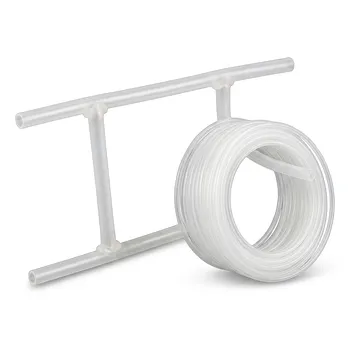
In PTFE and PFA tubing, low adhesion reduces the amount of liquid left behind as a film or isolated droplets after transfer. This can improve recovery during dispensing, sampling, and line draining.
Lower surface interaction also reduces the tendency of residues to accumulate during repeated use. The benefit is strongest for clean, compatible fluids and properly designed systems; dead legs, rough connections, and unfavorable routing can still trap material regardless of polymer choice.
Fittings and valves support cleaner transfer
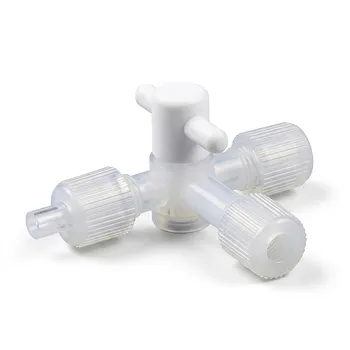
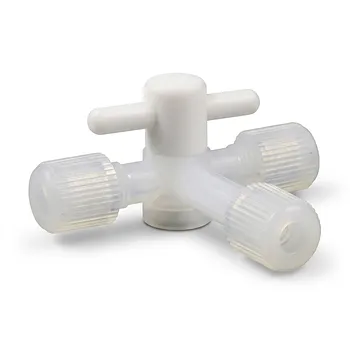
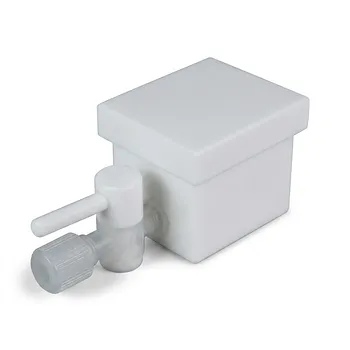
Fittings and valves expose internal surfaces to repeated changes in reagents, samples, and cleaning fluids. The low-energy fluoropolymer surface reduces residue attachment around wetted passages and helps cleaning fluids remove remaining material.
This can reduce carryover between runs, but it does not eliminate the need for validated flushing procedures. Valve geometry, seals, actuation, pressure cycling, and the compatibility of non-fluoropolymer components often matter as much as the body material.
Low friction supports mechanical performance
PTFE is widely associated with very low friction and inherent lubricity. In moving or sliding interfaces, this can reduce resistance, support smoother actuation, and limit mechanical wear.
For fluid transport itself, low wall adhesion can reduce drag caused by surface interaction, but it should not be treated as a universal flow-rate guarantee. Flow is also governed by internal diameter, pressure, viscosity, temperature, fittings, and system configuration.
Chemical residues are less likely to remain attached
The weak interaction between the fluoropolymer surface and many chemicals makes PTFE and PFA useful for aggressive reagents and high-purity transfer paths. Residues are less likely to form strongly bonded films on the surface.
That supports shorter or more effective cleaning cycles and reduces the risk that a previous reagent will contaminate a subsequent sample. The exact behavior still depends on the chemical, exposure time, temperature, concentration, and whether additives or impurities are present.
Effects on PTFE and PFA Labware
Beakers and dishes improve sample recovery
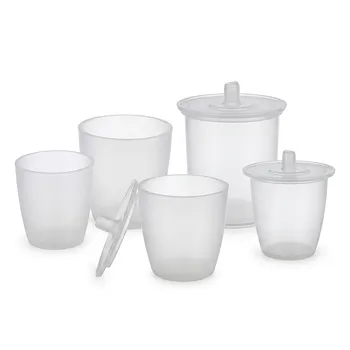
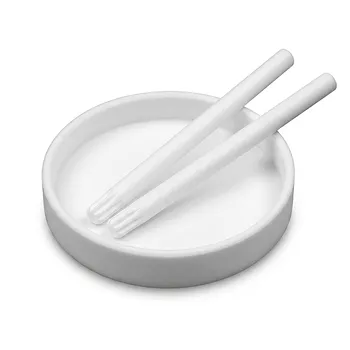
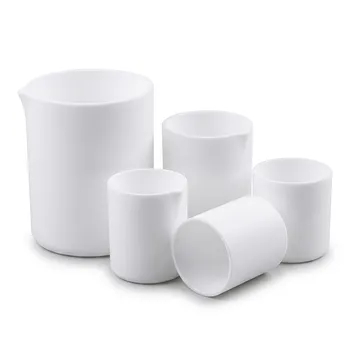
In PTFE and PFA beakers, dishes, and containers, liquids are less likely to spread across the walls and remain as persistent films. More of the sample can be poured, rinsed, or transferred into the next process step.
This matters in trace analysis and sample preparation, where a small retained quantity can create meaningful recovery error. Low surface energy reduces that loss but cannot compensate for evaporation, splashing, inaccessible geometry, or improper rinsing.
Digestion vessels resist residue accumulation
Digestion vessels are exposed to concentrated reagents, elevated temperatures, and materials that may otherwise deposit on container walls. PTFE and PFA surfaces resist many forms of adhesion and are comparatively easy to clean after processing.
PFA can be advantageous where visual inspection is useful because it is generally more transparent than PTFE. Material selection must still account for the specific digestion temperature and chemical exposure.
Reagent bottles limit carryover
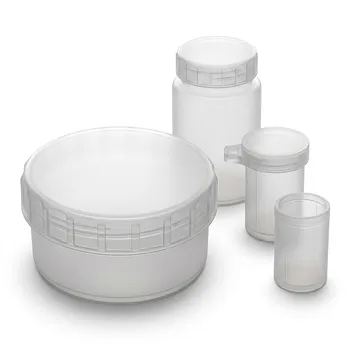
Fluoropolymer reagent bottles provide low-adhesion storage surfaces for many high-purity chemicals. Reduced wall retention helps with dispensing and makes rinsing more effective during cleaning or changeover.
The polymer surface should not be interpreted as an absolute barrier against all absorption or permeation. Some substances can diffuse into or through fluoropolymers under particular conditions, so storage compatibility must be verified for volatile, highly aggressive, or highly permeating chemicals.
Why Interfacial Behavior Matters in Analysis
Lower adsorption protects quantitative accuracy
When analytes adsorb onto a container wall or tubing interior, the measured concentration can be lower than the actual amount introduced. Low surface energy reduces the driving force for this type of surface retention.
This is particularly important for trace-level work, where losses that appear negligible in ordinary handling can become significant relative to the sample quantity.
Complete discharge improves recovery
Non-wetting behavior helps liquids detach from internal walls and container surfaces during draining. It can reduce droplet retention and improve recovery of rinses, digests, standards, and precious samples.
The practical outcome is not simply less waste. It is improved consistency between preparation, transfer, and measurement steps.
Reduced residue lowers cross-contamination risk
A surface that retains fewer residues is easier to return to a clean state. This reduces the amount of previous sample available to contaminate the next run.
The risk is reduced rather than eliminated. Cross-contamination can still arise from incomplete flushing, contaminated cleaning fluids, trapped volumes, external handling, or components made from different materials.
Understanding the Trade-offs
Low surface energy does not make components self-cleaning
PTFE and PFA resist adhesion, but they still require cleaning, rinsing, and inspection. Particulates, precipitates, viscous materials, and chemically reacted deposits can remain in fittings, valve cavities, or surface defects.
Cleaning validation should be based on the actual analytes and reagents used, not solely on the fluoropolymer designation.
Surface energy is not the same as chemical compatibility
A low-energy surface reduces wetting and adhesion, while chemical compatibility determines whether the polymer remains stable during exposure. These are related performance considerations but not interchangeable ones.
Temperature, pressure, concentration, duration, and mechanical stress can change the suitability of a component even when its surface remains non-stick.
Geometry can defeat favorable surface behavior
Sharp transitions, dead legs, narrow valve cavities, threaded connections, and poorly drained runs can retain fluid despite the low surface energy of the surrounding polymer.
System design therefore matters. Sloped routing, minimized dead volume, appropriate valve selection, and effective flushing often deliver more practical improvement than material selection alone.
Extreme water repellency should be described carefully
PTFE and PFA are intrinsically hydrophobic and oleophobic relative to many common materials. Very high contact angles, including values above 150 degrees, generally depend on surface texture or specialized measurement conditions and should not be assumed for every finished component.
Manufacturing method, surface finish, contamination, and the test liquid influence observed wetting behavior.
PTFE and PFA are not identical materials
Both provide low surface energy and strong chemical resistance, but they differ in processing, transparency, flexibility, mechanical behavior, and temperature performance. PFA is often selected when melt processability, greater transparency, or more flexible fabricated components are useful.
The appropriate choice depends on the full operating envelope rather than surface energy alone.
How to Apply This to Your Project
The most reliable selection evaluates surface behavior together with chemistry, geometry, temperature, pressure, and cleaning requirements.
- If your primary focus is sample recovery: Select well-drained PTFE or PFA wetted paths and minimize dead volume, sharp transitions, and trapped-fluid regions.
- If your primary focus is trace analysis: Use low-adsorption fluoropolymer labware and validate recovery, blanks, rinsing, and carryover for the specific analytes.
- If your primary focus is cross-contamination control: Combine fluoropolymer components with documented flushing and cleaning procedures rather than relying on non-stick behavior alone.
- If your primary focus is aggressive chemical handling: Verify temperature, concentration, exposure time, pressure, and permeation limits for the exact PTFE or PFA grade.
- If your primary focus is visual inspection or flexible fabricated components: Evaluate PFA where its transparency and processing characteristics provide an operational advantage.
- If your primary focus is valve actuation and mechanical durability: Consider PTFE's low friction alongside seal materials, actuation forces, wear conditions, and the valve's internal geometry.
Understanding the interface between the fluoropolymer and the fluid is the basis for using PTFE and PFA effectively: low surface energy reduces interaction, while sound system design and validated procedures turn that property into dependable performance.
Summary Table:
| Aspect | Impact of Low Surface Energy | Practical Benefit |
|---|---|---|
| Wetting | Higher contact angles, less spreading | Easier liquid discharge, less film retention |
| Adhesion | Weak molecular interaction | Reduced residue buildup, lower carryover |
| Sample Recovery | Less liquid remains on walls | More complete transfer, better accuracy |
| Cleaning | Residues detach more easily | Simpler and more effective rinsing |
| Chemical Resistance | Inert, non-porous surface | Withstands aggressive reagents without degradation |
Optimize Your Fluid Handling with High-Performance PTFE & PFA Components
At KINTEK, we specialize in manufacturing premium PTFE and PFA labware and fluid transfer components. Our products harness low surface energy to maximize sample recovery, minimize contamination, and ensure accurate trace analysis. Whether you need beakers, tubing, fittings, or custom-machined parts, our end-to-end CNC capabilities deliver precision and purity. Partner with us to elevate your lab's performance—contact our team today for expert guidance and tailored solutions.
Related Products
- Custom PTFE Constant Pressure Separatory Funnel Corrosion Resistant Low Background Labware for PFA Flasks
- High Purity PFA Crucible and Corrosion Resistant PTFE Beaker for Trace Analysis and Custom Laboratory Applications
- Corrosion Resistant High Purity PFA Valve and Weldable Transparent Tubing for Semiconductor Fluid Transfer
- High Corrosion Resistant PTFE Faucet Polytetrafluoroethylene Valve for Chemical Storage Drums and Fluid Transfer Systems Customizable Industrial Grade
- High Purity PFA Valves and Weldable Corrosion Resistant Transparent Tubing for Semiconductor Sensor Manufacturing Fluid Transfer
People Also Ask
- What customization options are available for PTFE materials? Tailor Performance for Your Application
- Why is specialized eluent selection critical for SEC of fluoropolymers, and how do PTFE/PFA labware components support this?
- What fundamental molecular characteristics give fluoropolymer labware, such as PTFE and PFA containers, their exceptional chemical inertness and high temperature resistance?
- What industries use custom PTFE parts and for what purposes? Solve Critical Challenges with High-Performance Materials
- What industries benefit most from custom PTFE parts? Solve Extreme Environment Challenges