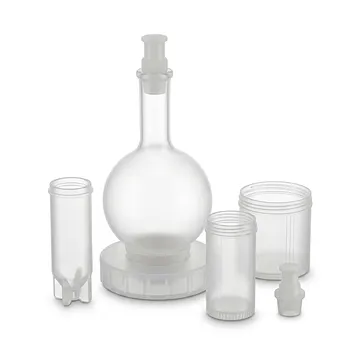
In-situ oleophilic nucleation is a controlled particle-birth process inside the polymerization reactor. In aqueous fluoropolymer dispersion polymerization, a water-soluble hydrocarbon surfactant and inorganic salt are heated with an oxidizing initiator, typically at 70–120 °C. The initiator degrades the surfactant’s hydrophilic portion, creating hydrophobic or oleophilic nucleation sites where fluoropolymer precipitates and grows. Uniform nucleation produces more consistent PTFE and PFA resin particles, which improves density, strength, and void resistance in finished laboratory components.
The key link is process control: uniform nucleation creates a narrow and consistent resin-particle population; that consistency translates into more predictable consolidation, machining, molding, and structural performance in PTFE and PFA labware.
How In-Situ Oleophilic Nucleation Works
Creating nucleation sites inside the reactor
The process begins with an aqueous mixture containing fluorinated monomer, a water-soluble hydrocarbon surfactant, and an inorganic salt. The surfactant helps establish the chemical environment in which new polymer particles can form.
When the mixture is heated in the presence of an oxidizing initiator, the surfactant’s hydrophilic moiety is degraded. This changes the local balance from water-compatible behavior toward hydrophobic, oleophilic domains.
These domains act as nucleation sites directly in the reactor. Rather than relying only on uncontrolled precipitation, the polymerization creates locations where fluoropolymer material can begin separating from the aqueous phase.
Fluoropolymer particles precipitate and grow
As TFE or another fluorinated monomer polymerizes, the newly formed fluoropolymer is poorly compatible with water. It therefore concentrates around the hydrophobic nucleation sites and develops into dispersed resin particles.
The nucleation stage is important because it establishes the initial number, size distribution, and morphology of the particles. Later growth cannot fully correct a poorly controlled particle-birth stage.
The role of the inorganic salt
The inorganic salt is used alongside the surfactant to help control the aqueous polymerization environment. Its presence influences the conditions under which nucleation and particle dispersion occur.
The salt should therefore be viewed as part of the nucleation-control system, rather than as the primary source of the oleophilic sites. The surfactant transformation creates the hydrophobic character; the salt helps regulate the surrounding aqueous conditions.
Why Particle Uniformity Matters
Uniform particles consolidate more consistently
Resin particles with consistent morphology pack and consolidate more predictably during downstream processing. This reduces local differences in density and limits regions where material may remain insufficiently consolidated.
For labware, that consistency is valuable because components may include thin walls, drilled passages, sealing surfaces, and complex machined geometries. A uniform starting resin makes the behavior of these features more predictable.
Uniformity supports structural integrity
The primary resin-particle structure affects the formation of internal voids and weak regions. Consistent particles are more likely to produce a continuous, dense fluoropolymer body when properly processed.
This supports the properties identified in the reference material: uniform density, high tensile strength, and void-free structural integrity. These attributes are especially important in electrochemical cells, high-performance valves, and custom-machined PTFE components.
Particle morphology affects manufacturing consistency
Particle uniformity is not simply a laboratory characterization issue. It influences how resin behaves during forming, consolidation, and finishing.
A narrow, consistent particle population can help reduce part-to-part variation in:
- Consolidated density
- Mechanical strength
- Dimensional stability
- Surface quality
- Machining response
- Resistance to internal defects
The exact outcome still depends on the complete manufacturing process, including forming and thermal history. Resin uniformity provides a more stable foundation; it does not replace process control.
Implications for PTFE and PFA Labware
PTFE components
PTFE labware is commonly produced through powder-based forming and consolidation, followed by machining when required. Custom CNC-machined PTFE parts therefore depend heavily on the resin’s ability to form a dense, coherent body before final machining.
If the resin contains inconsistent primary particles or poorly controlled agglomerates, the finished part may exhibit nonuniform density or internal weak regions. These defects can become especially significant when machining exposes internal areas or when the component must maintain leak-tightness and mechanical integrity.
PFA components
PFA is also a fluoropolymer used for high-performance laboratory equipment, but its processing behavior differs from PTFE because PFA is melt-processable. That difference changes the downstream manufacturing route, but it does not eliminate the importance of controlled resin morphology.
Consistent PFA resin can support more predictable molding and forming behavior, helping produce uniform walls, reliable sealing surfaces, and consistent structural performance. The nucleation stage remains important because it determines the starting particle population that later experiences thermal processing.
Critical laboratory applications
Electrochemical cells and high-performance valves place demanding requirements on fluoropolymer components. They may require low defect levels, consistent dimensions, chemical resistance, and reliable sealing or insulating performance.
For these applications, particle uniformity reduces one major source of variability before the material reaches the forming or machining operation. It makes the manufacturing process easier to control and the final component easier to qualify.
Understanding the Trade-offs
More nucleation is not automatically better
The objective is not simply to create the largest possible number of nucleation sites. Excessive or poorly controlled nucleation can alter particle size, dispersion behavior, and the later consolidation response.
The practical objective is controlled nucleation: enough sites to produce a stable and uniform particle population without creating undesirable dispersion or processing characteristics.
Uniformity does not guarantee defect-free parts
Even highly uniform resin can produce defective labware if processing conditions are poorly controlled. Forming pressure, heating, cooling, machining parameters, and part geometry can all affect final quality.
Resin uniformity should therefore be treated as a necessary quality factor, not a complete manufacturing guarantee.
PTFE and PFA require different process interpretations
The same resin-uniformity principle applies to both materials, but the manufacturing consequences are not identical. PTFE’s powder-forming and sintering route differs from PFA’s melt-processing route.
Quality systems should evaluate particle morphology together with the specific processing method rather than assuming that a resin specification has the same meaning for both polymers.
“Oleophilic” describes the nucleation environment
In this context, oleophilic nucleation means that hydrophobic regions generated in the aqueous system provide favorable sites for fluoropolymer formation. It should not be interpreted as introducing an oil phase into the final fluoropolymer product.
The relevant outcome is the creation of polymer-compatible, water-incompatible nucleation domains that help control particle formation.
Making the Right Choice for Your Goal
The mechanism matters because it connects reactor chemistry to finished-part reliability.
- If your primary focus is resin consistency: Control the surfactant, inorganic salt, temperature, and initiator conditions so nucleation produces a stable and uniform particle population.
- If your primary focus is PTFE labware: Prioritize resin morphology and consolidation behavior that support uniform density, strength, and reliable CNC machining.
- If your primary focus is PFA labware: Evaluate particle uniformity together with melt-processing behavior, wall-thickness control, and dimensional consistency.
- If your primary focus is valves or electrochemical cells: Treat low internal defect levels and consistent structural integrity as key acceptance criteria.
- If your primary focus is process qualification: Correlate resin-particle measurements with finished-part density, mechanical performance, void content, and dimensional results.
Controlled in-situ nucleation turns reactor-level particle uniformity into a practical foundation for reliable PTFE and PFA laboratory equipment.
Summary Table:
| Aspect | Influence on PTFE/PFA Labware |
|---|---|
| Nucleation Site Formation | Creates uniform particle birth, leading to consistent resin morphology. |
| Particle Size Distribution | Narrow distribution improves consolidation, density, and strength. |
| Structural Integrity | Uniform particles reduce voids and weak regions, enhancing durability. |
| Manufacturing Consistency | Predictable resin behavior improves machining and molding outcomes. |
| Process Control | Controlled nucleation is key; over-nucleation can harm dispersion. |
For high-quality, uniform PTFE and PFA labware engineered from precisely controlled resin, contact KINTEK today. Our expertise in fluoropolymer fabrication ensures your lab benefits from reliable, void-free components. Reach out to us now!
Related Products
- High Purity PFA Crucible and Corrosion Resistant PTFE Beaker for Trace Analysis and Custom Laboratory Applications
- Custom PTFE Constant Pressure Separatory Funnel Corrosion Resistant Low Background Labware for PFA Flasks
- Custom PFA Microcolumn Racks and PTFE Machined Low Background Corrosion Resistant Laboratory Fixtures
- PTFE PFA Vacuum Filtration System Corrosion Resistant Customizable Shatterproof Laboratory Device
- Corrosion Resistant PTFE Support with PFA Transparent Reaction Tank and High Purity PFA Sampling Tube for Trace Analysis
People Also Ask
- Why are high-purity vessels critical for BiFeO3 synthesis? Ensuring Phase Purity
- Why is the use of high-purity PFA or PTFE labware critical during TiO2 nanoparticle purification? Protect Sample Purity
- Why is high-purity PFA trace analysis labware used for MXene? Ensure Superior Material Integrity in Research
- Why is high-purity PFA trace analysis labware recommended for trace element detection? Achieve Gold Standard PPT Accuracy
- Why is high-purity PFA labware necessary for Znx@LS-2 zeolite ICP-OES analysis? Ensure Trace-Level Precision