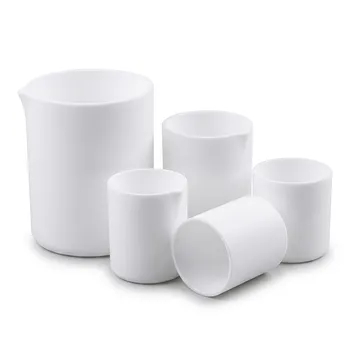
The selection of reaction vessels is a critical variable that directly determines the phase purity and stoichiometric integrity of Bismuth Ferrite ($BiFeO_3$) nanoparticles. High-purity beakers, particularly those made from advanced fluoropolymers, provide the essential chemical inertness required to prevent the leaching of background impurities and the unwanted adsorption of precursor ions during the sol-gel process. Without this controlled environment, the delicate balance of bismuth and iron is easily disrupted, leading to the formation of undesirable secondary phases rather than the intended perovskite structure.
Core Takeaway: To synthesize high-quality $BiFeO_3$ nanoparticles, the reaction environment must be chemically "invisible." High-purity vessels ensure that the precise ratio of bismuth to iron is maintained while preventing trace metal contamination that can degrade the material's catalytic and electromagnetic performance.
Maintaining Stoichiometric Precision
The Sensitivity of the Bismuth-to-Iron Ratio
Bismuth Ferrite (BFO) is exceptionally sensitive to the precise ratio of its precursors, iron nitrate and bismuth nitrate. Any deviation in this stoichiometry during the sol-gel process—where precursors mix in an ethylene glycol solution—will result in the formation of impurity phases that are difficult to remove.
Preventing Ion Adsorption
Standard laboratory glassware can be problematic because $Bi^{3+}$ ions have a tendency to adsorb onto the container walls. This adsorption effectively "steals" bismuth from the reaction, shifting the chemical balance and preventing the formation of a pure perovskite structure.
Ensuring Uniform Mixing
High-purity vessels facilitate thorough reaction and uniform mixing during the prolonged stirring stages. Because the vessel does not interact with the precursors, the chemical energy of the system remains focused entirely on the synthesis of the $BiFeO_3$ crystal nuclei.
Eliminating Contamination and Leaching
Avoiding Trace Metal Leaching
In strong oxidizing environments or during prolonged heating, standard beakers can leach trace metal ions or organic impurities into the sol. Even parts-per-billion levels of contamination can trigger competitive reactions, such as the hydrogen evolution reaction (HER), which masks the true properties of the $BiFeO_3$ nanoparticles.
The Role of Chemical Inertness
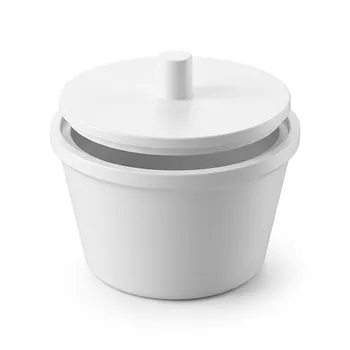
High-purity beakers, especially those manufactured from PFA (Perfluoroalkoxy) or PTFE (Polytetrafluoroethylene), offer extreme chemical inertness. These materials provide an ultra-clean background, ensuring that the synthesized powder achieves the high-phase purity necessary for advanced applications in photocatalysis and electronics.
Thermal Stability During Synthesis
The sol-gel process often involves stages of heating to promote ligand deprotonation and coordination. High-performance fluoropolymers maintain their structural integrity and inertness at elevated temperatures, preventing the release of background impurities that typically occurs when lower-grade materials are stressed by heat.
Understanding the Trade-offs
While high-purity fluoropolymer vessels (PFA/PTFE) are superior for maintaining stoichiometry and purity, they come with specific considerations. Cost is the primary factor, as these materials are significantly more expensive than standard borosilicate glass.
Additionally, unlike glass, PFA and PTFE are opaque or translucent, which can make visual monitoring of the "sol" to "gel" transition more difficult. Researchers must also be aware of the maximum temperature limits of these materials; while they handle standard sol-gel temperatures easily, they cannot be used for the final high-temperature calcination steps where ceramic or quartz crucibles are required.
How to Apply This to Your Synthesis
Selecting the right vessel depends on your specific research goals and the sensitivity of your final application.
- If your primary focus is phase purity and reproducibility: Utilize high-purity PFA beakers to eliminate ion adsorption and ensure the $Bi^{3+}/Fe^{3+}$ ratio remains perfectly balanced.
- If your primary focus is trace element analysis or electrochemical testing: Prioritize PTFE or PFA labware to prevent background metal leaching that could lead to false-positive results in catalytic activity.
- If your primary focus is high-temperature hydrothermal synthesis: Ensure you use pressure-resistant vessels with high-purity liners to safely manage the internal pressures required for optimal crystal growth.
By treating the reaction vessel as a critical reagent rather than just a container, you ensure the integrity of the Bismuth Ferrite perovskite structure.
Summary Table:
| Feature | PFA/PTFE Beakers | Standard Glassware |
|---|---|---|
| Chemical Inertness | Extreme; no reaction with precursors | High risk of leaching metal ions |
| Ion Adsorption | Minimal; maintains Bi:Fe stoichiometry | High; Bi3+ ions often stick to walls |
| Purity Control | Trace-metal free background | Potential contamination in acid/heat |
| Ideal Application | High-precision perovskite synthesis | Basic chemical mixing |
| Durability | High thermal & chemical resistance | Breakable and reactive at high pH |
Elevate Your Material Synthesis with KINTEK
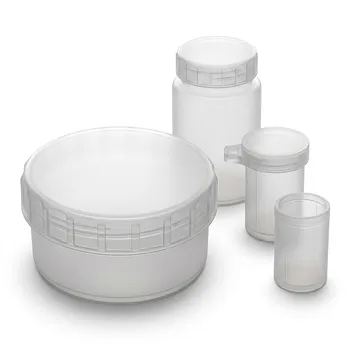
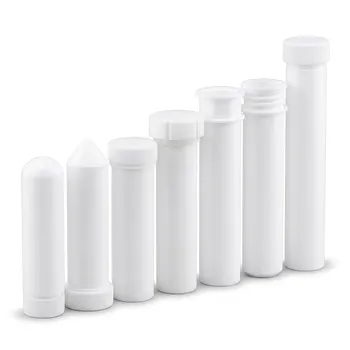
Don't let vessel-borne contamination compromise your stoichiometric precision. KINTEK specializes in high-performance fluoropolymer solutions designed for the most demanding research environments. From high-purity PFA/PTFE beakers, tubes, and crucibles for trace analysis to custom-engineered reaction apparatus and hydrothermal synthesis liners, we provide the chemically "invisible" tools you need for perfect results.
Whether you require everyday consumables like stirring bars and seal tapes or complex, non-standard CNC-machined parts, our end-to-end fabrication ensures absolute focus on purity and performance.
Ready to optimize your BiFeO3 synthesis? Contact our expert team today to discuss your custom laboratory needs and high-volume orders!
References
- Yanhong Gu, Yaohua Hu. Tribocatalytic degradation of concentrated methyl orange solutions by BiFeO<sub>3</sub> nanoparticles prepared through a sol–gel method. DOI: 10.1039/d5ra02423d
This article is also based on technical information from Kintek Knowledge Base .
Related Products
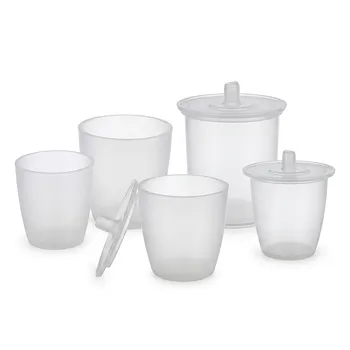
- High Purity PFA Crucible and Corrosion Resistant PTFE Beaker for Trace Analysis and Custom Laboratory Applications
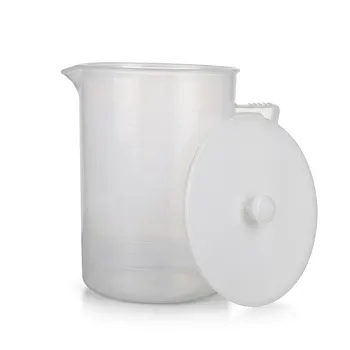
- High Purity Custom PTFE Beaker 5000ml With Lid Hot Plate Heating Compatible High Temperature Chemical Labware
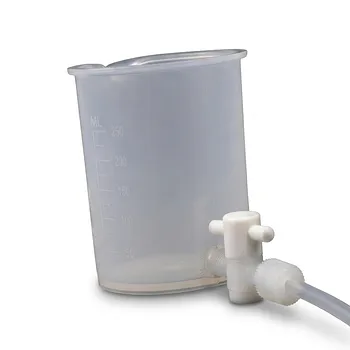
- High Purity PTFE Beaker Heat Resistant Laboratory Chemical Vessel Hot Plate Compatible Non Deforming Fluoropolymer Labware
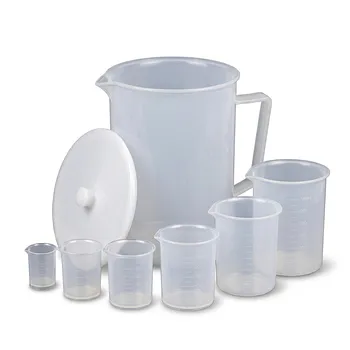
- High Purity PFA Beakers with Handles and Cleaning Baskets for Trace Analysis and Industrial Chemical Processing
- High Purity PFA Beakers with Handles Large Capacity Chemical Resistant Teflon Laboratory Beakers and Custom Cleaning Baskets
People Also Ask
- Why is the use of high-purity PFA or PTFE labware critical during TiO2 nanoparticle purification? Protect Sample Purity
- Why is high-purity PFA labware necessary for Znx@LS-2 zeolite ICP-OES analysis? Ensure Trace-Level Precision
- Why is high-purity PFA trace analysis labware used for MXene? Ensure Superior Material Integrity in Research
- What key material characteristics make PTFE and PFA suitable for high-purity laboratory labware, trace analysis containers, and medical microporous tubing? Discover the essential properties that ensure purity.
- Why is high-purity PFA trace analysis labware used for sample processing when preparing Mo2CTx@MoS2? Ensure Material Purity