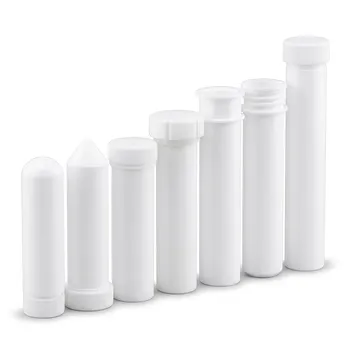
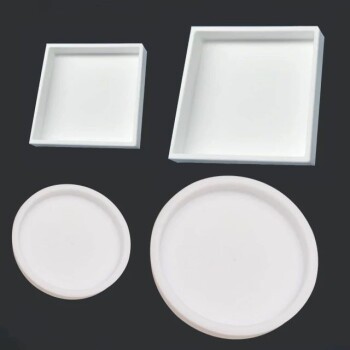
Fine-cut PTFE powders flow poorly and occupy more volume, while pelletized free-flow PTFE moves readily and packs more densely. Fine-cut grades typically have low apparent bulk density, often below 500 g/L, and their small particles can bridge or fill molds unevenly. Pelletized PTFE forms soft agglomerates without secondary chemical binders, increasing flow rates from roughly 6 g/s to more than 12 g/s and raising apparent bulk density from about 460 g/L to 540 g/L or higher.
The distinction is fundamentally about mold filling. Fine-cut PTFE can provide excellent final material properties, but pelletized free-flow resin is easier to meter, feeds equipment more reliably, and fills complex cavities more uniformly. The correct choice depends on whether the priority is maximum material performance or efficient, repeatable molding.
Why PTFE Powder Behavior Matters
Fine particles create handling problems
Fine-cut PTFE generally consists of small particles, commonly around 20 to 40 micrometers in average size. These particles have a high surface-area-to-volume ratio, which increases interparticle friction and makes the powder less willing to move through hoppers, feed systems, and narrow mold openings.
The powder can also bridge across an opening rather than flowing into the cavity. This interrupts feeding and can leave portions of the mold incompletely filled.
Low bulk density increases the required volume
Apparent bulk density describes how much PTFE powder occupies a given volume before compaction. A low-density powder requires a larger mold cavity or a larger charge volume to deliver the same mass of resin.
For example, a powder near 460 g/L occupies substantially more space than one above 540 g/L for an equivalent charge weight. This can increase tooling dimensions, complicate press setup, and reduce the practicality of automated production.
Pelletization changes physical handling
Pelletized PTFE is made by converting fine particles into larger, soft agglomerates. Because the agglomerates are larger and handle more like granules, they reduce friction-related flow problems without introducing a secondary chemical binder.
This increases powder flow rate and apparent bulk density while preserving the underlying PTFE chemistry. The result is a resin that feeds more predictably through automated equipment.
How the Two Grades Compare in Molding
Automatic compression molding
Automatic molding depends on rapid, repeatable transfer of a controlled resin charge into the mold. Free-flow PTFE is well suited to this process because it moves consistently through hoppers and filling mechanisms.
The higher bulk density also reduces the volume that must be transferred. That supports smaller or more compact tooling and makes production timing easier to control.
Isostatic molding
Isostatic molding requires the mold or flexible container to be filled thoroughly before pressure is applied. Poor-flowing fine-cut powder can create voids, density variations, or localized packing differences during this stage.
Free-flow agglomerates fill the cavity more quickly and uniformly. More consistent preform density improves the likelihood of producing a homogeneous molded stock after compaction and sintering.
Complex and intricate cavities
Laboratory equipment often includes narrow sections, deep cavities, flanges, threads, and other geometric features. Fine-cut powder may not reach every region reliably, particularly when the powder bridges at an inlet or packs unevenly.
Pelletized resin is more capable of moving into these features before compaction. This helps produce complete preforms and reduces defects caused by incomplete filling.
What This Means for Laboratory Equipment
Free-flow resin supports repeatable production
Free-flow PTFE is generally advantageous for high-volume production of standard laboratory items and other parts made with automated molding. More consistent filling reduces variation between molded blanks and improves process efficiency.
This is particularly important when the same mold must produce many parts with predictable dimensions and density.
Fine-cut resin can support demanding material performance
Fine-cut grades can produce molded PTFE with strong mechanical and physical properties, including high tensile strength, elongation, specific gravity, and dielectric performance. Their finer structure can also support low porosity and reduced permeability when the molding process is carefully controlled.
These characteristics may be valuable in high-purity vessels, reactor liners, gaskets, and other components exposed to aggressive chemicals or demanding service conditions.
Mold filling affects the finished part
Flow behavior is not merely a production concern. Uneven filling can create density gradients, micro-voids, or weak regions that remain after compaction and sintering.
A uniform charge distribution helps produce dense, consistent stock that can later be machined into vessels, fittings, valve seats, seals, and bushings. For precision laboratory equipment, that consistency can affect chemical resistance, dimensional stability, sealing reliability, and contamination control.
Understanding the Trade-offs
Higher flow does not automatically mean better properties
Pelletized free-flow PTFE improves handling and mold filling, but the resulting parts may show somewhat lower tensile strength, elongation, or dielectric performance than parts made from optimized fine-cut grades. The difference depends on resin grade, compaction conditions, sintering, and the finished geometry.
The manufacturing advantage therefore has to be balanced against the performance requirements of the component.
Fine-cut powder requires tighter process control
Fine-cut resin may be the better material choice when maximum density, strength, or purity is the priority. However, it demands careful control of powder charging, mold design, preforming pressure, and handling because poor flow can otherwise create inconsistent parts.
Using a fine grade in equipment designed for free-flow material can lead to bridging, slow filling, oversized charge volumes, and nonuniform preforms.
Particle size and density are not interchangeable
A larger particle size often improves flow and apparent bulk density, but bulk density alone does not fully describe molding behavior. Particle shape, agglomerate strength, compressibility, and the specific molding process also influence how a resin fills and consolidates.
Material selection should therefore use the supplier's flow, density, particle-size, and molding recommendations together rather than relying on a single specification.
Do not confuse granular PTFE with dispersion fine powder
Granular PTFE used for compression or isostatic molding is different from dispersion-produced fine powder commonly used with lubricant in paste extrusion. The latter is intended for applications such as thin tubing, wire insulation, and films, not necessarily for rigid molded laboratory stock.
Confirming the resin's intended processing method is essential before evaluating its flow or density.
Making the Right Choice for Your Goal
The resin should be selected against both the molding process and the performance demands of the finished laboratory component.
- If your primary focus is automated, high-volume molding: Choose a pelletized free-flow grade with higher apparent bulk density and reliable hopper feeding to achieve faster, more uniform cavity filling.
- If your primary focus is maximum mechanical and physical performance: Evaluate a fine-cut grade, provided the tooling and process can control its lower flowability and larger required charge volume.
- If your primary focus is complex molded geometry: Favor a resin whose flow behavior supports complete filling of narrow or intricate sections before compaction.
- If your primary focus is precision-machined, high-purity stock: Prioritize the grade and molding process that minimize density variation, porosity, and micro-voids throughout the preform.
The practical decision is to match PTFE flow and bulk density to the molding method so the finished laboratory equipment receives both the required material performance and the required manufacturing consistency.
Summary Table:
| Property | Fine-Cut PTFE | Pelletized (Free-Flow) PTFE |
|---|---|---|
| Average Particle Size | 20–40 µm | Larger agglomerates |
| Apparent Bulk Density | <500 g/L (e.g., ~460 g/L) | >540 g/L (e.g., 540 g/L or higher) |
| Flow Rate | Low (e.g., ~6 g/s) | High (e.g., >12 g/s) |
| Flowability | Poor (bridging, uneven filling) | Good (reliable feeding) |
| Mold Filling | Incomplete in complex cavities | Uniform and complete |
| Material Properties | Higher tensile strength, elongation, dielectric performance | Slightly lower mechanical/electrical properties |
| Best For | Demanding performance, high purity | Automated, high-volume molding |
Optimize your PTFE molding with the right resin grade. At KINTEK, we specialize in high-performance fluoropolymers, offering a full range of PTFE and PFA products. Whether you need fine-cut powder for maximum material performance or free-flow pellets for efficient automated molding, our lab supplies—from beakers and digestion vessels to custom CNC-machined parts—are crafted to meet your exact specifications. Contact our experts today to select the ideal resin for your application and ensure consistent, high-quality results in your lab equipment. Contact us now!
Related Products
- High Purity PTFE Filter Membrane Cutter with Ceramic Blade for PM2.5 Analysis and Customizable Laboratory Filter Paper Splitter
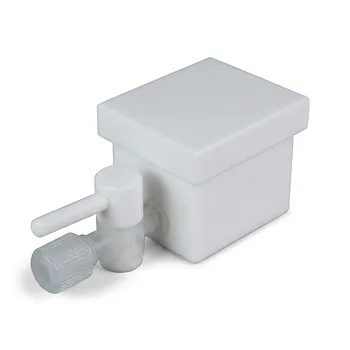
- High Purity PTFE Square Membrane Cutter and Filter Aliquot Device for Trace Analysis and Cleanroom Laboratory Applications
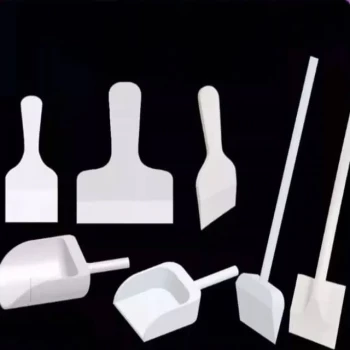
- Custom PTFE Pharmaceutical Sampling Scoop Low Leaching Cylindrical Chemical Powder Sampler Zero Contamination High Purity Laboratory Shovel
- High Purity PTFE Square Membrane Cutter Equipartition Device for Trace Analysis and Disease Control Centers Clean Non Stick No Leaching
- High Temperature Resistant PTFE Solid Sampler Corrosion Resistant Non Leaching Reusable Biopharmaceutical White Powder Sampling Device
People Also Ask
- What are the structural characteristics and manufacturing principles of Polytetrafluoroethylene (PTFE) filter membranes?
- What is the chemical composition and temperature resistance of PTFE filter membranes? Essential Specs for Labs
- How does the inherent hydrophobicity of PTFE filter membranes affect liquid and gas separation? Optimize Performance
- What are the performance advantages of PTFE filter membranes vs depth filters? Boosting Lab Purity and Efficiency
- What is the thermal stability range for PTFE filter membranes? Master Extremes from -200°C to +260°C