PTFE improves specialized laboratory instrumentation by providing strong, stable electrical isolation with minimal dielectric loss. Its low dielectric constant, very low dissipation factor, high volume resistivity, and high breakdown strength help prevent leakage current, voltage breakdown, and signal distortion. Combined with chemical resistance and thermal stability, these properties make PTFE well suited to electrochemical cells, sensor housings, analytical instruments, and high-frequency laboratory components.
PTFE acts as an electrically quiet barrier between conductive components and aggressive chemical environments. It preserves signal integrity and prevents unwanted current paths while remaining stable across broad temperature, humidity, frequency, and chemical-exposure ranges.
Why Electrical Isolation Matters in Laboratory Systems
Preventing Unwanted Current Paths
PTFE has a volume resistivity on the order of 10¹⁸ Ω·cm, so it strongly restricts current flow through the material. In an electrochemical apparatus, this helps isolate electrodes, contacts, wiring, and measurement circuitry from one another.
This isolation reduces leakage currents that could otherwise alter measured potentials, currents, impedance values, or reaction behavior.
Protecting Against Voltage Breakdown
PTFE provides high dielectric strength, with reported values dependent on thickness, test method, and material condition. A representative value is approximately 24 kV/mm at a 2.03 mm thickness.
This allows PTFE barriers, spacers, feedthrough components, and insulating housings to withstand substantial electric fields before electrical failure occurs. The reported dielectric strength of thin sections can be higher, but design decisions should use supplier data measured under conditions that match the actual geometry and environment.
Maintaining Surface Insulation
PTFE also has strong resistance to surface electrical tracking. Its surface arc resistance exceeds 300 seconds in reported testing, and it does not readily form conductive carbonized tracks during electrical discharge.
That characteristic is valuable where contamination, high voltage, moisture, or repeated discharge events could otherwise create a permanent leakage path across an insulating surface.
How PTFE Preserves Measurement Accuracy
Low Dielectric Constant Reduces Field Disturbance
PTFE has a low dielectric constant of approximately 2.0 to 2.1 across many relevant conditions. A low dielectric constant means the material polarizes relatively little when exposed to an electric field.
In sensor housings and electrochemical cells, this reduces the extent to which the insulating structure changes the local electric field. The result is more predictable electrode behavior and less disturbance to sensitive measurements.
Low Dissipation Factor Minimizes Energy Loss
PTFE's dissipation factor is typically below 0.0004 under commonly cited test conditions. This indicates that only a very small portion of the applied electrical energy is converted into heat within the dielectric.
Low dielectric loss is especially important in impedance analysis, high-frequency sensing, microwave-assisted laboratory equipment, and signal-transmitting fluidic components. It helps reduce attenuation, phase error, and measurement drift caused by the insulating material itself.
Nonpolar Molecular Structure Supports Stable Signals
PTFE is a nonpolar fluoropolymer without permanent molecular dipoles or ferroelectric domains. Its dielectric response is therefore approximately linear, with negligible dielectric hysteresis under ordinary operating conditions.
This supports stable signal transmission and low field-induced polarization in sensitive analytical and electrochemical environments.
Why PTFE Performs Well in Harsh Laboratory Environments
Electrical Properties Remain Stable During Moisture Exposure
PTFE absorbs virtually no water. Its volume resistivity therefore remains comparatively stable during prolonged immersion or exposure to high humidity.
This matters in electrochemical apparatus, where insulating components may be continuously exposed to aqueous electrolytes, cleaning fluids, or humid laboratory conditions. The material is less likely than moisture-sensitive dielectrics to develop changing leakage characteristics.
Chemical Resistance Protects the Insulating Barrier
PTFE resists a broad range of corrosive chemical media. A PTFE cell body, separator, probe component, or sensor housing can therefore maintain physical and electrical separation without rapidly degrading in contact with aggressive reagents.
Chemical stability is essential because a crack, swelling event, deposit, or degraded surface can compromise insulation even when the original dielectric properties are excellent.
Thermal Stability Supports Continuous Operation
PTFE provides useful thermal stability up to approximately 550°F, although the allowable service temperature depends on load, pressure, chemical exposure, processing, and the specific PTFE grade.
This thermal margin helps insulating components retain their function during heated analytical procedures, sterilization-related processes, and microwave digestion equipment applications.
Applications in Specialized Instrumentation
Custom Electrochemical Cells
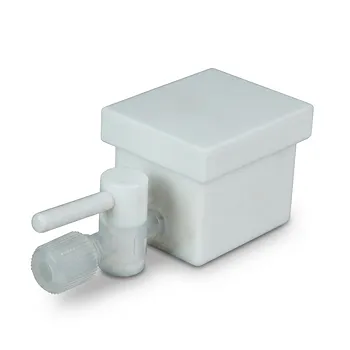
In custom-machined electrochemical cells, PTFE can form the cell body, electrode supports, spacers, seals, and insulating inserts. Its high resistivity prevents current from bypassing the intended electrochemical path.
Its low dielectric loss also limits the electrical contribution of the cell structure during sensitive impedance or low-current measurements.
Sensor Housings and Probes
PTFE sensor housings isolate electrodes and conductors from one another while protecting them from corrosive fluids. The low dielectric constant helps avoid substantial distortion of the electric field around the sensing region.
For fluid-contact probes, low moisture absorption helps maintain more consistent electrical behavior over time.
Analytical Instrument Components
PTFE is useful in analytical instruments where electrical insulation must coexist with chemical purity and aggressive media. Examples include insulating fixtures, fluidic components, sample-contact structures, and microwave digestion vessel components.
The combination of low signal loss, high resistivity, and chemical resistance allows these parts to support reliable operation without becoming a significant source of contamination or electrical interference.
High-Frequency Laboratory Assemblies
PTFE and expanded PTFE are used in high-frequency cable assemblies, dielectric separators, and sensor housings. Their low dielectric constant and low dielectric loss reduce signal attenuation and help maintain predictable impedance.
Expanded PTFE can also be used where a lightweight, low-loss, or porous dielectric structure is appropriate. Its suitability depends on whether the application can tolerate its different mechanical and fluid-transport characteristics.
Understanding the Trade-offs
Dielectric Values Are Not Universal Constants
PTFE's dielectric constant and dissipation factor vary with frequency, temperature, crystallinity, density, thickness, and test method. Losses can increase at specific resonant conditions where molecular motion couples more strongly to the applied field.
Designers should therefore use data measured over the actual operating frequency and temperature range rather than relying on a single catalog value.
Breakdown Strength Depends on Geometry
Dielectric breakdown strength is influenced by material thickness, defects, surface condition, electrode geometry, and the surrounding medium. Thin PTFE sections may show higher measured breakdown strength, but that result should not be extrapolated directly to thick or machined components.
Sharp edges, voids, contamination, and machining damage can create local electric-field concentrations that reduce practical voltage withstand.
PTFE Does Not Solve Every Interference Problem
PTFE provides electrical isolation, but it is not itself a conductive electromagnetic shield. If an instrument requires EMI shielding, the design may need a separate conductive layer, grounded enclosure, shielded cable, or specialized expanded-PTFE construction.
Insulation prevents unwanted current paths; it does not automatically block every radiated or coupled electromagnetic field.
Mechanical and Processing Limits Still Matter
PTFE has useful thermal and chemical performance but can deform under sustained mechanical load and may require careful design around creep, sealing force, dimensional tolerances, and joining methods.
A component that maintains excellent dielectric properties but shifts dimensionally, leaks, or loses mechanical contact pressure can still compromise an apparatus.
Making the Right Choice for Your Goal
PTFE is most effective when its electrical, chemical, thermal, and mechanical requirements are evaluated together.
- If your primary focus is measurement accuracy: Use PTFE to isolate electrodes, sensors, and conductors while taking advantage of its low dielectric constant and very low dissipation factor to reduce field disturbance and signal loss.
- If your primary focus is high-voltage reliability: Design around verified dielectric-strength data for the actual thickness, geometry, and environment, and use PTFE to reduce leakage and resist surface tracking.
- If your primary focus is corrosive or wet operation: Select PTFE for components exposed to electrolytes, aggressive chemicals, or humidity because its chemical resistance and negligible water absorption help preserve insulation.
- If your primary focus is high-frequency performance: Use PTFE or an appropriate ePTFE construction where low dielectric constant and low dielectric loss are required, while separately addressing grounding and EMI-shielding needs.
- If your primary focus is long-term instrument stability: Validate dielectric behavior across the complete frequency, temperature, pressure, and mechanical-loading range rather than relying on nominal room-temperature material values.
When properly matched to the operating conditions, PTFE provides a stable electrical boundary that protects measurements, prevents leakage, and extends the reliability of specialized laboratory and electrochemical equipment.
Summary Table:
| Property | Typical Value | Benefit in Lab Instruments |
|---|---|---|
| Volume Resistivity | ~10¹⁸ Ω·cm | Prevents leakage currents, ensures accurate measurements |
| Dielectric Strength | ~24 kV/mm (2.03 mm) | Withstands high voltages, robust insulation |
| Dielectric Constant | 2.0-2.1 | Minimal field distortion, better sensor accuracy |
| Dissipation Factor | <0.0004 | Low energy loss, stable signals in high-frequency applications |
| Water Absorption | Negligible | Stable insulation in humid or wet conditions |
| Surface Arc Resistance | >300 s | Resists tracking, safe under discharge |
Elevate your laboratory's precision with KINTEK's custom PTFE and PFA components. From electrochemical cells and sensor housings to high-frequency assemblies, our end-to-end CNC machining delivers tailored solutions that optimize dielectric performance and chemical resistance. Contact our experts today to discuss your specific requirements and enhance your instrument's reliability and accuracy! Get in touch.
Related Products
- Custom PTFE Filtration System Acid Resistant High Purity Semiconductor Grade Chemical Processing Filter
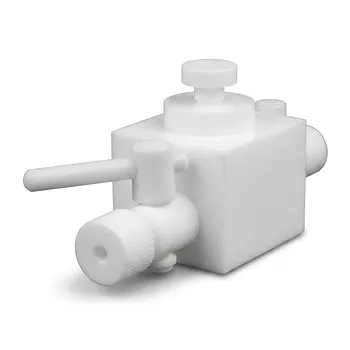
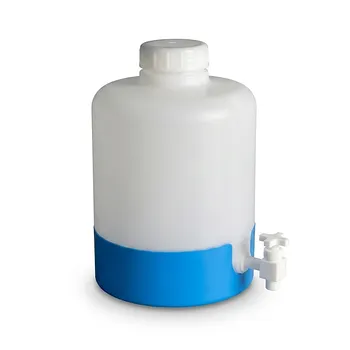
- High Corrosion Resistant PTFE Faucet Polytetrafluoroethylene Valve for Chemical Storage Drums and Fluid Transfer Systems Customizable Industrial Grade
- PTFE PFA Vacuum Filtration System Corrosion Resistant Customizable Shatterproof Laboratory Device
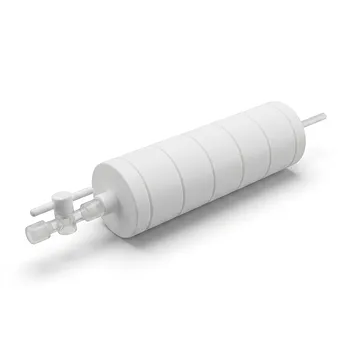
- PTFE Corrosion Resistant Filter with PFA Valve Connections and Integrated Sieve Plate
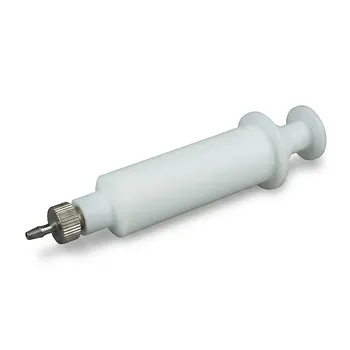
- High Temperature Chemical Resistant 50ml PTFE Syringe Customized Teflon Injector with Threaded Seal for Trace Analysis
People Also Ask
- What makes PTFE filtration systems advantageous for industrial and scientific use? Unmatched Chemical & Thermal Stability
- What sizes and pore options are available for PTFE filters? Choose the Right Filter for Your Application
- What steps are involved in selecting the proper PTFE filter? A 4-Step Guide to Optimal Filtration
- How does the hydrophobicity of PTFE filters benefit their use? Ensure Uninterrupted Gas Flow and Solvent Filtration
- What temperature resistance do PTFE filters offer? Unmatched Thermal Stability from -200°C to +260°C