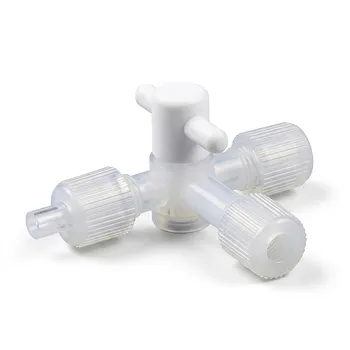
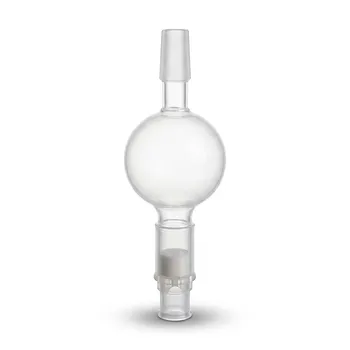
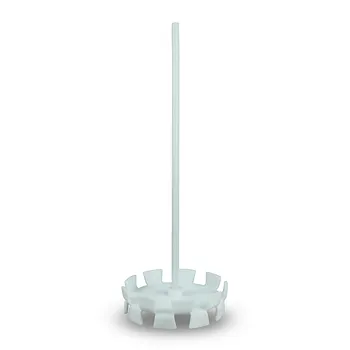
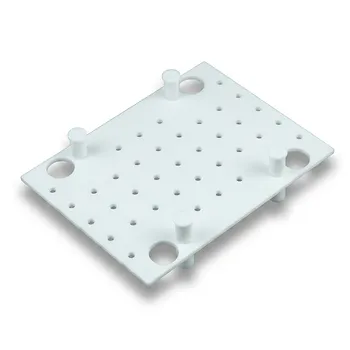
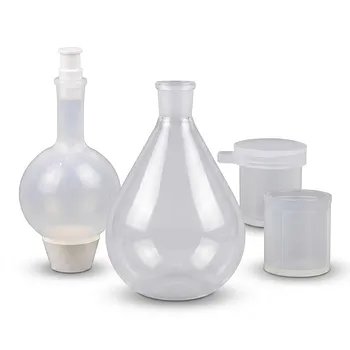
PTFE and PFA occupy nearly the same high-performance chemical and thermal range, but they serve different design priorities. Both support continuous service temperatures of approximately 260°C and resist strong acids, bases, organic solvents, and other aggressive laboratory chemicals. PTFE provides the lowest friction, stronger extreme-temperature and cryogenic performance, and excellent suitability for machined parts; PFA provides melt processability, transparency, and highly consistent molded fluid-handling components.
Choose PTFE when friction, cryogenic performance, or machined structural parts are decisive. Choose PFA when seamless molding, visual inspection, high purity, or complex fluidic geometry matters most.
Where PTFE and PFA Are Similar
Continuous Operating Temperature
Both materials are generally rated for continuous use up to about 260°C. This makes either polymer suitable for demanding laboratory equipment such as reaction vessels, tubing, fittings, valves, digestion components, and analytical instrument parts.
This rating should not be confused with the polymer’s melting point or its short-term processing limit. Continuous service depends on time, mechanical load, chemical exposure, geometry, and the surrounding environment.
Chemical Resistance
PTFE and PFA are among the most chemically resistant fluoropolymers. Their fluorinated structures provide excellent resistance to strong acids, bases, and organic solvents.
For high-purity work, chemical resistance is only part of the decision. The manufacturing method, surface condition, joints, seals, and potential extractables can also affect contamination and measurement quality.
Electrical and Dielectric Behavior
Both materials have an exceptionally low dielectric constant of approximately 2.1. Their dissipation factors are also extremely low, reported at less than 0.0003 for PTFE and approximately 0.0002 for PFA at 10³ cycles.
This makes them useful as insulating components in electrochemical cells, analytical instruments, sensor assemblies, and other applications where dielectric losses or signal interference must be minimized.
Where PTFE and PFA Differ
Manufacturing and Design Flexibility
PTFE is non-melt-processible in the conventional sense. Above its melting point, it forms a highly viscous, non-flowing material rather than flowing like a typical thermoplastic.
Manufacturers generally use compression molding, sintering, paste extrusion, and subsequent CNC machining to produce PTFE components. This approach is well suited to custom parts, crucibles, seals, precision spacers, and non-standard laboratory apparatus.
PFA is melt-processible because its perfluoroalkoxy side groups reduce melt viscosity and crystallinity. It can therefore be extruded or injection molded into seamless tubing, bottles, valves, fittings, reaction vessels, and other intricate geometries.
Friction and Non-Stick Performance
PTFE has the lowest coefficient of friction among the fluoropolymers described in the references. It is therefore particularly effective where sliding resistance, release behavior, and non-stick performance are central requirements.
Typical examples include stir-bar surfaces, sliding seals, valve components, and contact surfaces exposed to viscous or reactive materials. PFA also has a very low coefficient of friction, but PTFE remains the stronger choice when minimizing friction is the primary objective.
Transparency and Visual Inspection
PFA can be produced as a translucent or transparent material, allowing users to inspect fluid levels, bubbles, deposits, discoloration, or flow behavior.
PTFE is generally opaque. This is not a chemical or thermal disadvantage, but it can make visual monitoring more difficult in fluid-transfer and containment applications.
Purity and Seamless Containment
PFA’s melt processability enables smooth, seamless, and non-porous molded components. That characteristic is valuable in trace-analysis vessels, high-purity bottles, tubing, valves, and fittings where minimizing crevices and contamination sources is important.
PTFE can also provide excellent chemical purity and inertness, but its fabrication route may be less convenient for complex seamless geometries. The final performance depends on the grade, processing history, machining, and cleaning procedures.
Understanding the Thermal Trade-offs
Melting Point Is Not Operating Temperature
PTFE has a melting point of approximately 327°C, while PFA melts at approximately 305°C to 310°C. Neither melting point should be treated as the recommended operating temperature.
Both materials have a typical maximum continuous service temperature near 260°C, leaving a substantial gap between normal use and melting. Mechanical strength, creep, dimensional stability, and chemical exposure may impose lower practical limits.
Extreme-Temperature Stability
The references identify PTFE as having greater thermal stability at extreme temperatures. In one comparison after thermal equilibrium between 400°C and 425°C, PFA lost weight at approximately 1% per hour, compared with approximately 0.01% per hour for PTFE.
These temperatures are well above the stated continuous-use range for both materials. The comparison is useful for understanding relative thermal stability, but it does not make PTFE suitable for routine continuous operation at 400°C.
Short-Term Processing Exposure
PFA can tolerate substantially elevated temperatures during processing because higher temperatures reduce its melt viscosity. Processing exposure, however, is different from long-term service in a loaded laboratory component.
For equipment selection, use the supplier’s time-and-temperature limits for the exact grade and application. Consider pressure, stress, chemical contact, cycling, and whether the component must maintain dimensional accuracy.
How Physical Properties Affect Component Selection
Structural and Machined Components
PTFE is well suited to custom-machined components and heavy-duty laboratory parts. Its processing method supports precise production of unusual shapes after molding or sintering, without requiring a dedicated melt-molding tool for every geometry.
It is often the more practical option for one-off or low-volume components, especially when the design requires low friction, excellent chemical inertness, or cryogenic service.
Tubing, Fittings, and Valves
PFA is advantageous for complex fluid-handling components because it can be molded and extruded into smooth, continuous geometries. Its transparency can also simplify inspection during operation.
This makes PFA a strong candidate for high-purity tubing, molded fittings, valves, bottles, and fluidic assemblies that must combine chemical resistance with clean internal surfaces.
Low-Temperature and Cryogenic Service
PTFE retains structural integrity to approximately -267°C (-450°F) according to the primary reference. This gives it a distinct advantage for cryogenic containment and very-low-temperature laboratory setups.
PFA may be appropriate for many cold applications, but PTFE should receive priority when the component must remain reliable at the most extreme cryogenic temperatures.
Common Pitfalls to Avoid
Treating the Materials as Fully Interchangeable
Their chemical resistance and continuous-use temperature ratings are similar, but their manufacturing behavior is not. Substituting PFA for PTFE can solve a molding problem while sacrificing some friction or extreme-temperature performance.
Conversely, replacing PFA with PTFE may create unnecessary machining, reduce transparency, or complicate the production of seamless fluidic parts.
Selecting by Melting Point Alone
A higher melting point does not automatically determine suitability for laboratory service. Long-term creep, load, pressure, thermal cycling, dimensional tolerances, and the actual exposure duration can be more important than the nominal melting point.
The relevant comparison is the complete operating envelope, not one temperature value.
Ignoring Fabrication and Surface Requirements
Machined PTFE and molded PFA can differ in surface finish, dimensional consistency, joints, and internal crevices. These differences matter in trace analysis, contamination-sensitive workflows, and repeated cleaning or sterilization cycles.
Material selection should therefore include the finished component and its manufacturing process, not only the polymer name.
Making the Right Choice for Your Goal
The best selection depends on the component’s dominant performance requirement.
- If your primary focus is lowest friction and non-stick performance: Choose PTFE, particularly for stir bars, sliding seals, and low-resistance contact surfaces.
- If your primary focus is cryogenic operation: Choose PTFE because it maintains integrity at temperatures down to approximately -267°C.
- If your primary focus is complex molded geometry: Choose PFA because it can be melt-processed into seamless tubing, fittings, valves, and vessels.
- If your primary focus is visual inspection: Choose PFA because its translucency or transparency can reveal fluid condition and flow.
- If your primary focus is high-purity fluid containment: Favor PFA for smooth, seamless molded components, while also evaluating grade, processing, cleaning, and extractables.
- If your primary focus is custom machined or low-volume parts: Favor PTFE because compression molding, sintering, and CNC machining support specialized geometries.
PTFE is the stronger choice for friction reduction, cryogenic service, and custom machined performance, while PFA is the stronger choice for complex, transparent, high-purity molded laboratory components.
Summary Table:
| Property | PTFE | PFA |
|---|---|---|
| Continuous Operating Temperature | ~260°C | ~260°C |
| Melting Point | ~327°C | ~305-310°C |
| Processability | Non-melt-processible, requires machining | Melt-processible, can be molded/extruded |
| Friction | Lowest coefficient of friction | Very low but higher than PTFE |
| Transparency | Opaque | Translucent/transparent |
| Cryogenic Performance | Maintains integrity to ~-267°C | Not specified for extreme cryogenic |
| Typical Applications | Machined parts, seals, stir bars, cryogenic equipment | Molded tubing, fittings, valves, high-purity vessels |
Need the Right Fluoropolymer for Your Lab?
At KINTEK, we specialize in high-performance PTFE and PFA labware and custom components. Whether you need low-friction stir bars, cryogenic-compatible parts, or seamless high-purity PFA fluid handling systems, our experts can guide you. With our end-to-end CNC machining capabilities, we deliver bespoke solutions from prototypes to high-volume orders. Contact us today to discuss your application and get a tailored recommendation.
Related Products
- PTFE PFA Vacuum Filtration System Corrosion Resistant Customizable Shatterproof Laboratory Device
- PTFE Corrosion Resistant Filter with PFA Valve Connections and Integrated Sieve Plate
- High Purity PTFE Filter with PFA Valve Connections and Integrated Sieve Plate for Corrosive Fluid Processing
- Custom PTFE Constant Pressure Separatory Funnel Corrosion Resistant Low Background Labware for PFA Flasks
- High Purity PFA Crucible and Corrosion Resistant PTFE Beaker for Trace Analysis and Custom Laboratory Applications
People Also Ask
- What makes PTFE filtration systems advantageous for industrial and scientific use? Unmatched Chemical & Thermal Stability
- How does the hydrophobicity of PTFE filters benefit their use? Ensure Uninterrupted Gas Flow and Solvent Filtration
- What temperature resistance do PTFE filters offer? Unmatched Thermal Stability from -200°C to +260°C
- Which chemicals are fully compatible with PTFE filters? Discover Unmatched Chemical Resistance
- What steps are involved in selecting the proper PTFE filter? A 4-Step Guide to Optimal Filtration