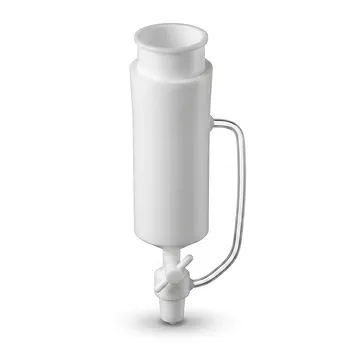
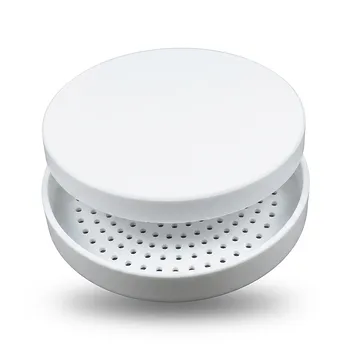
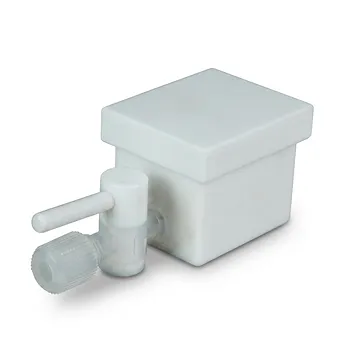
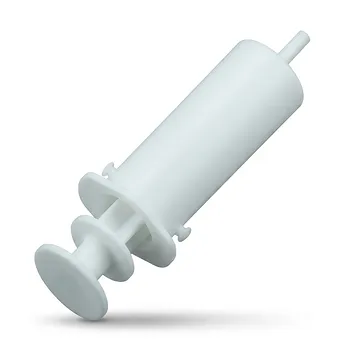
For the most demanding high-purity labware, fully fluorinated polymers such as PTFE generally provide the widest safety margin. PTFE offers the highest continuous service temperature of the materials discussed, approximately 260°C, along with exceptional resistance to acids, bases, and most organic solvents. Partially fluorinated plastics such as PVdF, PCTFE, and ETFE usually provide higher tensile strength, stiffness, toughness, or barrier performance, but at the cost of lower temperature capability and narrower chemical compatibility.
Choose PTFE when chemical inertness, thermal endurance, and low contamination risk are the primary requirements. Choose PVdF, PCTFE, or ETFE when mechanical strength, rigidity, gas impermeability, transparency, or resistance to mechanical damage matters more than maximum chemical and thermal performance.
Why Fluorination Changes Labware Performance
Fully Fluorinated Polymers Form a Protective Chemical Shield
PTFE has a carbon backbone surrounded by fluorine atoms. This non-polar carbon-fluorine structure limits molecular interaction with solvents and reagents, giving PTFE unusually broad chemical resistance and very low solvent absorption.
The same structure produces low surface energy, a low coefficient of friction, and strong non-stick behavior. These properties are useful for vessels, tubing, fittings, liners, and components where residue retention or sample carryover must be minimized.
Partial Fluorination Increases Intermolecular Interaction
PVdF and ETFE retain hydrogen-containing groups, while PCTFE replaces part of the fluorine content with chlorine. These structural changes increase intermolecular interactions within the polymer.
The result is generally greater mechanical strength, stiffness, hardness, or toughness than standard PTFE. The trade-off is that these polymers are more chemically and thermally sensitive than fully fluorinated alternatives.
Thermal Stability Determines the Operating Envelope
PTFE Handles the Highest Continuous Temperatures
PTFE has a melting point of approximately 327°C and a continuous service temperature of about 260°C, depending on grade, load, environment, and design. It is therefore well suited to aggressive thermal cycling, heated reaction systems, and high-temperature digestion equipment.
PTFE also retains a significant thermal-stability advantage over PCTFE under decomposition testing. The temperature associated with 25% weight loss is approximately 482°C to 494°C for PTFE, compared with roughly 349°C to 355°C for PCTFE, depending on the atmosphere.
PVdF and ETFE Fit Moderate-Temperature Applications
PVdF and ETFE typically operate continuously in the approximate range of 120°C to 150°C. ETFE is often suitable up to around 150°C, but the actual limit depends on mechanical loading and exposure duration.
These temperatures are adequate for many laboratory fluid-handling applications, but they provide less margin for repeated high-temperature cycles, hot solvent exposure, or externally heated vessels.
PCTFE Performs Well at Cryogenic Temperatures
PCTFE can be useful across a broad low-temperature range, including applications reported around -255°C to +150°C. Its low cold flow under compression and high stiffness make it valuable for specialty seals and cryogenic components.
Its upper-temperature performance and thermal stability remain below PTFE, so PCTFE should not be selected solely because it is a fluoropolymer. Its strength is a particular combination of rigidity, dimensional stability, and barrier performance.
Chemical Resistance Is Usually the Deciding Factor
PTFE Provides the Broadest Compatibility
PTFE is generally the preferred material for concentrated acids, strong bases, aggressive oxidizers within the material's compatibility limits, and most standard organic solvents. It is also highly resistant across a broad pH range.
This makes PTFE appropriate for microwave digestion vessels, electrochemical cells, centrifuge tubes, reaction vessels, tubing, and fluid-contact components used in trace analysis. It reduces the risk that the labware will swell, dissolve, degrade, or contribute extractables to the sample.
PTFE is not chemically invulnerable. Highly reactive fluorinating agents, molten alkali metals, and certain extreme chemical conditions require a specific compatibility review rather than a blanket assumption of resistance.
PVdF Has Good but More Limited Chemical Resistance
PVdF resists many acids, bases, salts, and halogens and is suitable for numerous moderate chemical-processing environments. However, its hydrogen-containing structure makes it more vulnerable than PTFE to swelling or dissolution in some polar organic solvents, particularly at elevated temperature.
Amides, ketones, and hot aromatic compounds deserve particular scrutiny before PVdF is used in wetted high-purity components.
ETFE Resists Many Chemicals but Has Important Exceptions
ETFE offers strong resistance to many chemicals and is tougher than PTFE. However, it can be attacked by strong oxidizing acids, boiling sulfonic acids, and organic amines that PTFE and PFA generally tolerate more effectively.
ETFE is therefore a strong candidate for mechanically demanding tubing, fittings, and protective components, but not the default choice for the most aggressive chemical environments.
PCTFE Requires Solvent-Specific Evaluation
PCTFE provides useful resistance to many acids and chemical reagents, but it is less universally resistant than PTFE. Certain organic solvents can attack or affect it, especially under hot or prolonged exposure.
For PCTFE, compatibility should be checked against the exact reagent, concentration, temperature, stress level, and exposure time. Its selection is usually driven by barrier or mechanical requirements rather than maximum chemical inertness.
Mechanical Properties Favor the Partially Fluorinated Materials
PTFE Has Moderate Strength and High Cold-Flow Risk
Standard PTFE typically has tensile strength in the range of 20 to 35 MPa. It is chemically robust, but it is comparatively soft and can deform under sustained compressive loads.
PTFE's creep and cold flow can affect threaded parts, thin walls, seals, and fittings. Filled PTFE grades can improve wear resistance, stiffness, or dimensional stability, but fillers may be unacceptable in applications requiring the lowest possible contamination risk.
PVdF Provides Higher Strength and Rigidity
PVdF commonly provides tensile strength around 30 to 70 MPa, depending on grade and processing. Its higher strength and modulus make it more suitable than standard PTFE for components that must retain shape under mechanical load.
This advantage must be balanced against its lower temperature ceiling and narrower resistance to aggressive solvents.
ETFE Improves Toughness and Cut-Through Resistance
ETFE typically provides tensile strength around 38 to 42 MPa and has superior toughness and resistance to mechanical cut-through compared with PTFE. It is useful where tubing, liners, or components may experience abrasion, impact, flexing, or sharp-edge contact.
ETFE's mechanical advantage does not eliminate the need to evaluate chemical and thermal exposure. It is a tougher material, not a universally more resistant one.
PCTFE Offers Stiffness and Dimensional Stability
PCTFE generally provides higher mechanical rigidity than PTFE and exhibits lower cold flow under compressive loading. These properties are valuable for seals, valves, precision components, and applications where dimensional stability is important.
PCTFE also has significantly lower gas permeability than PTFE, which can be decisive for moisture-sensitive or oxygen-sensitive systems.
Match the Polymer to the Labware Function
Use PTFE for Chemical Contact and Thermal Stress
PTFE is the strongest general-purpose choice when the component will contact highly aggressive reagents, undergo elevated-temperature cycles, or be used in ultra-pure trace analysis.
Its lower hardness and potential for creep should be addressed through appropriate geometry, support, wall thickness, and sealing design.
Use PVdF for Stronger Moderate-Temperature Components
PVdF is appropriate when the application needs better strength and rigidity than PTFE can provide, while chemical exposure remains within PVdF's compatibility range.
It is often a practical choice for fluid-handling components operating at moderate temperatures, provided that polar solvents and elevated-temperature exposure have been assessed.
Use ETFE for Tough, Mechanically Exposed Parts
ETFE is well suited to applications where resistance to impact, abrasion, flexing, and cut-through is important. It can be preferable for protective liners, tubing, and fittings that face mechanical abuse.
It should be avoided when the system involves chemicals known to attack ETFE or temperatures approaching its upper service range.
Use PCTFE for Barrier and Precision Requirements
PCTFE is particularly valuable when low gas permeability, optical clarity, stiffness, or low compressive creep is more important than maximum temperature or solvent resistance.
Its transparency can also support visual inspection, while its barrier performance helps protect sensitive contents from gas transmission. These benefits are application-specific and do not make PCTFE a replacement for PTFE in highly aggressive chemical service.
Understanding the Trade-offs
Higher Strength Does Not Mean Better Overall Performance
PVdF, PCTFE, and ETFE can outperform PTFE mechanically, but mechanical strength is only one part of labware suitability. A stronger material that swells, extracts, or degrades in the process chemical can create a greater failure and contamination risk than a softer but chemically inert material.
The correct comparison must include temperature, chemical concentration, exposure time, stress, and cleanliness requirements.
High Purity Depends on Grade and Processing
Polymer family alone does not guarantee high-purity performance. Resin grade, manufacturing method, surface finish, additives, fillers, cleaning procedure, and prior service history can all affect extractables and contamination.
For trace analysis, select materials specifically qualified for high-purity service and verify extractables, leachables, and cleaning compatibility where the application requires it.
Thermal Limits Include Mechanical Loading
A polymer may tolerate a temperature chemically while failing mechanically at that same temperature. Sustained pressure, compression, flexing, and dimensional tolerances can reduce the practical operating limit.
This is especially important for PTFE seals and threaded components because creep can occur well below the melting point.
Transparency and Barrier Performance May Matter More Than Inertness
A clear PCTFE component can provide inspection capability that opaque PTFE cannot. Similarly, PCTFE's low gas permeability may be more valuable than PTFE's broader chemical resistance in a sealed, gas-sensitive application.
These are valid reasons to choose a partially fluorinated polymer, but the chemical exposure must remain within its verified compatibility envelope.
Making the Right Choice for Your Goal
The selection should begin with the most severe condition the labware must reliably withstand.
- If your primary focus is maximum chemical resistance: Choose PTFE, or another qualified perfluoropolymer such as PFA, for aggressive acids, strong bases, demanding solvents, and ultra-pure sample contact.
- If your primary focus is maximum thermal endurance: Choose PTFE for continuous service around 260°C and severe thermal cycling, subject to the design's mechanical limits.
- If your primary focus is mechanical strength and toughness: Consider PVdF or ETFE for moderate-temperature service where higher tensile strength, rigidity, or cut-through resistance is required.
- If your primary focus is gas barrier performance or dimensional stability: Consider PCTFE for low permeability, optical clarity, and lower cold flow, provided the chemical and temperature conditions are suitable.
- If your primary focus is trace-level cleanliness: Select a qualified high-purity grade, confirm the manufacturing and cleaning history, and favor PTFE when its broader resistance provides the greatest contamination margin.
The best high-purity labware material is the one that preserves chemical integrity, dimensional reliability, and sample cleanliness under the complete operating conditions, not merely the one with the highest tensile strength.
Summary Table:
| Property | PTFE | PVdF | PCTFE | ETFE |
|---|---|---|---|---|
| Continuous Service Temp | ~260°C | 120-150°C | -255 to +150°C | ~150°C |
| Chemical Resistance | Exceptional, broad | Good, but susceptible to polar solvents | Good but solvent-specific | Resistant but attacked by strong oxidizing acids |
| Tensile Strength | 20-35 MPa (moderate) | 30-70 MPa (higher) | Higher than PTFE, stiff | 38-42 MPa (tough) |
| Key Weaknesses | Soft, cold flow | Lower temp ceiling, solvent sensitivity | Limited upper temp, less universal chemical resistance | Chemical exceptions at high temps |
| Best For | Maximum inertness & heat | Strong moderate-temp components | Gas barrier, clarity, low creep | Tough, mechanically exposed parts |
Need the right high-purity labware? Let KINTEK help.
We specialize in PTFE and PFA products engineered for the most demanding applications. From standard labware like beakers and digestion vessels to custom CNC-machined components and complex electrochemical cells, our materials ensure purity, durability, and reliability.
Whether you require maximum chemical resistance, thermal endurance, or a specific mechanical property, our experts can guide you to the best polymer for your application. Contact us today to discuss your needs and get a quote.
Related Products
- Custom PTFE Filtration System Acid Resistant High Purity Semiconductor Grade Chemical Processing Filter
- High Corrosion Resistant PTFE Faucet Polytetrafluoroethylene Valve for Chemical Storage Drums and Fluid Transfer Systems Customizable Industrial Grade
- PTFE PFA Vacuum Filtration System Corrosion Resistant Customizable Shatterproof Laboratory Device
- PTFE Corrosion Resistant Filter with PFA Valve Connections and Integrated Sieve Plate
- High Temperature Chemical Resistant 50ml PTFE Syringe Customized Teflon Injector with Threaded Seal for Trace Analysis
People Also Ask
- What makes PTFE filtration systems advantageous for industrial and scientific use? Unmatched Chemical & Thermal Stability
- What sizes and pore options are available for PTFE filters? Choose the Right Filter for Your Application
- What steps are involved in selecting the proper PTFE filter? A 4-Step Guide to Optimal Filtration
- What temperature resistance do PTFE filters offer? Unmatched Thermal Stability from -200°C to +260°C
- How does the hydrophobicity of PTFE filters benefit their use? Ensure Uninterrupted Gas Flow and Solvent Filtration