Fluorinated oligomer nanocomposite matrices maintain high-temperature integrity through a combination of fluorinated polymer chemistry and inorganic network reinforcement. In fluoroalkyl end-capped oligomer composites containing calcium carbonate, strong Ca–F interactions, electrostatic attraction, and interactions between fluorinated groups and inorganic moieties help stabilize the matrix during severe heating. The inorganic phase also reduces the amount of readily combustible organic material and can form a heat-resistant framework, supporting nonflammability and structural retention during thermal processing.
Core takeaway: The matrix does not rely on the fluoropolymer alone. Its high-temperature performance comes from a hybrid structure in which strong fluorinated interfacial interactions and inorganic reinforcement limit deformation, chemical breakdown, and flame propagation.
Why the Matrix Resists Thermal Breakdown
Strong Ca–F Interactions Stabilize the Interface
In calcium carbonate-containing systems, fluorinated groups can interact strongly with calcium-containing inorganic sites. The reported Ca–F bond strength is approximately 132 kcal/mol, or 552 kJ/mol, providing a highly stable interfacial interaction.
These bonds help anchor the oligomer phase to the inorganic component. That anchoring limits chain mobility, interfacial separation, and loss of structural cohesion as temperature increases.
Fluorinated Groups Resist Oxidative Degradation
Fluorinated polymer chains, particularly those containing perfluoroalkyl or trifluoromethyl groups, have strong carbon–fluorine bonds and low surface energy. These features reduce chemical reactivity and support resistance to thermal and oxidative degradation.
Fluorination can also raise the glass-transition temperature substantially, in some formulations to well above 170°C. A higher glass-transition temperature helps the material retain useful stiffness over a broader temperature range.
Inorganic Components Carry the Thermal Load
Calcium carbonate and silica nanoparticles contribute a thermally stable inorganic phase. This phase acts as a reinforcing scaffold within the oligomer matrix and helps preserve dimensional structure when the organic component begins to soften or decompose.
In silica-based systems, sol-gel reactions can cross-link fluoroalkyl end-capped oligomers with the nanoparticle phase. The resulting hybrid network provides greater resistance to collapse than an uncross-linked fluoropolymer.
How Nonflammability Is Maintained
The Composite Contains Less Combustible Material
A nanocomposite combines an organic fluorinated phase with inorganic constituents. The inorganic fraction does not provide fuel for combustion, so it dilutes the combustible portion of the material and helps suppress flame propagation.
This is an important distinction: nonflammability is a composite-level property, not simply a consequence of the presence of fluorine in the polymer.
Heat Is Distributed Through the Hybrid Network
Nanoparticles and inorganic domains can distribute thermal stresses through the matrix. Strong interfacial bonding prevents the formation of large defects, cracks, or regions where heat can rapidly concentrate.
The result is a material that is less likely to lose its shape abruptly during high-temperature exposure.
The Network Restricts Polymer Movement
Cross-linking and fluorinated interfacial interactions constrain molecular motion. Restricted movement reduces the likelihood of rapid flow, swelling, and structural separation during thermal cycling.
In practical terms, the hybrid network behaves more like a connected framework than a collection of freely moving polymer chains.
What Happens During Extreme Heating
Thermal Resistance Does Not Mean the Polymer Is Indestructible
The reported retention of integrity after calcination at temperatures up to 800°C, and in some silica nanocomposite systems up to 800°C to 1000°C, should be interpreted carefully. At these temperatures, the organic fluoropolymer component may undergo substantial decomposition even if the composite retains a coherent inorganic-rich structure.
Therefore, visual shape retention or nonflammability does not necessarily mean that the original polymer chemistry remains unchanged.
The Inorganic-Rich Residue Preserves Form
When the organic fraction is thermally degraded, the inorganic phase and strongly bonded interfaces can preserve a residual framework. This explains how a composite may remain structurally coherent after exposure that would completely decompose a conventional polymer.
For comparison, conventional PTFE is reported to decompose around 700°C. Hybrid fluorinated silica systems can retain greater apparent structural integrity because their sol-gel-derived inorganic network carries part of the mechanical and thermal burden.
Performance Depends on the Exposure Conditions
Short calcination, continuous operation, repeated thermal cycling, oxygen availability, heating rate, and mechanical loading do not produce equivalent results. A specimen that retains its form after a laboratory furnace cycle may not provide the same performance as a continuously loaded component at the same nominal temperature.
Material qualification must therefore distinguish between survival after thermal exposure and reliable service at operating temperature.
Chemical and Dimensional Stability
Low Swelling Supports Sealing Performance
Fluorinated elastomer compounds can maintain dimensional stability in aggressive chemical environments. After one week at 100°C, reported volume swell was 2.8% in 10% sulfuric acid, 7.8% in 10% sodium hydroxide, and 6.6% in 10% ammonia.
Low swelling helps seals, valves, fittings, and fluid-transfer components retain their intended geometry. That reduces the risk of leakage or loss of contact pressure during hot chemical processing.
Resistance Extends Beyond Aqueous Chemicals
Exposure to IRM 903 reference oil at 325°F for 166 hours produced reported swelling between 1.8% and 2.5% in the tested compounds. This indicates that fluorinated formulations can also resist dimensional change in hot hydrocarbon environments.
The exact result remains formulation-dependent, particularly for elastomer systems with different cross-link densities, fillers, and cure chemistries.
Hydrophobicity Limits Unwanted Uptake
Fluorinated side groups provide strong hydrophobic character and low surface energy. In laboratory applications, these attributes can reduce chemical sorption and help preserve predictable barrier or fluid-transport behavior.
Fluorination may also increase fractional free volume and gas permeability. That benefit must be evaluated against the specific barrier requirement rather than assumed to improve every containment application.
Understanding the Trade-offs
Structural Retention Can Mask Chemical Decomposition
A composite may remain recognizable or mechanically connected after heating while its polymer phase has already degraded. Post-exposure inspection should therefore include mass change, spectroscopy, microscopy, mechanical testing, and, where relevant, analysis of volatile decomposition products.
High-Temperature Ratings Are Not Universal
The presence of Ca–F bonds or a silica network does not automatically establish a safe continuous-use temperature. The applicable rating depends on the polymer architecture, inorganic loading, cross-linking, geometry, atmosphere, pressure, and duration of exposure.
Strong Interfaces Can Reduce Flexibility
The same cross-linking and interfacial bonding that improve thermal stability can reduce elongation, processability, and impact tolerance. Increasing inorganic content may also make the material more brittle or difficult to form.
Chemical Compatibility Still Requires Testing
Fluoropolymers generally provide broad chemical resistance, but seals and composite matrices can respond differently to acids, bases, solvents, oils, and temperature. Swelling data should be obtained for the actual formulation and service conditions.
How to Apply This to Your Project
Select the formulation according to the dominant failure mode and verify performance under the actual thermal, chemical, and mechanical conditions.
- If your primary focus is extreme thermal processing: Use a fluorinated oligomer system reinforced with a strongly bonded inorganic phase, such as calcium carbonate or a sol-gel-derived silica network, and distinguish structural retention from preservation of the original polymer chemistry.
- If your primary focus is nonflammability: Evaluate the full organic-inorganic composition, inorganic loading, flame behavior, and post-exposure residue rather than relying on fluorine content alone.
- If your primary focus is dimensional stability in aggressive chemicals: Select a fluorinated elastomer or composite with measured low swelling in the relevant acid, base, ammonia, oil, or solvent at the intended temperature.
- If your primary focus is long-term component reliability: Test continuous exposure, thermal cycling, pressure, and mechanical load together, because furnace survival alone does not establish service life.
A properly designed fluorinated oligomer nanocomposite uses strong molecular interfaces and inorganic reinforcement to preserve function where an unmodified fluoropolymer would soften, decompose, or lose dimensional control.
Summary Table:
| Mechanism | Key Factor | Thermal Contribution |
|---|---|---|
| Strong interfacial bonding | Ca-F interactions (552 kJ/mol) | Anchors polymer, limits degradation |
| Fluorinated polymer chemistry | C-F bonds, high Tg (>170°C) | Resists oxidation, retains stiffness |
| Inorganic reinforcement | CaCO3, silica nanoparticles | Heat-resistant scaffold, dilutes fuel |
| Hybrid network cross-linking | Sol-gel reactions | Restricts movement, distributes stress |
| Nonflammability | Low combustible content, barrier | Suppresses flame propagation |
| Dimensional stability | Low swelling in chemicals | Maintains geometry in harsh conditions |
Need high-performance fluoropolymer labware that withstands extreme heat and chemicals? At KINTEK, we specialize in PTFE and PFA products, from beakers to custom CNC-machined parts, designed for demanding applications. Our materials maintain integrity at high temperatures, ensuring safety and reliability. Contact us today to find the right solution for your lab: Contact KINTEK.
Related Products
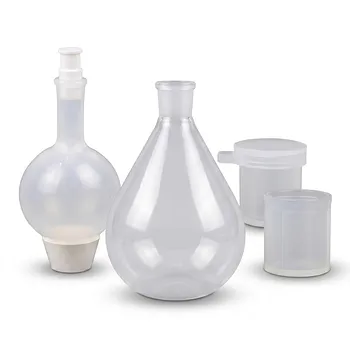
- PFA Eggplant Flask Custom Molded Pear Shaped Laboratory Flask Corrosion Resistant Glass Alternative
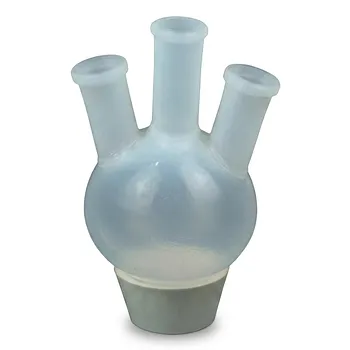
- Custom Corrosion Resistant PFA PTFE Multi Neck Laboratory Reaction Flask GL Standard Mouth Fluoropolymer Flasks
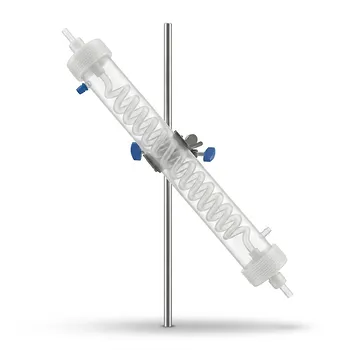
- Custom PFA Serpentine Straight Condenser HF Resistant Reaction Device Laboratory Cooling Column
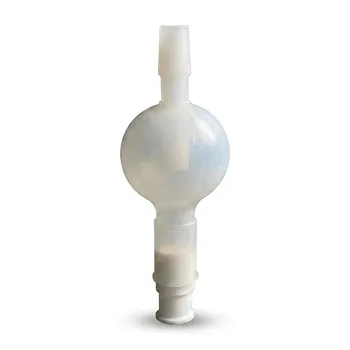
- High Purity PFA Chromatography Column with Collection Bottle Corrosion Resistant Fluoropolymer Filtration System for Trace Analysis
- Custom Multi Neck PTFE Flask for Chemical Engineering and High Purity Laboratory Synthesis Applications
People Also Ask
- Why is the chemical stability of polymer endgroups critical when selecting melt-processible fluoropolymers like PFA for high-purity laboratory apparatus? Choose Stable Endgroups for Reliable Performance
- Why is PFA often selected over traditional PTFE for manufacturing complex fluoropolymer fluid components, custom fittings, and sealed laboratory digestion vessels? Discover the key advantages for your lab.
- What are the characteristics of PFA material? A Guide to Its High-Performance Balance
- What are the key properties of PFA (PerFluoroAlkoxy)? A Guide to Extreme Chemical and Thermal Resistance
- Why is perfluoroalkoxy polymer (PFA) often selected over PTFE and FEP for complex molded lab apparatus?