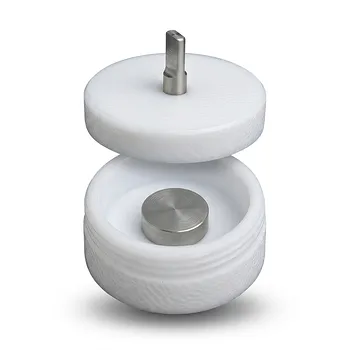
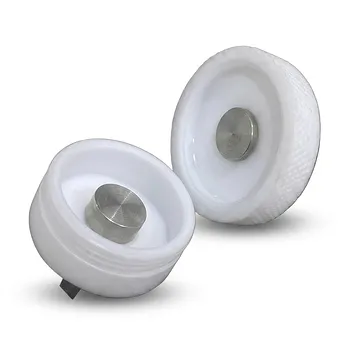
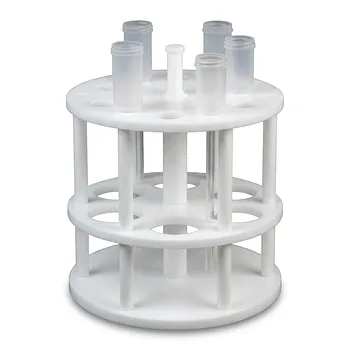
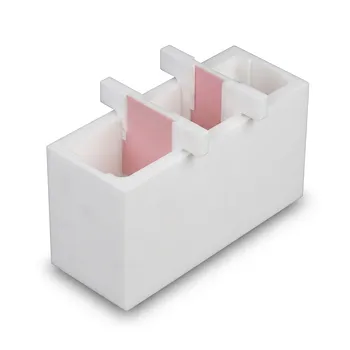
Evaluating MnFe2O4/rGO electrode materials requires specialized electrochemical test fixtures to ensure precise mechanical support and minimize internal resistance. These fixtures create a controlled environment that allows the material's true electrochemical potential to be measured without interference from poor physical connections. By stabilizing the interface between the electrode and the current collector, they ensure that data regarding capacitance, rate capability, and cycle life is both accurate and reproducible.
Specialized fixtures isolate the material's intrinsic performance by eliminating parasitic variables like contact resistance and electrolyte evaporation, which would otherwise lead to significant measurement errors in high-performance supercapacitor testing.
Optimizing Electrical and Mechanical Interconnectivity
Minimizing Equivalent Series Resistance (ESR)
For composite materials like MnFe2O4/rGO, achieving low-impedance electrical connections is vital for reflecting energy release capabilities. Specialized fixtures apply stable contact pressure between the carbon-based electrode and the current collector, which directly reduces ESR. This reduction is critical for capturing the material's performance at high current densities, where even minor resistance can cause significant voltage drops.
Ensuring Uniform Current Distribution
Precise fixture design ensures that current is distributed evenly across the entire surface of the MnFe2O4/rGO electrode during Galvanostatic Charge-Discharge (GCD). Without uniform distribution, gravimetric capacitance measurements become unreliable because parts of the material may be underutilized or overstressed. This uniformity is a prerequisite for generating repeatable experimental data in a laboratory setting.
Reducing Thermal and Voltage Distortion
By maintaining a constant and uniform mechanical pressure, specialized fixtures prevent thermal effects and voltage fluctuations caused by unstable physical connections. This ensures that the collected electrochemical signals represent the energy storage characteristics of the material itself. This precision is particularly important when evaluating the subtle redox peaks of metal oxides like MnFe2O4.
Maintaining Chemical and Environmental Stability
Preventing Electrolyte Evaporation
Specialized test cells incorporate sealing structures that prevent the evaporation of the electrolyte during long-term testing. Maintaining a constant electrolyte volume is essential for the accuracy of cycle stability tests, as any loss of solvent would artificially alter the chemical concentration. This sealed environment is fundamental for ensuring that the reference electrode remains stable throughout the experiment.
Standardizing the Testing Environment
Whether using a two-electrode or three-electrode configuration, specialized fixtures provide a standardized environment for MnFe2O4/rGO. They ensure full contact between the electrolyte and the electrode material, which is necessary for accurate Cyclic Voltammetry (CV) and Electrochemical Impedance Spectroscopy (EIS). A standardized setup allows researchers to compare results across different batches and laboratories with confidence.
Supporting Interface Integrity
The mechanical stability provided by these fixtures ensures that the separators and electrode interfaces remain tightly compressed. This prevents the physical shifting of components during the expansion and contraction cycles common in supercapacitor materials. Such stability is vital for evaluating the long-term cycle life of the composite material under realistic operating conditions.
Understanding the Trade-offs
Complexity and Setup Time
While specialized fixtures offer superior accuracy, they often require more meticulous assembly and cleaning compared to basic setups. Incorrectly applied pressure can damage delicate rGO structures or cause short circuits if the internal components are misaligned. Researchers must balance the need for precision with the increased time investment required for each test run.
Cost and Material Compatibility
High-precision fixtures are significantly more expensive than standard laboratory glassware or makeshift holders. Additionally, the materials used in the fixture must be chemically inert to the specific electrolytes used with MnFe2O4/rGO to avoid corrosion or secondary reactions. Choosing the wrong fixture material can introduce new impurities into the system, defeating the purpose of high-precision testing.
How to Apply This to Your Project
When selecting or designing a fixture for MnFe2O4/rGO evaluation, consider your specific research goals:
- If your primary focus is rate capability: Prioritize fixtures that offer the lowest possible Equivalent Series Resistance (ESR) and high-conductivity current collectors.
- If your primary focus is cycle stability: Ensure the fixture has a robust sealing structure to prevent electrolyte evaporation over thousands of cycles.
- If your primary focus is material comparison: Use a standardized three-electrode cell to maintain a consistent environment for all test samples.
- If your primary focus is commercial scalability: Utilize pouch cell or coin cell fixtures that simulate the mechanical pressures found in real-world supercapacitor housings.
By utilizing specialized electrochemical fixtures, you ensure that your data reflects the true scientific potential of your MnFe2O4/rGO composites rather than the limitations of your testing apparatus.
Summary Table:
| Key Feature | Benefit for MnFe2O4/rGO Testing | Impact on Data Accuracy |
|---|---|---|
| Stable Contact Pressure | Minimizes Equivalent Series Resistance (ESR) | Accurate high-current energy release data |
| Advanced Sealing | Prevents electrolyte evaporation | Reliable long-term cycle stability results |
| Uniform Design | Ensures even current distribution | Precise gravimetric capacitance measurement |
| Inert Construction | Eliminates secondary chemical reactions | High-purity electrochemical signals |
| Mechanical Stability | Prevents interface shifting/delamination | Repeatable CV and EIS spectroscopy |
Elevate Your Research with Precision Fluoropolymer Engineering
At KINTEK, we understand that the integrity of your electrochemical data depends on the quality of your testing environment. We specialize in high-performance laboratory supplies crafted from PTFE and PFA, ensuring that your MnFe2O4/rGO evaluations remain free from impurities and parasitic resistance.
From everyday essentials like beakers, crucibles, and high-purity trace analysis tools to advanced standard and custom electrochemical cells and battery testing fixtures, KINTEK provides everything you need for specialized energy storage research. Our capabilities extend to comprehensive fluid transfer components (tubing, valves), sample prep tools, and complex custom CNC-fabricated parts designed for bespoke laboratory setups.
Ready to eliminate measurement errors and achieve repeatable, high-precision results?
Contact KINTEK today to discuss your high-volume orders or custom-machined components. Let us provide the high-performance fluoropolymer solutions your research deserves.
References
- Kun-Yauh Shih, H.‐H. Tseng. One-Step Microwave-Assisted Synthesis of MnFe<sub>2</sub>O<sub>4</sub>/rGO Nanocomposites and Their Electrochemical Properties in Supercapacitors. DOI: 10.1021/acsomega.4c07810
This article is also based on technical information from Kintek Knowledge Base .
Related Products
- Acid Resistant PTFE Button Cell Battery Test Fixture Customizable Machining High Purity Electrochemical Testing Clamp
- Corrosion Resistant PTFE Coin Cell Battery Testing Clamps and Acid Proof Custom Fluoropolymer Battery Fixtures
- Custom PFA Microcolumn Racks and PTFE Machined Low Background Corrosion Resistant Laboratory Fixtures
- Corrosion Resistant PTFE Electrochemical Cell for New Energy Research Inert Insulating Customizable Lab Reaction Vessel
- Custom PTFE Electrolytic Cell Corrosion Resistant Low Background Reaction Vessel with Inlet Outlet Ports
People Also Ask
- In what ways do PTFE battery testing fixtures enhance laboratory throughput and reliability? Maximize Research Efficiency
- How does the chemical inertness of PTFE benefit laboratory-scale battery testing? Ensure high-purity research results.
- In what industrial manufacturing contexts are PTFE battery clamps or fixtures utilized? Optimize Battery Production.
- What is the thermal operating range for PTFE battery clamps in electrochemical research? Stability from -200°C to +260°C
- What are the primary functions and material compositions of PTFE battery clamps? Ensure Precision & Chemical Resistance