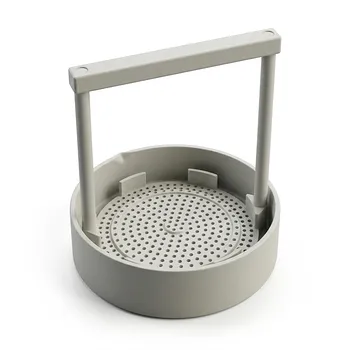
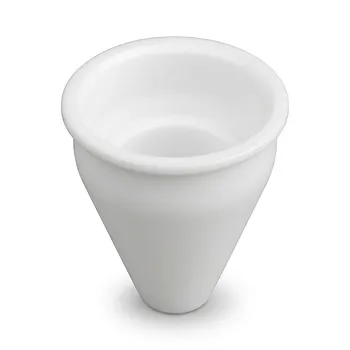
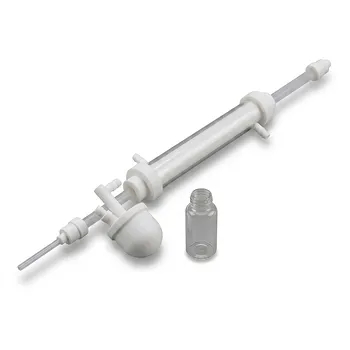
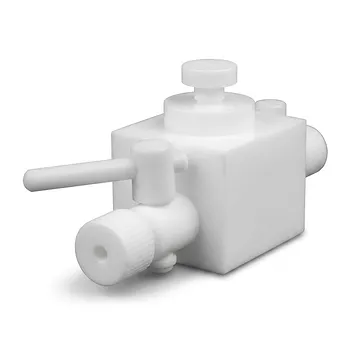
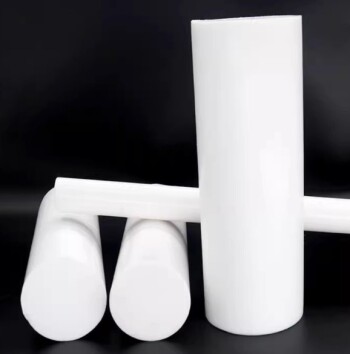
Pelletized free-flow granular PTFE resins offer a major manufacturing advantage over fine-cut powders: they fill molds more quickly, uniformly, and reliably. Their soft agglomerated structure increases bulk density and powder flow, making them better suited to automatic and isostatic molding of laboratory supplies such as beakers, cylinders, containers, and valve bodies. Wet-bead processing before pelletization can also remove trapped initiator residues, supporting high chemical purity, consistent color, and visual clarity in the finished product.
The central benefit is process reliability: pelletized PTFE reduces bridging, incomplete filling, and oversized tooling requirements while producing more uniform molded preforms for laboratory supplies.
Why Fine-Cut Powders Create Manufacturing Problems
Low Bulk Density Increases Tooling Demands
Fine-cut PTFE powders typically have low apparent bulk density, often below 500 g/L. The mold must therefore accommodate more powder volume to achieve the required compacted part size.
This can require larger mold cavities and tooling, increasing equipment size and reducing manufacturing efficiency.
Poor Flow Causes Incomplete Filling
Fine particles do not move freely through automated feed systems or into intricate mold cavities. They can bridge over openings, form voids, or fail to reach narrow sections of the mold.
The result may be incomplete mold filling, nonuniform density, and inconsistent dimensions in the molded laboratory component.
Manual Handling Becomes More Difficult
Poor-flowing powder is harder to meter and transfer consistently. That creates additional process sensitivity when manufacturers depend on automated molding cycles or repeatable charge weights.
How Pelletization Improves Mold Filling
Higher Bulk Density Uses Tooling More Efficiently
Pelletized resins convert fine PTFE particles into soft agglomerates. These agglomerates occupy less volume per unit of material, increasing apparent bulk density, commonly above 500 to 550 g/L and in some grades substantially higher.
Manufacturers can use smaller or more efficiently sized tooling for a given part weight and geometry.
Free Flow Supports Automatic Molding
The larger, soft agglomerates move more readily through hoppers, feed systems, and mold entrances. This improves powder flow rate and makes automated charging more consistent.
For example, the referenced processing data indicates that flow can increase from approximately 6 g/s for fine-cut material to more than 12 g/s for free-flow material.
Complex Cavities Fill More Completely
Improved flow helps the resin reach corners, narrow passages, and other features in complex mold cavities. This is particularly valuable for molded labware and valve components with demanding geometry.
More complete filling supports uniform compaction and homogeneous density throughout the molded stock.
Manufacturing Benefits for Molded Laboratory Supplies
More Consistent Part Quality
Uniform mold filling reduces local differences in compaction and density. After sintering, this can produce more consistent molded preforms with fewer internal defects and more predictable machining behavior.
That consistency matters when manufacturing repeated batches of beakers, cylinders, valve bodies, seals, or machined laboratory components.
Better Compatibility With Automated and Isostatic Molding
Free-flow granular PTFE is designed for processes that depend on reliable powder movement and repeatable cavity charging. It is therefore well suited to automatic compression molding and isostatic molding.
This can reduce operator intervention and improve cycle-to-cycle repeatability.
Dense, Void-Free Stock for Machining
Properly filled molds can produce dense molded billets, blocks, and other stock shapes. These preforms are suitable for precision CNC machining into complex laboratory apparatus, containers, reaction vessels, valve seats, and bushings.
The key advantage is not simply faster filling; it is the ability to start with a more uniform and structurally reliable blank.
Reduced Risk of Bridging and Defects
Fine-cut powders can form bridges at mold entrances or within feeding equipment. Pelletized material is less prone to this behavior because its agglomerates flow more freely.
Reducing bridging lowers the risk of underfilled areas, density variation, and rejected parts.
Purity and Appearance Advantages
Removal of Trapped Initiator Residues
When wet polymer beads are processed before pelletization, the process can remove trapped initiator residues. This is an important distinction for applications where internal cleanliness and appearance matter.
The result is a resin better suited to producing molded laboratory supplies with high chemical purity and consistent visual quality.
Improved Color and Visual Clarity
Residual materials trapped within the polymer can contribute to internal discoloration during processing. Removing those residues helps maintain the clean, white appearance and visual clarity expected in PTFE laboratory products.
This is especially relevant for transparent or translucent inspection areas, visual fluid handling, and products where contamination must be readily detectable.
Understanding the Trade-offs
Fine-Cut Powder Can Provide Stronger Final Properties
Fine-cut PTFE generally offers higher tensile strength, elongation, specific gravity, and dielectric breakdown strength than free-flow grades. Its small particle structure can therefore be preferable when maximum mechanical integrity or electrical performance is the primary requirement.
Pelletized resin may provide somewhat lower tensile and elongation properties, depending on the grade and molding conditions.
Pelletized Resin Is Not the Universal Choice
Free-flow PTFE is advantageous when efficient molding, uniform filling, and automated processing are central requirements. It is not automatically the best material for every laboratory application.
High-integrity reactor liners, fluid gaskets, and electrical insulation may require the property profile of fine-cut resin instead.
Do Not Confuse Granular PTFE With Fine Powder PTFE
Granular PTFE, whether fine-cut or pelletized, is generally associated with compression molding and high-temperature sintering of solid stock shapes. Fine powder PTFE is a different material category commonly used in paste extrusion for tubing, hoses, and sealing tape.
Selecting between these materials requires matching the resin to the forming process and final product geometry, not simply choosing the grade with the highest flowability.
Making the Right Choice for Your Goal
Select the resin based on the manufacturing constraint that matters most for the laboratory supply.
- If your primary focus is automated or isostatic molding: Choose pelletized free-flow granular PTFE to improve metering, cavity filling, cycle consistency, and resistance to bridging.
- If your primary focus is smaller or more efficient tooling: Choose a higher-bulk-density free-flow grade to reduce the powder volume required for a given molded charge.
- If your primary focus is uniform density and machinable stock shapes: Use pelletized granular PTFE to produce consistently filled billets, blocks, and preforms for CNC machining.
- If your primary focus is chemical purity and appearance: Select pelletized resin made from properly processed wet polymer beads to reduce initiator residues and limit internal discoloration.
- If your primary focus is maximum tensile, elongation, or dielectric performance: Evaluate fine-cut granular PTFE, accepting its more difficult flow and larger tooling requirements.
For molded laboratory supplies, pelletized free-flow PTFE is the stronger manufacturing choice when reliable filling, automation, tooling efficiency, and consistent product quality outweigh the peak mechanical properties of fine-cut powder.
Summary Table:
| Aspect | Pelletized Free-Flow PTFE | Fine-Cut Powder PTFE |
|---|---|---|
| Bulk density | Higher (often >500 g/L) | Lower (often <500 g/L) |
| Flow rate | Increased (e.g., >12 g/s) | Reduced (e.g., ~6 g/s) |
| Mold filling | Uniform and complete | Risk of bridging and voids |
| Tooling efficiency | Smaller molds possible | Larger molds required |
| Automation suitability | Excellent | Difficult |
| Mechanical properties | Lower tensile/elongation | Higher tensile/elongation |
| Chemical purity | Improved (residues removed) | Possibly lower purity |
| Appearance | Clean, consistent color | Potential discoloration |
Elevate your lab supply manufacturing with KINTEK's high-performance PTFE and PFA materials. Our pelletized free-flow granular resins ensure efficient molding, superior purity, and consistent quality for beakers, valves, and custom parts. With end-to-end CNC machining and comprehensive labware solutions, we empower your production. Contact us today to discover how we can meet your exact specifications and boost your operational efficiency!
Related Products
- Custom PTFE Condensation Reflux Distillation Purification System 500ml Corrosion Resistant Low Background
- High Purity Laboratory Grade PTFE Syringe Chemical Resistant Fluoropolymer Injector for Trace Analysis
- Custom PTFE Teflon Balls for Advanced Industrial Applications
- Custom PTFE Condensation Reflux Apparatus with Serpentine Coil and Flask Collection System for Corrosive Chemical Processing
- Corrosion Resistant PTFE Dispersing Disc and High Temperature Propeller Stirring Paddle for Laboratory Chemical Mixing
People Also Ask
- How does PTFE's melting behavior affect custom lab apparatus? Key insights for manufacturing.
- What are the mechanical and safety advantages of using PTFE apparatus in a laboratory? Enhance Safety & Durability
- How can PTFE be customized for specific applications? Tailor Performance with Fillers & Fabrication
- How does the low surface energy of PTFE benefit the condensation process? Boost Heat Transfer and Prevent Fouling
- What makes PTFE filtration systems advantageous for industrial and scientific use? Unmatched Chemical & Thermal Stability