For large PTFE fine-powder batches, use a controlled low-shear blending sequence: load the resin gently, distribute the lubricant evenly, tumble the twin-shell V-blender at approximately 24 rpm, then screen and age the compound before extrusion. A 25 kg batch typically requires about 13 minutes of blending, while larger batches require a validated time adjustment rather than aggressive increases in speed.
The objective is uniform lubricant absorption without shearing or fibrillating the PTFE particles. Low-speed tumbling, controlled temperature and humidity, careful screening, and adequate aging are more important than maximizing mixer intensity.
Prepare the Blending Environment
Control the Temperature
Conduct blending in an enclosed, clean area maintained below approximately 19 °C, the PTFE transition temperature referenced for this process. Keeping the resin cool helps reduce premature particle deformation or fibrillation during handling.
Temperature control should include the resin, lubricant, blender, and surrounding work area. Local heating from equipment or prolonged processing can affect compound consistency.
Control Humidity and Contamination
Maintain relative humidity at approximately 50% and prevent lint, dust, and foreign material from entering the blender. Use clean, lint-free work clothing and ensure that the equipment is suitable for fine-powder handling.
Because the lubricant may be an organic hydrocarbon, the facility should use grounded equipment, antistatic flooring, and explosion-proof lighting where required by the lubricant's safety classification and local regulations.
Confirm the Blender Is Clean and Sealed
Before loading, verify that the twin-shell V-blender is clean, dry, and free of residue from previous materials. Confirm that closures, seals, and access ports can prevent lubricant evaporation during blending.
A tight seal is important because loss of lubricant changes the formulation and can produce non-uniform extrusion behavior.
Load the PTFE Resin Without Shearing It
Add the Powder Carefully
Load the PTFE fine powder into the V-blender without applying excessive force, compacting it, or allowing it to fall violently against the vessel. Fine-powder PTFE is highly shear-sensitive, and aggressive handling can damage the resin structure before lubricant addition.
The powder should be distributed into the blender as evenly as practical while avoiding scraping, pressing, or high-impact loading methods.
Check the Batch Size
For large batches, the process is commonly applied to approximately 25 kg to 70 kg of PTFE resin. Do not assume that the same blending time is automatically suitable across this entire range.
The working fill level, blender geometry, lubricant quantity, resin grade, and powder flow behavior should be considered when establishing the final cycle.
Add and Blend the Lubricant
Distribute the Lubricant Evenly
Add the required liquid lubricant evenly across the powder bed rather than concentrating it in one location. Uniform distribution reduces wet spots, dry regions, and hard agglomerates.
Close the blender promptly after addition to limit evaporation. The lubricant quantity must follow the formulation for the specific PTFE grade and extrusion process.
Use Low-Speed Tumbling
Operate the twin-shell V-blender at approximately 24 rpm. This provides multidirectional movement while limiting the shear and impact that can cause premature fibrillation.
For a 25 kg batch, approximately 13 minutes is a practical starting point. Larger batches may require a longer, validated cycle, but extending time strictly in direct proportion to batch mass should be treated as an initial estimate rather than a universal rule.
Judge Uniformity by Process Results
The blended material should appear uniformly lubricated, without obvious dry powder zones or concentrated wet regions. Visual inspection alone is not sufficient to establish final quality.
Use the first production trials to correlate blend time and loading conditions with sieve behavior, lubricant distribution, bulk handling, preforming, and extrusion performance.
Screen and Age the Compound
Screen Out Loose Agglomerates
After blending, pass the lubricated resin through a suitable screen. The purpose is to remove loose agglomerates and improve the consistency of the compound before processing.
Hard lumps that do not break easily should be isolated and investigated rather than forced through the screen. They may indicate excessive local wetting, contamination, poor lubricant distribution, or damaging handling conditions.
Transfer the Material to a Sealed Container
Place the screened compound in a tightly sealed jar or return it to the original drum, provided that the drum is clean, compatible with the lubricant, and capable of maintaining a reliable seal.
Minimize exposure to the open environment during transfer. Evaporation or contamination during this stage can undermine an otherwise acceptable blend.
Allow Sufficient Aging
Age the sealed compound for at least 12 hours at approximately 35 °C, unless the material supplier or validated process specifies otherwise. Aging allows the lubricant to diffuse uniformly into the porous PTFE particles.
The compound should remain sealed during aging so that lubricant loss does not change the formulation. After aging, inspect and screen the material again if minor agglomeration is present before preforming or extrusion.
Understanding the Trade-offs
More Mixing Is Not Always Better
Increasing speed or mixing intensity may shorten the apparent blending time, but it also increases the risk of PTFE shearing and premature fibrillation. The relevant target is uniform lubricant absorption, not maximum mechanical action.
A longer low-shear cycle is generally preferable to a high-speed cycle, provided that lubricant evaporation and temperature rise remain controlled.
Larger Batches Do Not Scale Perfectly
A larger mass changes the powder bed depth, movement pattern, contact frequency, and heat-transfer behavior. Therefore, simply multiplying the 13-minute cycle by the ratio of batch masses may produce an unsuitable process.
Use proportional adjustment only as a starting point, then confirm the result through product-quality and extrusion-performance checks.
Screening Cannot Repair Severe Damage
Screening can remove loose agglomerates, but it cannot restore PTFE particles that have been structurally damaged by excessive shear or impact. Hard lumps should be treated as a process signal, not merely as material to be forced through the screen.
Aging Requires Formulation and Temperature Control
Aging at approximately 35 °C supports lubricant diffusion, but it does not compensate for incorrect lubricant addition, evaporation, contamination, or poor initial mixing. The container must remain sealed and the aging conditions must be consistent from batch to batch.
How to Apply This to Your Project
The following priorities provide a practical basis for establishing the twin-shell V-blender procedure:
- If your primary focus is uniform lubricant distribution: Load gently, add the lubricant evenly, blend at approximately 24 rpm, and confirm uniformity through screening and extrusion trials.
- If your primary focus is preventing PTFE fibrillation: Keep the process below approximately 19 °C and avoid high-speed, high-impact, or forceful powder handling.
- If your primary focus is scaling from 25 kg to larger batches: Use the 13-minute cycle for 25 kg as a starting reference, then validate the required time for the actual batch size and blender fill level.
- If your primary focus is consistent downstream extrusion: Seal and age the compound for at least 12 hours at approximately 35 °C before preforming or extrusion.
- If your primary focus is troubleshooting hard lumps: Isolate lumps that resist screening and investigate lubricant distribution, contamination, temperature, loading, and blending intensity.
A successful large-batch PTFE blend is achieved through gentle, temperature-controlled tumbling followed by sealed aging, not through higher mixer intensity.
Summary Table:
| Parameter | Recommended Value | Key Consideration |
|---|---|---|
| Temperature | < 19 °C | Prevents premature fibrillation |
| Humidity | ~50% RH | Avoid static and contamination |
| Mixing speed | ~24 rpm | Low shear, uniform tumbling |
| Blend time (25 kg) | ~13 min | Starting point; validate for larger batches |
| Aging time | ≥ 12 h at ~35 °C | Allows lubricant diffusion |
| Screening | After blending | Removes loose agglomerates |
Optimize your PTFE blending process with KINTEK's high-performance fluoropolymer labware and custom solutions. Our PTFE and PFA products are designed for precision and reliability, ensuring consistent results in your powder blending applications. Contact us today to discuss your requirements and benefit from our expert support, custom CNC machining, and high-volume supply capabilities. Get in touch now!
Related Products
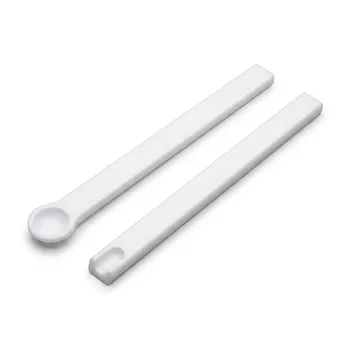
- Corrosion Resistant PTFE Sampling Spoon for High Purity Solid Powder Reagent Handling and Laboratory Chemical Transfer
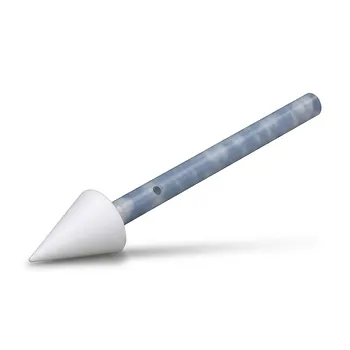
- High Temperature Resistant PTFE Solid Sampler Corrosion Resistant Non Leaching Reusable Biopharmaceutical White Powder Sampling Device
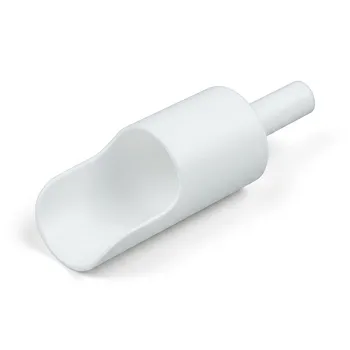
- Custom PTFE Pharmaceutical Sampling Scoop Low Leaching Cylindrical Chemical Powder Sampler Zero Contamination High Purity Laboratory Shovel
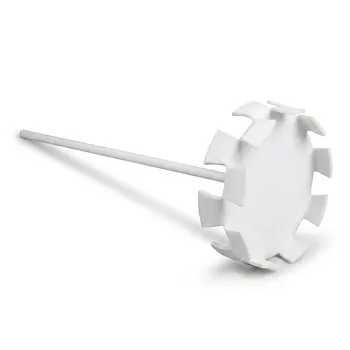
- PTFE Dispersion Disk Food Cosmetic Grade Non Stick Corrosion Resistant Large Stirring Paddle Customizable Impeller
- Corrosion Resistant PTFE Stirring Paddle and Customizable Toothed Dispersion Disk for Chemical Pharmaceutical Mixing
People Also Ask
- How does PTFE's chemical resistance make it suitable for high-purity lab supplies and transfer systems? Discover its key benefits in handling extreme corrosives.
- How do the high melting point and non-flowing melt characteristics of PTFE influence custom machining? Discover key fabrication insights and design tips for lab fluid components.
- How do the low surface energy and non-wetting properties of PTFE fluoropolymers benefit precision laboratory fluid transfer components and analytical labware? Discover the advantages for your lab.
- How do fluoropolymers benefit fluid transfer systems and sample prep containers? Non-stick performance for improved recovery, reduced contamination, and easier cleaning.
- What factors should be considered when selecting a PTFE shovel for laboratory use? Ensure Chemical Inertness & Sample Integrity