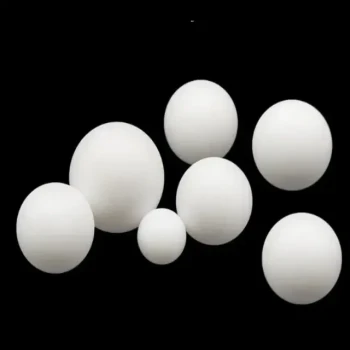
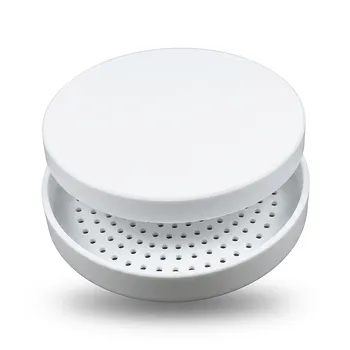
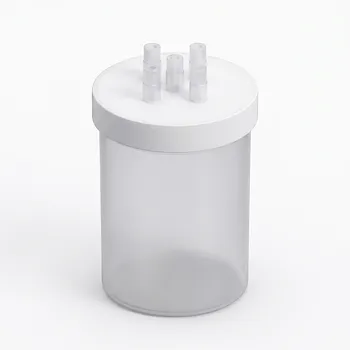
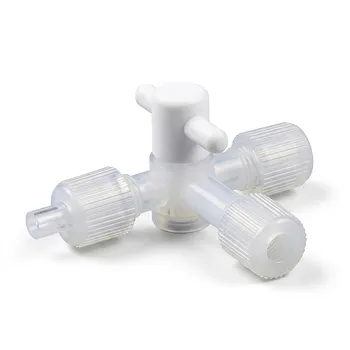
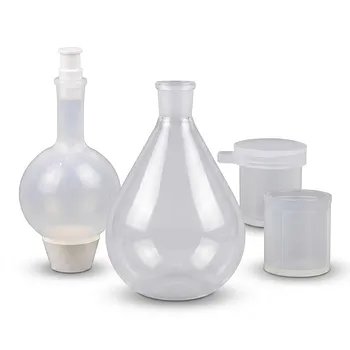
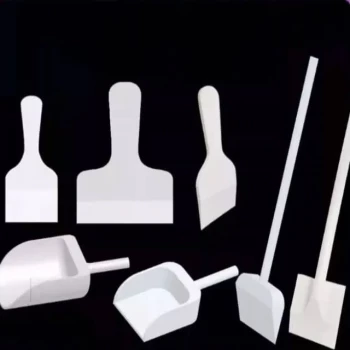
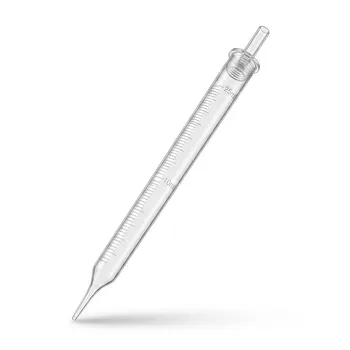
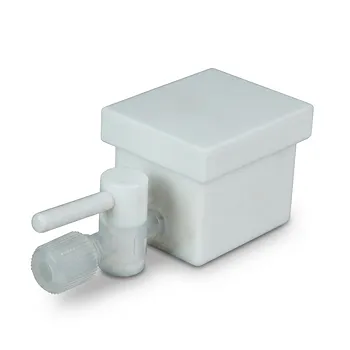
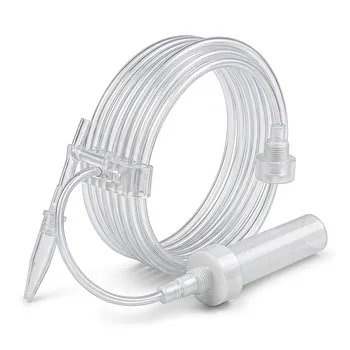
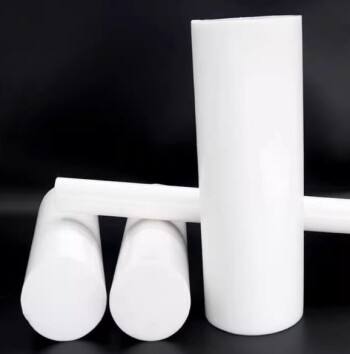
PTFE and PFA offer the strongest combination of chemical resistance and high-temperature stability among commonly used fluoropolymers. Both can support continuous service around 260°C (500°F), with PFA sometimes specified toward approximately 288°C (550°F) depending on grade and application conditions. Compared with melt-processable fluoropolymers such as FEP, ETFE, and ECTFE, they generally provide greater resistance to aggressive chemicals and thermal degradation, which is why they are selected for high-purity laboratory ware, digestion vessels, tubing, fittings, and valves.
PTFE is the benchmark for chemical inertness, low friction, and extreme thermal stability; PFA provides nearly comparable performance with the major advantage of melt processability. Together, these properties help protect both the component and the sample from chemical attack, contamination, and thermal breakdown.
Why PTFE and PFA Resist Extreme Conditions
The Role of the Carbon-Fluorine Bond
The performance of PTFE and PFA begins with the strength of the carbon-fluorine bond, which has a dissociation energy of approximately 116 kcal/mol.
Their fluorinated molecular structures create a protective sheath around the carbon backbone. This limits chemical access to the polymer chain and gives both materials exceptional resistance to acids, solvents, oxidizers, and other aggressive reagents.
Perfluorination Improves Thermal Stability
PTFE and PFA are perfluoropolymers, meaning their structures are extensively fluorinated. Their high fluorine content generally gives them greater thermal stability than partially fluorinated polymers such as ETFE and PVDF.
PTFE's linear, unbranched structure provides the highest thermal stability within this comparison. PFA follows closely, although its processing advantages introduce some reduction in extreme-temperature performance.
Melting Point and Continuous Service Temperature
PTFE has a melting point near 342°C, while PFA melts at approximately 305°C to 310°C. Despite this difference, both are commonly used for continuous service near 260°C, depending on grade, mechanical load, exposure time, and design.
Melting point alone does not define a safe operating temperature. Long-term dimensional stability, pressure, thermal cycling, and chemical exposure must also be considered.
How PTFE and PFA Compare With Other Fluoropolymers
Chemical Resistance
PTFE and PFA are generally regarded as having top-tier chemical resistance among fluoropolymers. Their perfluorinated structures provide broader chemical inertness than many partially fluorinated or modified fluoropolymers.
Other fluoropolymers may still be preferable when a balance of toughness, flexibility, weldability, cost, or mechanical strength is more important than maximum inertness.
Thermal Performance
PTFE and PFA typically tolerate higher continuous temperatures than melt-processable materials such as FEP, ETFE, and ECTFE.
PTFE has the strongest performance at the most extreme temperatures. PFA provides nearly comparable thermal endurance under normal service conditions, while offering manufacturing flexibility that PTFE cannot provide.
Low-Friction and Non-Stick Behavior
PTFE has the lowest coefficient of friction among the fluoropolymers discussed. This makes it particularly useful for stir bars, sliding seals, valve components, and applications where material adhesion must be minimized.
PFA also has very low friction and strong non-wetting behavior, although PTFE remains the preferred choice when maximum non-stick performance is the primary requirement.
Electrical Properties
Both materials have an exceptionally low dielectric constant of approximately 2.1 and very low dissipation factors.
This makes them useful in electrochemical cells, analytical instruments, and laboratory systems where the material should introduce minimal electrical interference or signal loss.
Why PTFE and PFA Suit High-Purity Laboratory Ware
They Minimize Chemical Contamination
PTFE and PFA resist chemical attack and have low surface energy. Reagents are less likely to react with, adhere to, or extract material from the component under demanding conditions.
That matters in trace analysis, digestion, sample preparation, and other workflows where even small levels of leaching or carryover can compromise results.
They Withstand Aggressive Digestion Conditions
High-purity digestion vessels, crucibles, reaction components, and microwave digestion parts may encounter concentrated acids, solvents, elevated temperatures, and repeated thermal cycling.
PTFE provides maximum thermal and chemical stability for severe environments. PFA offers similar service capability when the component also benefits from transparency, seamless molding, or complex geometry.
They Support Clean, Non-Porous Designs
PFA can be molded into translucent, seamless, and non-porous vessels, tubing, fittings, and valves. These characteristics simplify visual inspection and reduce sites where residues can accumulate.
PTFE is commonly supplied as stock shapes or molded blanks that can be precision-machined into custom vessels, cell bodies, crucibles, and reaction components.
Why PFA Is Preferred for Many Fluid Handling Components
Melt Processability Enables Complex Geometry
PTFE does not conventionally melt-flow. Above its melting point, it forms a stiff, non-flowing gel, so it is typically formed by sintering, compression molding, paste extrusion, and subsequent machining.
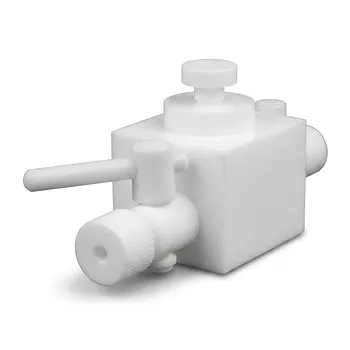
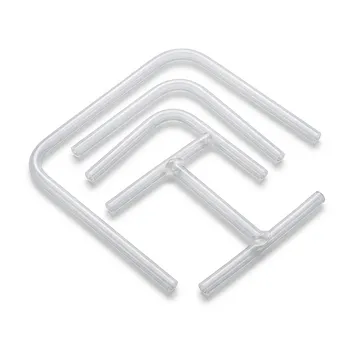
PFA is melt-processible, allowing it to be conventionally molded or extruded into seamless tubing, intricate fittings, valves, and specialized containment components.
PFA Supports High-Purity Fluid Paths
Melt processing can produce continuous fluid-contact surfaces with fewer joints and less need for post-machining. This is valuable in systems handling high-purity chemicals, ultrapure fluids, and trace-analysis samples.
PFA therefore combines near-PTFE chemical resistance with a manufacturing route that is well suited to fluidic assemblies.
Transparency Adds Practical Value
PFA's high transparency or translucency allows operators to inspect fluid flow, bubbles, particulates, and residue inside tubing or vessels.
That visibility is a practical advantage in laboratory and process systems where confirming cleanliness or observing the sample is important.
Understanding the Trade-offs
PTFE Offers the Maximum Extreme-Temperature Margin
At temperatures around 400°C to 425°C, PTFE shows greater thermal stability than PFA. PFA's perfluoroalkoxy side groups make melt processing possible but can increase degradation at the most extreme temperatures.
Neither material should be selected solely from a melting-point figure. The actual operating limit must account for load, pressure, exposure duration, thermal cycling, and the specific compound or grade.
PTFE Requires More Specialized Manufacturing
PTFE's non-melt-processible nature limits its ability to produce complex seamless shapes through standard molding or extrusion.
Machining can provide excellent dimensional control, but it may increase manufacturing time, cost, and the number of design constraints for intricate fluid paths.
PFA Is Not Identical to PTFE
PFA is often described as having PTFE-like chemical resistance, but it is not a complete substitute in every application. PTFE remains preferable where the lowest friction, maximum non-stick behavior, cryogenic performance, or highest extreme-temperature stability is decisive.
PFA is preferable where processability, transparency, seamless construction, and high-purity fluid handling are more important.
Operating Conditions Still Matter
Chemical compatibility charts and nominal temperature ratings are starting points, not guarantees. Concentration, pressure, mechanical stress, radiation, surface finish, and exposure time can change performance.
Critical laboratory systems should be evaluated against the exact reagent, temperature profile, and mechanical design rather than a polymer family name alone.
Making the Right Choice for Your Goal
Select between PTFE, PFA, and other fluoropolymers according to the dominant requirement of the application.
- If your primary focus is maximum chemical inertness, low friction, or extreme-temperature and cryogenic performance: Choose PTFE, particularly for crucibles, stir bars, seals, custom-machined vessels, and severe laboratory environments.
- If your primary focus is high-purity fluid handling with complex geometry, transparency, or seamless construction: Choose PFA for tubing, fittings, valves, wash bottles, and molded digestion or trace-analysis vessels.
- If your primary focus is flexibility, toughness, or easier conventional processing at less severe temperatures: Evaluate other fluoropolymers, provided their chemical and thermal limits match the application.
- If your primary focus is preventing analytical contamination: Prefer high-purity PTFE or PFA grades and validate the complete component, including processing, machining, cleaning, and sealing practices.
The right fluoropolymer is the one whose chemical, thermal, and manufacturing properties match the full operating environment, not merely the nominal temperature rating.
Summary Table:
| Property | PTFE | PFA | FEP | ETFE | PVDF |
|---|---|---|---|---|---|
| Chemical Resistance | Excellent | Excellent | Good | Good | Moderate |
| Max Continuous Service Temp (°C) | 260 | 260-288 | 200 | 150 | 150 |
| Melting Point (°C) | 342 | 305-310 | 260 | 270 | 177 |
| Friction Coefficient | Very Low | Low | Low | Medium | Medium |
| Processability | Non-melt-processable | Melt-processable | Melt-processable | Melt-processable | Melt-processable |
| Transparency | Opaque | Translucent | Transparent | Translucent | Opaque |
| Typical Applications | Custom-machined parts, seals, crucibles | Tubing, fittings, valves, molded vessels | Tubing, linings | Electrical insulation, chemical tanks | Pipes, fittings, valves |
Need the ideal fluoropolymer for your high-purity lab? KINTEK offers a comprehensive range of PTFE and PFA labware, from digestion vessels and tubing to custom-machined components. Our experts help you choose the right material for your application. Contact us today for a consultation and product quote!
Related Products
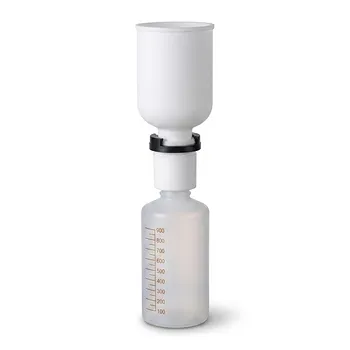
- PTFE PFA Vacuum Filtration System Corrosion Resistant Customizable Shatterproof Laboratory Device
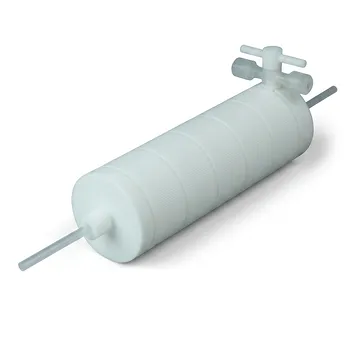
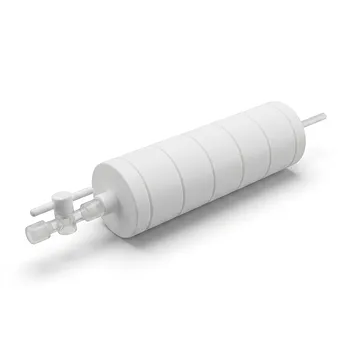
- High Purity PTFE Filter with PFA Valve Connections and Integrated Sieve Plate for Corrosive Fluid Processing
- PTFE Corrosion Resistant Filter with PFA Valve Connections and Integrated Sieve Plate
- Custom PTFE Constant Pressure Separatory Funnel Corrosion Resistant Low Background Labware for PFA Flasks
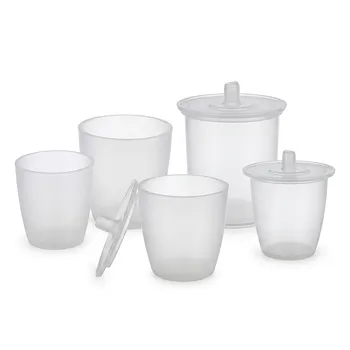
- High Purity PFA Crucible and Corrosion Resistant PTFE Beaker for Trace Analysis and Custom Laboratory Applications
People Also Ask
- What makes PTFE filtration systems advantageous for industrial and scientific use? Unmatched Chemical & Thermal Stability
- How does the hydrophobicity of PTFE filters benefit their use? Ensure Uninterrupted Gas Flow and Solvent Filtration
- What temperature resistance do PTFE filters offer? Unmatched Thermal Stability from -200°C to +260°C
- Which chemicals are fully compatible with PTFE filters? Discover Unmatched Chemical Resistance
- What sizes and pore options are available for PTFE filters? Choose the Right Filter for Your Application