PTFE generally provides slightly greater thermal headroom and better low-friction performance, while PFA offers comparable chemical resistance with superior manufacturing flexibility. The supplied data lists PTFE at up to 550°F (288°C) continuous service and PFA at 500°F (260°C), with PTFE also showing higher tensile strength and elongation. In practice, published temperature limits vary by grade, load, geometry, and manufacturer; 260°C (500°F) is a conservative common continuous-use benchmark for both materials, while higher PTFE ratings may apply under specified conditions.
For the most demanding temperature, friction, and heavy-duty machined applications, PTFE is usually preferred. For complex, seamless, translucent, or high-purity molded fluid-handling components, PFA is often the better choice despite its somewhat lower—or equivalent, depending on grade—continuous temperature rating.
How Their Temperature Ratings Compare
PTFE offers the higher nominal temperature ceiling
The primary comparison gives PTFE a maximum continuous operating temperature of approximately 550°F (288°C) and a melting point of about 627°F.
This makes PTFE attractive when a component must retain useful performance close to the upper end of fluoropolymer service temperatures.
PFA provides comparable high-temperature service
PFA is listed at approximately 500°F (260°C) continuous operation, with a melting range of 575–590°F. Other commonly cited specifications place both PTFE and PFA at approximately 260°C continuous use, so the exact comparison depends on the product grade and operating conditions.
The practical conclusion is that both materials are suitable for high-temperature chemical fluid handling, but the design should use the supplier’s rating for the specific resin, pressure, wall thickness, and exposure environment.
Melting point is not the same as operating temperature
A material’s melting point indicates when it transitions into a melt; it does not define a safe continuous service temperature. Mechanical strength, creep resistance, pressure, chemical exposure, and dimensional stability usually become limiting well before melting occurs.
For laboratory vessels and fluid systems, the relevant value is therefore the allowable continuous-use temperature under load, not simply the melting point.
How Their Mechanical Properties Compare
PTFE has the stronger stated tensile profile
The supplied values identify PTFE with approximately 5,000 psi tensile strength and 400% elongation at break at room temperature.
PFA is listed at approximately 4,500 psi tensile strength and 300% elongation at break. On these figures, PTFE has a modest advantage in both tensile strength and ultimate elongation.
Both remain flexible, but neither should be judged only by tensile data
The high elongation values indicate that both materials can deform substantially before rupture. However, high-temperature equipment is often limited by creep, deformation under sustained pressure, and seal relaxation, rather than short-term tensile failure.
Mechanical properties also decrease as temperature rises. Components supporting pressure or maintaining tight tolerances therefore require design calculations based on temperature-specific data, not room-temperature catalog values alone.
PTFE excels in low-friction and non-stick behavior
PTFE has the lower stated coefficient-of-friction ranking, identified as 1, compared with 2 for PFA. This gives PTFE an advantage for sliding seals, stir-bar surfaces, valve interfaces, and parts where minimizing adhesion or friction is important.
PFA still provides very low friction and excellent release characteristics, but PTFE is generally the stronger choice when friction reduction is the primary mechanical requirement.
Chemical Fluid Handling and Laboratory Applications
Both provide top-tier chemical resistance
PTFE and PFA are fully fluorinated materials with exceptionally broad chemical resistance, including resistance to many aggressive acids, solvents, and reagents.
Neither material should be treated as universally compatible. Strong bases, reactive fluorinating agents, molten alkali metals, temperature, concentration, pressure, and permeation requirements must still be checked against the specific chemical-resistance data.
PTFE suits robust machined components
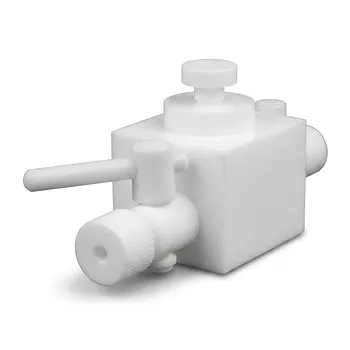
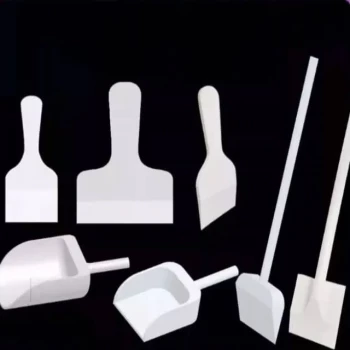
PTFE is commonly selected for custom-machined labware, vessel liners, digestion components, seals, valve parts, and heavy-duty containment hardware.
Its mechanical profile, very low friction, and high thermal headroom make it particularly useful where the component must withstand sliding contact, repeated handling, or demanding non-stick requirements.
PFA suits molded and high-purity fluidic components
PFA is melt-processable, unlike standard PTFE. It can be extruded, injection molded, or otherwise formed into complex, seamless geometries.
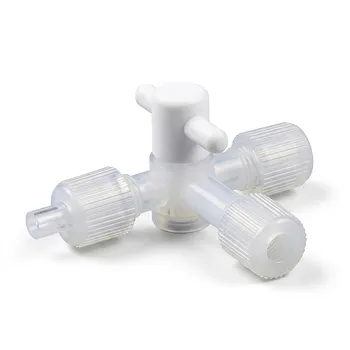
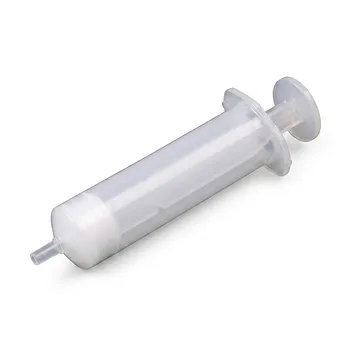
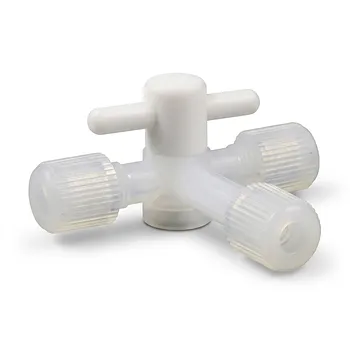
That processing advantage makes PFA well suited to tubing, fittings, valves, translucent vessels, reagent containers, and high-purity fluid-handling assemblies where molded geometry, visibility, low contamination risk, or seamless construction matters.
The Manufacturing Difference That Often Decides the Selection
PTFE requires specialized fabrication
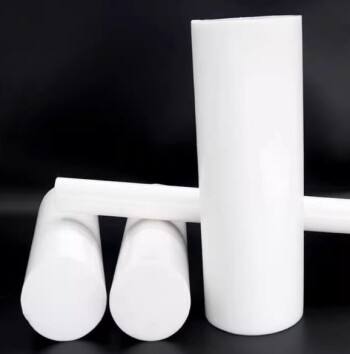
Standard PTFE is effectively non-melt-processable in conventional manufacturing because it does not flow like an ordinary thermoplastic above its melting transition. It is typically formed through sintering or molding and then finished by machining; paste extrusion is also used for some products.
This approach can produce highly capable parts, but it is less convenient for intricate, thin-walled, or seamlessly molded shapes.
PFA enables greater geometric flexibility
PFA can be processed using conventional thermoplastic methods such as extrusion and injection molding. This supports complex fluid paths, integrated fittings, thin sections, and translucent components.
For laboratories handling trace chemicals or high-purity fluids, fewer joints and seamless molded surfaces can simplify cleaning and reduce potential contamination points.
Understanding the Trade-offs
Do not choose solely by the highest published temperature
A nominal PTFE rating of 288°C does not mean every PTFE part can safely operate continuously at that temperature. Pressure, applied load, dimensional tolerances, thermal cycling, and the manufacturer’s design limits may reduce the allowable temperature substantially.
Likewise, PFA’s approximately 260°C rating is not automatically inferior if the application operates below that limit and benefits from molded construction.
PTFE can deform under sustained load
PTFE’s softness and creep tendency can create dimensional changes in heavily loaded components, particularly at elevated temperature. Back-up rings, support structures, reduced pressure, or an alternative design may be necessary for seals and pressure-containing parts.
PFA also requires creep evaluation. Melt-processability improves manufacturing options, but it does not eliminate the need to account for long-term deformation.
PFA may be preferable for integrated assemblies
Choosing PTFE for maximum temperature or friction performance can lead to more machining, more joints, and higher fabrication complexity. PFA may provide a more reliable overall solution when a single molded component can replace several machined or assembled parts.
Verify grade-specific data
The stated tensile strength, elongation, friction, melting, and operating-temperature values should be treated as representative comparison data, not universal specifications. Filled PTFE, modified PFA, processing history, wall thickness, and supplier standards can materially change performance.
Making the Right Choice for Your Goal
Both materials are technically strong candidates, but the final selection should be based on the limiting requirement rather than chemical resistance alone.
- If your primary focus is maximum continuous temperature and lowest friction: Prefer PTFE, subject to the manufacturer’s temperature and load limits; it offers the higher nominal temperature ceiling and stronger non-stick performance.
- If your primary focus is complex molded geometry and high-purity fluid handling: Prefer PFA, because melt-processability supports seamless tubing, fittings, valves, and translucent vessels.
- If your primary focus is heavy-duty custom-machined laboratory hardware: Prefer PTFE when its mechanical profile, machining availability, and low-friction behavior outweigh fabrication complexity.
- If your primary focus is pressure-containing components at elevated temperature: Compare temperature-specific creep, pressure, and dimensional data for the exact grade rather than relying on room-temperature tensile strength.
The right choice is usually PTFE for maximum mechanical and friction performance, and PFA for manufacturing flexibility without giving up fluoropolymer-grade chemical resistance.
Summary Table:
| Property | PTFE | PFA |
|---|---|---|
| Max Continuous Service Temp | ~550°F (288°C) | ~500°F (260°C) |
| Melting Point | ~627°F (330°C) | 575–590°F (302–310°C) |
| Tensile Strength | ~5,000 psi | ~4,500 psi |
| Elongation at Break | ~400% | ~300% |
| Coefficient of Friction Rank | 1 (lower) | 2 (higher) |
| Chemical Resistance | Excellent | Excellent |
| Fabrication Method | Non-melt-processable (sintering, molding, machining) | Melt-processable (extrusion, injection molding) |
| Typical Applications | Custom-machined parts, seals, valve components | Tubing, fittings, translucent vessels, high-purity molded parts |
| Best Suited For | Maximum temperature, low friction, heavy-duty machining | Complex geometries, high-purity fluid handling, seamless parts |
You need reliable PTFE or PFA components for your high-temperature chemical fluid handling? At KINTEK, we specialize in high-performance fluoropolymers, manufacturing virtually all kinds of lab supplies from PTFE and PFA, from beakers and tubes to custom-machined parts and high-purity fluid systems. Our precision CNC machining and molding capabilities ensure your exact specifications are met. Contact us today to discuss your requirements and get the best solution for your lab. Contact us now!
Related Products
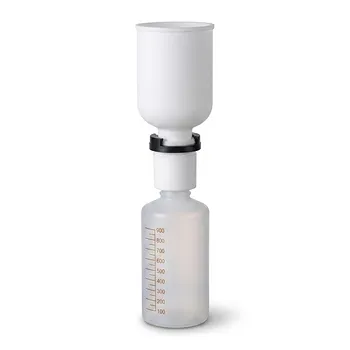
- PTFE PFA Vacuum Filtration System Corrosion Resistant Customizable Shatterproof Laboratory Device
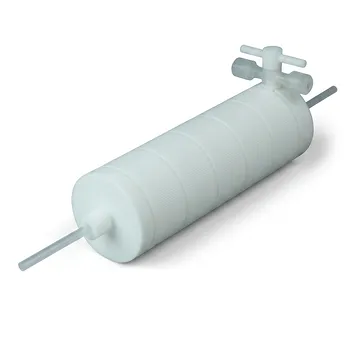
- High Purity PTFE Filter with PFA Valve Connections and Integrated Sieve Plate for Corrosive Fluid Processing
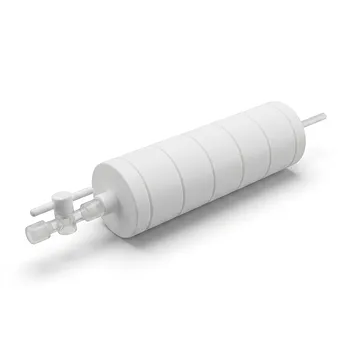
- PTFE Corrosion Resistant Filter with PFA Valve Connections and Integrated Sieve Plate
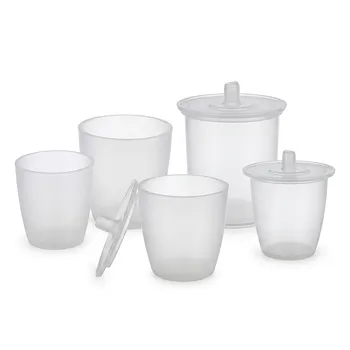
- High Purity PFA Crucible and Corrosion Resistant PTFE Beaker for Trace Analysis and Custom Laboratory Applications
- Custom PTFE Constant Pressure Separatory Funnel Corrosion Resistant Low Background Labware for PFA Flasks
People Also Ask
- What makes PTFE filtration systems advantageous for industrial and scientific use? Unmatched Chemical & Thermal Stability
- How does the hydrophobicity of PTFE filters benefit their use? Ensure Uninterrupted Gas Flow and Solvent Filtration
- What temperature resistance do PTFE filters offer? Unmatched Thermal Stability from -200°C to +260°C
- Which chemicals are fully compatible with PTFE filters? Discover Unmatched Chemical Resistance
- What sizes and pore options are available for PTFE filters? Choose the Right Filter for Your Application