Fluorinated oligomer–silica nanocomposites can withstand temperatures above 700°C more effectively than standard PTFE because the silica phase converts the material from a mostly organic fluoropolymer into a hybrid inorganic–organic network. PTFE undergoes major thermal decomposition near the 600–700°C range, whereas sol-gel-derived fluorinated silica systems can retain a nonflammable, structurally coherent inorganic framework during exposure near 800°C and, in some formulations, up to approximately 1000°C.
The key improvement is not that the fluorinated oligomer remains unchanged at 800–1000°C. Rather, silica nanoparticles and the sol-gel network confine and protect the fluorinated phase while providing a heat-resistant structural skeleton that remains after much of the organic material would otherwise decompose.
Why Standard PTFE Fails Above 700°C
PTFE is highly stable—but still an organic polymer
PTFE has substantially higher thermal stability than most organic polymers because its carbon backbone is heavily protected by fluorine. However, strong C–C and C–F bonds do not make it thermally indefinite.
At sufficiently high temperatures, PTFE undergoes chain scission and depolymerization, producing volatile fluorocarbon species. The exact decomposition temperature depends on atmosphere, heating rate, exposure time, and measurement method, but severe degradation occurs in the several-hundred-degree range and is generally complete near the 700°C region cited for conventional PTFE.
Decomposition destroys the polymer’s useful properties
Once PTFE chains break down, the material loses molecular weight, strength, dimensional stability, and sealing performance. A component may leave some carbonaceous or inorganic residue, but that residue should not be confused with an intact, functional PTFE part.
This distinction is critical for laboratory vessels, seals, tubing, and fluid-handling components. Thermal residue retention is not equivalent to maintaining chemical resistance, flexibility, impermeability, or mechanical load capacity.
How the Silica Hybrid Changes Thermal Behavior
It creates an inorganic heat-resistant skeleton
Fluoroalkyl end-capped oligomers can be cross-linked with silica nanoparticles through sol-gel reactions. The resulting silica network is thermally more robust than the fluoropolymer alone and can preserve the overall architecture as the organic phase is heated.
Silica does not depolymerize in the same way as PTFE. It therefore acts as a stable framework that supports structural integrity at temperatures where an unmodified fluoropolymer would rapidly lose mass.
It confines the fluorinated oligomers at the nanoscale
The fluorinated chains are distributed within nanometer-scale silica domains. This confinement reduces the mobility of the oligomers and limits the growth and transport of degradation products.
The silica matrix also acts as a physical barrier, slowing heat and mass transfer through the material. This does not eliminate decomposition of the organic phase, but it can delay it and reduce the rate at which volatile products escape.
It reduces exposure of the organic phase
Encapsulation and network formation shield portions of the fluorinated oligomer from direct thermal and oxidative attack. The hybrid structure is therefore more resistant to rapid collapse than a bulk PTFE phase exposed under the same conditions.
In some sol-gel systems, fluorinated species and inorganic components also form strong interfacial interactions. These interactions help anchor the oligomers within the silica matrix and improve resistance to thermal rearrangement or loss.
It produces nonflammable or flame-resistant behavior
The silica phase is inorganic and nonflammable. As a result, the composite does not behave like a conventional combustible organic polymer when exposed to intense heat.
This is especially valuable in laboratory environments where a material must resist ignition and retain a coherent barrier under thermal processing. The nonflammability comes primarily from the inorganic network; it should not be attributed solely to the fluoroalkyl groups.
What “Stability to 800–1000°C” Really Means
The material can retain a stable hybrid residue
Reported high-temperature performance for these composites includes very low mass loss after calcination near 800°C and structural retention at temperatures approaching 1000°C in selected formulations.
That performance reflects the persistence of the silica-rich hybrid network. The fluorinated oligomer itself should not automatically be assumed to remain chemically intact throughout that temperature range.
Function depends on the application
For a protective coating, thermal barrier, flame-resistant layer, or inorganic-supported structure, retention of the silica network may be sufficient to provide useful performance above 700°C.
For a reaction vessel expected to contain aggressive fluids under pressure, however, the relevant questions are more demanding: Does it remain sealed? Does it retain chemical impermeability? Does it maintain strength and dimensional tolerance? A high-temperature TGA residue alone cannot answer those questions.
Laboratory operating limits must be validated separately
A composite may show excellent calcination resistance while still failing as a functional component because of cracking, shrinkage, porosity, embrittlement, or loss of fluoropolymer-derived chemical resistance.
Therefore, a claimed 800–1000°C stability range should be interpreted as a materials-screening or structural-retention result unless supported by application-specific mechanical, chemical, permeability, and thermal-cycling data.
The Main Advantages Over Standard PTFE
Higher resistance to mass loss
Standard PTFE loses its polymeric structure as it decomposes. The silica network limits total structural collapse and can substantially reduce apparent mass loss in the composite, particularly after the inorganic phase becomes dominant.
Better structural retention
The silica skeleton maintains a continuous framework after the fluorinated oligomer phase begins to degrade. This gives the composite a better chance of retaining shape and resisting catastrophic shrinkage than unmodified PTFE.
Improved flame and heat resistance
The hybrid contains a nonflammable inorganic component, so it is more resistant to ignition and flame propagation than a wholly organic fluoropolymer material.
Greater tolerance of extreme thermal processing
For coatings, liners, composite fixtures, and other systems designed around the inorganic network, the material can remain coherent during thermal treatments far beyond the practical decomposition range of PTFE.
Understanding the Trade-offs
The fluoropolymer benefit is not preserved indefinitely
The silica phase improves high-temperature endurance, but it does not make the fluoroalkyl oligomer permanently stable. At extreme temperatures, organic fluorinated material can still decompose, volatilize, or lose its original functionality.
A rigid network may reduce flexibility
Cross-linking and inorganic reinforcement generally increase rigidity and dimensional stability. They can also reduce the flexibility, elongation, toughness, and conformability that make PTFE useful for seals and flexible tubing.
Thermal expansion becomes more complex
PTFE and silica have different thermal-expansion behavior. This mismatch can generate interfacial stresses during heating and cooling, potentially causing microcracking or delamination if the formulation and processing are not well controlled.
The composite may lose PTFE-like chemical behavior
The original fluoropolymer phase provides much of the familiar low friction, nonstick behavior, and chemical resistance. As the silica fraction increases or the organic phase decomposes, the surface and bulk properties may shift toward those of a rigid, porous, or glass-like inorganic material.
“Zero weight loss” claims require careful interpretation
A reported near-zero weight loss after calcination may describe a particular formulation, test protocol, or inorganic residue content. It does not necessarily demonstrate that the fluorinated oligomer survived unchanged or that a finished laboratory component can operate continuously at that temperature.
Making the Right Choice for Your Goal
The appropriate material depends on whether the requirement is polymer performance, structural retention, or resistance to a specific thermal process.
- If your primary focus is continuous chemical containment above 700°C: Do not assume a fluorinated silica nanocomposite is a direct PTFE replacement; require application-specific pressure, permeability, chemical-compatibility, and thermal-cycling data.
- If your primary focus is flame resistance and structural retention during short high-temperature exposure: A silica-rich fluorinated hybrid can provide a major advantage over PTFE by preserving a nonflammable inorganic framework.
- If your primary focus is retaining PTFE-like flexibility and low-friction behavior: Standard PTFE or another perfluoropolymer may remain preferable within its validated temperature range, because silica reinforcement can increase rigidity and extreme-temperature exposure can destroy the organic phase.
- If your primary focus is high-temperature coatings or thermal-processing fixtures: Evaluate the composite as a hybrid or silica-supported material, not simply as “PTFE with a higher temperature rating.”
The practical advantage of fluorinated oligomer–silica nanocomposites is their hybrid architecture: silica preserves structure and nonflammability above PTFE’s decomposition range, while the fluorinated phase contributes performance only within the limits confirmed by testing.
Summary Table:
| Property | Standard PTFE | Fluorinated Silica Nanocomposite |
|---|---|---|
| Thermal Stability Above 700°C | Decomposes near 600-700°C | Retains structure up to 800-1000°C |
| Mass Loss at High Temp | High | Reduced due to silica skeleton |
| Structural Retention | Poor | Excellent (inorganic framework) |
| Flame Resistance | Combustible | Nonflammable (inorganic phase) |
| Flexibility | High | Reduced (more rigid) |
| Chemical Resistance | Excellent | May decrease with high silica content |
| Application Suitability | Continuous use below 260°C | High-temp coatings, thermal barriers |
Elevate your lab's thermal performance with KINTEK's advanced PTFE/PFA solutions. Whether you need custom-machined parts or standard labware, our fluoropolymer expertise ensures reliability. Contact us today to find the right material for your high-temperature applications and discover how our products can enhance your research efficiency.
Related Products
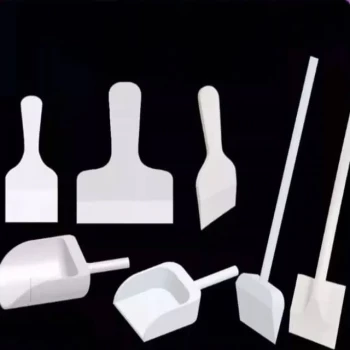
- Customizable PTFE Scrapers and Shovels for Demanding Applications
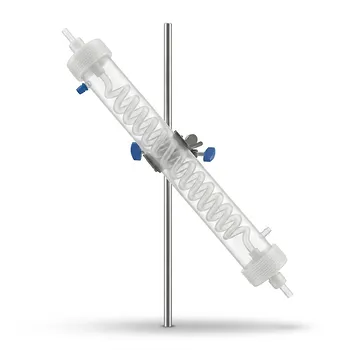
- Custom PFA Serpentine Straight Condenser HF Resistant Reaction Device Laboratory Cooling Column
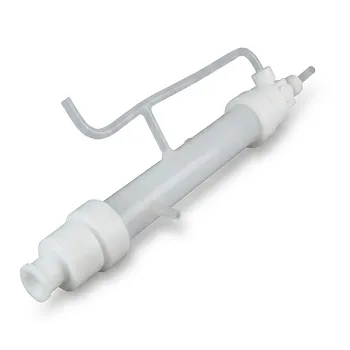
- PFA Eggplant Flask Custom Molded Pear Shaped Laboratory Flask Corrosion Resistant Glass Alternative
- High Purity PFA Chromatography Column Double Layer Constant Pressure Filtration System with Sieve Plate for Strong Acid Resistance
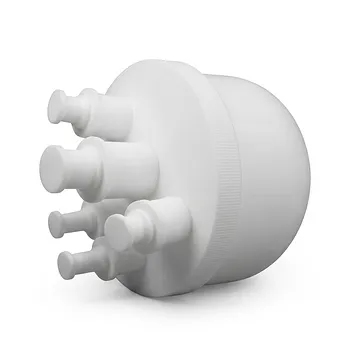
- Custom Corrosion Resistant PFA PTFE Multi Neck Laboratory Reaction Flask GL Standard Mouth Fluoropolymer Flasks
People Also Ask
- Why are PTFE shovels considered cost-effective? Maximize ROI with Superior Durability
- What are the key properties that make PTFE shovels ideal for laboratory use? Ensure Sample Integrity with Chemically Inert Tools
- What are some specific applications of PTFE shovels in the laboratory? Ensure Sample Purity and Safety
- How does the durability of PTFE shovels compare to plastic shovels? Discover the Superior Choice for Harsh Conditions
- What are the advantages of PTFE shovels in terms of chemical resistance? Unmatched Inertness for Handling Corrosives