Shear control is critical because PTFE fine powder can fibrillate before it reaches the extrusion stage. Premature fibrillation changes the resin’s structure and can produce inconsistent paste flow, uneven wall thickness, and defects in extruded tubing, rods, and preforms. Low-shear equipment such as bottle rollers, low-speed V-cone blenders, and multidirectional shaker mixers preserves the powder’s integrity while distributing the lubricant uniformly.
PTFE fine powder should be mixed gently enough to distribute the lubricant without mechanically working the polymer. The right mixer is therefore defined less by maximum blending intensity than by how effectively it achieves uniformity while minimizing impact, friction, and particle deformation.
Why PTFE Fine Powder Requires Shear Control
The polymer can fibrillate prematurely
PTFE fine powder is unusually sensitive to mechanical shear. Aggressive mixing can cause the particles to form fibrils before extrusion, consuming part of the structure that should develop during controlled paste extrusion.
This premature change can make the compound less consistent and reduce the process window for producing uniform extrudates.
Paste extrusion depends on preserved resin structure
In paste extrusion, the resin must respond predictably as lubricant and pressure are applied during the intended forming stages. If mixing has already altered the particles, the paste may no longer compact and flow consistently.
The practical consequences can include variable flow behavior, nonuniform wall thickness, and defects in the finished PTFE product.
Lubricant distribution must be uniform but gentle
Fine powder is commonly blended with approximately 15–20% mineral oil or naphtha-based lubricant, depending on the formulation and process. The objective is to distribute the lubricant throughout the powder without forcing the polymer particles into high-shear contact.
This makes mixing a balance: insufficient blending creates uneven lubricant distribution, while excessive energy can damage the resin before extrusion.
How Mixer Type Affects the Polymer
Bottle rollers provide gentle particle movement
Bottle rolling is a low-shear method in which the container rotates and the powder is repeatedly lifted and folded. The movement distributes the lubricant without applying the concentrated mechanical forces associated with high-impact mixing.
This approach is well suited when preserving the original PTFE particle structure is more important than achieving very rapid blending.
V-cone blenders support low-speed tumbling
A V-cone mixer blends material through repeated division and recombination as the vessel rotates. When operated at low speed, such as around 20–30 rpm, it can provide uniform mixing with relatively limited impact and friction.
The mixer should be operated gently and long enough to distribute the lubricant. Increasing speed simply to shorten the cycle can increase the risk of premature fibrillation.
Rolling mills must be operated conservatively
A rolling mill can be used for low-speed blending, but its mechanical action must be controlled carefully. The closer the process comes to squeezing, smearing, or forcing the powder through a high-friction region, the greater the risk of changing the resin before extrusion.
Its suitability therefore depends on the equipment design, operating speed, batch condition, and validated process settings rather than on the machine name alone.
Multidirectional shaker mixers reduce wall impact
Multidirectional shaker mixers use complex three-dimensional motion to move the powder through the container. Because the material is not repeatedly driven violently into the walls, these mixers can achieve high-volume blending with less damaging impact than conventional high-impact equipment.
They are useful when batch size requires more capacity than bottle rolling or small tumbling vessels can provide, provided the motion and cycle are validated for the specific resin.
Conventional high-impact mixers increase process risk
High-impact mixers can expose PTFE particles to intense collision, friction, and localized shear. These forces may accelerate blending, but they also increase the likelihood of premature fibrillation and inconsistent resin behavior.
Equipment that is effective for tougher polymers or ordinary powders should not automatically be used for PTFE fine powder. The relevant question is whether it produces the required uniformity without mechanically working the resin.
The Process Around Mixing Also Matters
Add the lubricant evenly
Uneven lubricant addition can create wet pockets, dry regions, and agglomerates. These local variations may encourage operators to extend the mixing cycle or raise the speed, increasing the total mechanical stress imposed on the powder.
Controlled addition and gentle blending reduce the need for corrective mixing.
Use conservative operating conditions
A representative low-shear process uses approximately 20–30 rpm for 20–30 minutes, but the correct values depend on the equipment, batch size, resin, lubricant, and required product performance. These figures should be treated as starting points for process validation, not universal settings.
The best operating condition is the lowest energy input that achieves the required lubricant distribution and repeatable paste behavior.
Sieve loose lumps after blending
Sieving can remove or break up loose lumps after mixing without subjecting the entire batch to another aggressive mixing cycle. This helps improve feed consistency while limiting additional mechanical stress on the resin.
The sieving step should remain gentle enough to avoid becoming a second high-shear treatment.
Age the compound before extrusion
After mixing, the paste should be aged at approximately 30–40°C to allow the lubricant to distribute or diffuse fully into the polymer particles. Reference procedures describe aging for more than 5 hours, while other guidance specifies at least 12 hours around 35°C.
Because the required time depends on resin, lubricant, batch size, and equipment, the aging schedule should be established through process validation rather than selected from a single fixed value.
Understanding the Trade-offs
More intensity does not necessarily mean better mixing
High energy can shorten the apparent blending time, but the resulting paste may be less usable because the polymer has already been altered. For PTFE fine powder, mixing quality means uniformity with minimal structural damage, not maximum dispersion speed.
Low shear can require more time and capacity
Gentle tumbling and rolling may require longer cycles than high-impact mixing. Multidirectional shaker mixers can address higher-volume requirements, but they still need suitable loading, motion, and cycle-time controls.
The capacity solution should preserve low-shear behavior rather than simply scaling up impact energy.
Under-mixing is also a problem
Avoiding shear damage does not justify inadequate blending. Poor lubricant distribution can lead to inconsistent extrusion pressure, variable flow, and nonuniform product dimensions.
The process must therefore be judged using measurable outcomes such as lubricant uniformity, paste consistency, extrusion behavior, and final product quality.
Equipment labels are not enough
Two mixers with the same general designation can impose different levels of impact and friction because of differences in geometry, fill level, speed, motion, and batch size. Mixer selection should be based on the actual mechanical environment experienced by the powder.
Small-scale trials and resin-specific validation are necessary before transferring settings to production.
Choosing the Right Approach for Your Goal
The decision should begin with the required resin condition after mixing, then work backward to the least aggressive equipment that can achieve it.
- If your primary focus is preserving polymer structure: Use bottle rolling or low-speed V-cone tumbling, and keep speed and cycle time only as high as needed for uniform lubricant distribution.
- If your primary focus is high-volume processing: Evaluate a multidirectional shaker mixer whose three-dimensional motion limits violent wall impact and minimizes particle damage.
- If your primary focus is extrusion consistency: Control lubricant addition, use gentle post-mixing sieving, and validate the aging temperature and duration before extrusion.
- If your primary focus is production throughput: Increase capacity or optimize loading and cycle time before increasing mixing intensity, because excessive shear can undermine the extrusion process.
- If your primary focus is process qualification: Compare mixer settings using paste uniformity, extrusion behavior, dimensional consistency, and evidence of premature fibrillation.
For PTFE fine powder, the right mixer is the one that delivers uniform lubricant distribution while leaving the polymer’s fibrillation behavior for the extrusion stage where it belongs.
Summary Table:
| Mixer Type | Shear Level | Effect on PTFE | Best Use Case |
|---|---|---|---|
| Bottle Rollers | Low | Gentle particle movement; preserves structure | Small batches, lab use |
| V-cone Blenders | Low (at 20-30 rpm) | Tumbling action; uniform blending with minimal impact | Medium batches, gentle mixing |
| Rolling Mills | Low (if conservative) | Controlled action; risk of fibrillation if too aggressive | Specialized blending, requires validation |
| Multidirectional Shaker Mixers | Low to moderate | 3D motion; reduces wall impact | High-volume blending |
| High-Impact Mixers | High | Intense collision; high risk of premature fibrillation | Not recommended for PTFE fine powder |
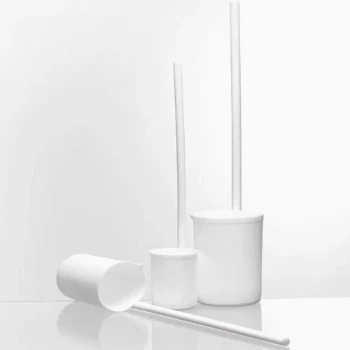
Ensure your PTFE fine powder mixing process preserves resin integrity with KINTEK's advanced low-shear lab equipment. Our PTFE and PFA labware and custom solutions are designed for gentle yet precise mixing, validated for consistent extrusion results. Contact us today to optimize your process and maintain high product quality—our experts are ready to support your specific application needs. Get in touch with KINTEK now and discover how our high-performance fluoropolymer products can enhance your lab's efficiency and reliability.
Related Products
- High Purity Corrosion Resistant PTFE Dispersion Disk and Inert Stirring Paddle for Food Pharmaceutical and Cosmetic Mixing
- Custom PTFE Dispersing Disc and Stirring Rod for Chemical Processing and Laboratory Mixing
- PTFE Dispersion Disk Food Cosmetic Grade Non Stick Corrosion Resistant Large Stirring Paddle Customizable Impeller
- Corrosion Resistant PTFE Dispersing Disc and High Temperature Propeller Stirring Paddle for Laboratory Chemical Mixing
- Corrosion Resistant PTFE Stirring Disk Chemical Dispersion Plate 350mm Diameter Fluoropolymer Mixer Accessory
People Also Ask
- What is Dispersion PTFE used for? Creating Thin, High-Performance Coatings and Films
- How many variations of PTFE disks are available and what parameters do they differ in? Choose the Right Material for Your Application
- What key properties are measured under ASTM D4441 to classify and evaluate PTFE dispersions?
- What is PTFE dispersion, and how is it used? A Guide to Non-Stick Coatings & Chemical Resistance
- What is the dispersion method of producing PTFE and what are its products? Ideal for Thin Coatings and Films