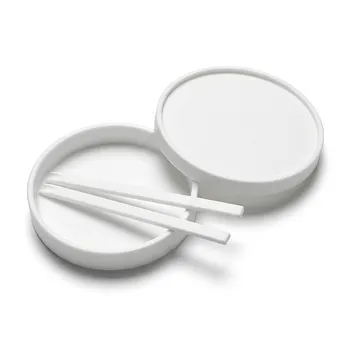
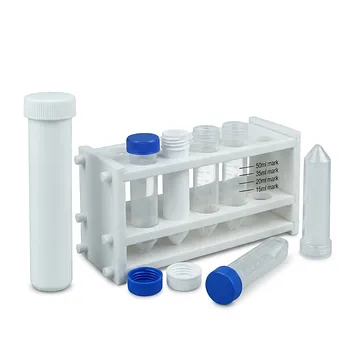
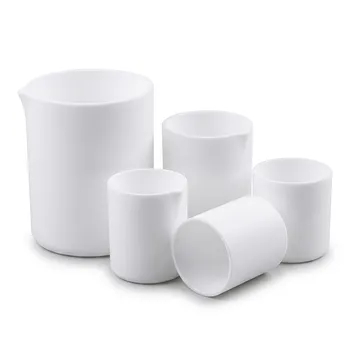
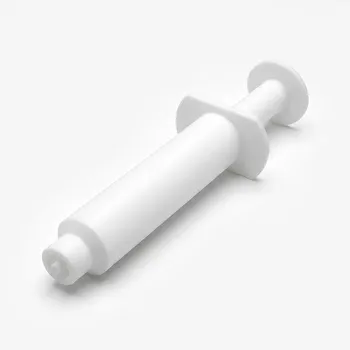
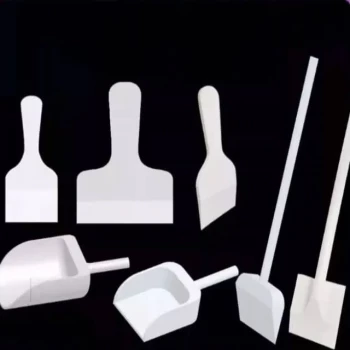
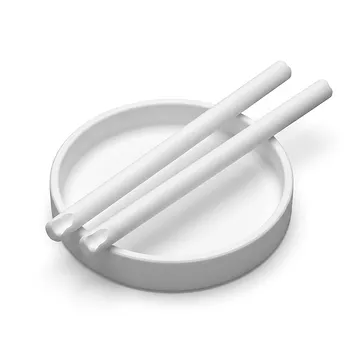
Post-polymerization sulfonation of PFCB aryl ether polymers requires strongly acidic, highly corrosive conditions. The process uses aggressive reagents such as chlorosulfonic acid (ClSO₃H), thionyl chloride (SOCl₂), and hydrochloric acid (HCl) to introduce hydrophilic sulfonic acid groups onto the polymer backbone. Because these reagents can attack conventional glass or metallic equipment, high-purity PTFE and PFA laboratory supplies provide chemically inert containment and fluid handling throughout the multi-step modification.
The chemistry depends on reagents that are both corrosive and contamination-sensitive. PTFE and PFA equipment helps preserve polymer quality and process safety by resisting chemical attack, avoiding trace-metal contamination, and maintaining reliable containment.
Why PFCB Polymers Require Aggressive Chemistry
Introducing Hydrophilic Sulfonic Acid Groups
PFCB aryl ether backbones are hydrophobic fluorinated polymers. Post-polymerization sulfonation modifies the existing polymer rather than requiring all functionality to be incorporated during the original polymerization.
The objective is to attach sulfonic acid groups, which increase hydrophilicity and can provide ion-conducting or other acid-functional properties.
Required Reagents
The primary reference identifies chlorosulfonic acid, thionyl chloride, and hydrochloric acid as key reagents used in the modification sequence.
These substances are highly reactive and corrosive. The exact order, concentration, temperature, reaction time, and workup must be established from the validated procedure for the specific PFCB polymer, because those parameters determine both functionalization and backbone stability.
Multi-Step Chemical Conditions
The process may involve more than a single sulfonation operation. Reagent preparation, activation, reaction, quenching, washing, and acid conversion can all expose equipment to severe chemical conditions.
Related fluorochemical synthesis may also involve fluorinated sulfonyl fluorides, silylated sulfonamides, elemental bromine, activated zinc, strong acids, and alkalis. These reagents reinforce the need for equipment selected for broad chemical compatibility rather than for one isolated reaction step.
Why Conventional Labware Can Be a Risk
Glass Is Not Universally Inert
Glass is often suitable for general organic synthesis, but strongly acidic and reactive fluorochemical conditions can cause chemical attack or surface degradation.
Even when visible damage does not occur, contact with glass can introduce trace ionic impurities. These impurities may affect polymer functionalization, monomer purity, or later fluoropolymer emulsion copolymerization.
Metals Can Contaminate the Reaction
Metallic vessels, fittings, needles, valves, and tubing can corrode under exposure to chlorosulfonic acid, hydrochloric acid, thionyl chloride, or related reagents.
Corrosion creates two problems: it weakens the equipment and releases metal species into the reaction mixture. In contamination-sensitive fluorochemical work, those trace species can compromise reproducibility and downstream product quality.
Containment Must Survive the Entire Workflow
The risk is not limited to the main reaction vessel. Reagents must be stored, transferred, mixed, digested or quenched, sampled, and disposed of without introducing incompatible contact surfaces.
A chemically resistant system therefore needs compatible bottles, reaction vessels, tubing, fittings, closures, and transfer components.
How PTFE and PFA Supplies Support the Process
PTFE Provides Broad Chemical Resistance
PTFE laboratory supplies are highly resistant to aggressive acids, halogenated reagents, and many other corrosive fluorochemical process chemicals.
PTFE can be used for specialized reaction vessels, digestion vessels, tubing, fittings, and other components where chemical inertness is the primary requirement.
PFA Supports High-Purity Fluid Handling
PFA is also highly chemically resistant and is particularly useful for reagent bottles, digestion tubes, reaction vessels, tubing, valves, and fittings.
Its melt processability allows manufacturers to produce complex, seamless, and translucent components. Translucency can help operators inspect fluid levels, particulate formation, or gross reaction changes without opening the system.
Both Materials Reduce Contamination Risk
High-purity PTFE and PFA avoid the corrosion and ionic contamination risks associated with many glass and metal components.
This is especially important when the functionalized polymer will undergo additional processing or when trace impurities could affect molecular weight, ion-exchange behavior, polymer purity, or copolymerization performance.
Thermal Stability Supports Multi-Step Workflows
PFA and PTFE supplies can support controlled heating and cooling steps within their specified operating limits. This matters when the procedure includes staged reactions, digestion, solvent removal, acid treatment, or thermal conditioning.
The equipment must still be selected according to the actual temperature, pressure, reagent concentration, and exposure time. Chemical resistance does not remove the need for process-specific engineering review.
Choosing Between PTFE and PFA
When PTFE Is the Better Choice
PTFE is well suited to custom or heavy-duty equipment where maximum chemical resistance and mechanical robustness are important.
Because PTFE cannot be processed through ordinary melt-molding, it is typically produced from granular resin by compression molding and sintering or from fine powder by paste extrusion. The resulting stock shapes can be CNC-machined into specialized reaction vessels, electrochemical cells, and other custom labware.
When PFA Is the Better Choice
PFA is advantageous when the laboratory needs molded, seamless, or translucent components with high purity and strong chemical resistance.
It is melt-processible, so it can be injection molded or melt-extruded into consistent tubing, fittings, bottles, valves, and reaction components. This makes PFA particularly practical for integrated fluid-transfer systems.
Use the Materials as a System
The most reliable setup may use both materials. For example, a custom PTFE reaction vessel can be paired with PFA reagent bottles, tubing, and fittings where visibility, seamless construction, or complex molded geometry is useful.
The correct choice depends on the reagent exposure, required geometry, temperature, pressure, flexibility, visibility, and cleaning method.
Understanding the Trade-offs
Chemical Resistance Is Not the Same as Universal Compatibility
PTFE and PFA are strong choices for the reagents identified here, but no material should be treated as universally compatible under every condition.
Compatibility depends on concentration, temperature, contact time, mechanical stress, pressure, and whether the equipment contains seals or other non-fluoropolymer components.
Mechanical Design Still Matters
Fluoropolymers can have different stiffness, creep behavior, and dimensional stability than glass or metal. Thin tubing, threaded connections, and seals may require careful support, torque control, and pressure management.
A chemically inert material can still fail if it is mechanically overloaded or used outside its rated temperature and pressure range.
Avoid Introducing Contamination Upstream
Using PTFE or PFA vessels does not guarantee a clean process if reagents, cleaning agents, tools, or transfer hardware are contaminated.
High-purity components should be cleaned, handled, and stored according to a validated procedure. All wetted parts, including valves, gaskets, tubing connections, and sampling devices, should be reviewed as potential contamination sources.
Safety Procedures Remain Essential
Chlorosulfonic acid, thionyl chloride, hydrochloric acid, bromine, strong alkalis, and related reagents require appropriate engineering controls, personal protective equipment, compatible secondary containment, and trained handling.
PTFE and PFA improve equipment compatibility and containment, but they do not make the chemistry nonhazardous.
Applying This to the Laboratory
The equipment specification should be based on the complete functionalization sequence rather than only the sulfonation reaction.
- If your primary focus is chemical resistance: Use high-purity PTFE or PFA for all wetted reaction, storage, and transfer components exposed to chlorosulfonic acid, thionyl chloride, hydrochloric acid, and related reagents.
- If your primary focus is contamination control: Minimize glass and metal contact and use fluoropolymer components selected for low ionic and trace-metal contribution.
- If your primary focus is custom reaction equipment: Consider machined PTFE for specialized vessels, digestion systems, or electrochemical cells that require tailored geometry.
- If your primary focus is fluid-transfer reliability: Use melt-processible PFA tubing, fittings, valves, and bottles to build seamless, inspectable, and chemically resistant transfer paths.
- If your primary focus is downstream polymer or monomer purity: Validate cleaning, storage, sampling, and transfer procedures so that contamination is controlled across the entire workflow.
The right combination of aggressive chemical control and compatible PTFE or PFA equipment protects both the functionalization chemistry and the quality of the final fluorinated polymer.
Summary Table:
| Condition | Requirement | PTFE/PFA Support |
|---|---|---|
| Reagents | Chlorosulfonic acid, thionyl chloride, HCl | Chemically inert, corrosion-resistant |
| Purity | Avoid trace metal/ionic contamination | High-purity, low leachables |
| Containment | Safe handling of corrosive chemicals | Leak-proof, durable vessels and tubing |
| Temperature | Multi-step heating/cooling | Thermal stability within limits |
| Customization | Specialized reaction vessels | CNC machined PTFE/PFA custom parts |
Ensure your PFCB sulfonation process is safe and contamination-free with KINTEK's high-purity PTFE and PFA lab supplies. From custom reaction vessels to seamless fluid handling systems, we engineer products for aggressive chemical environments. Contact us today to discuss your requirements and get a quote tailored to your process. Contact KINTEK
Related Products
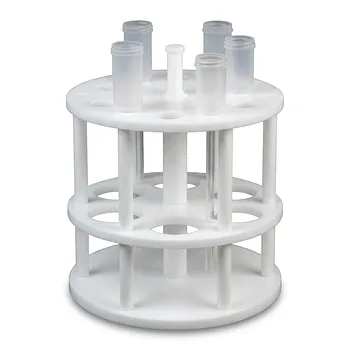
- Custom PFA Microcolumn Racks and PTFE Machined Low Background Corrosion Resistant Laboratory Fixtures
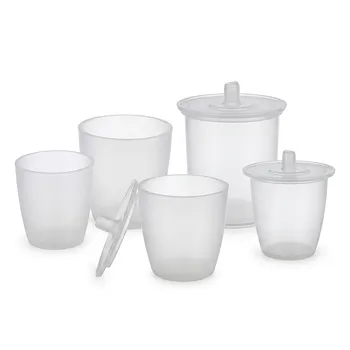
- High Purity PFA Crucible and Corrosion Resistant PTFE Beaker for Trace Analysis and Custom Laboratory Applications
- PTFE PFA Vacuum Filtration System Corrosion Resistant Customizable Shatterproof Laboratory Device
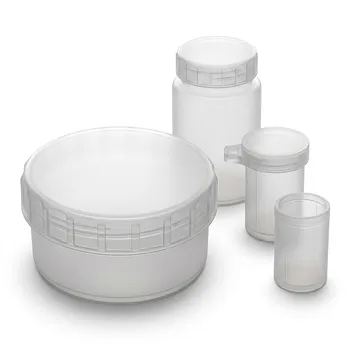
- PFA Reaction Jar Corrosion Resistant Wide Mouth PTFE Lab Bottle High Purity Chemical Vessel
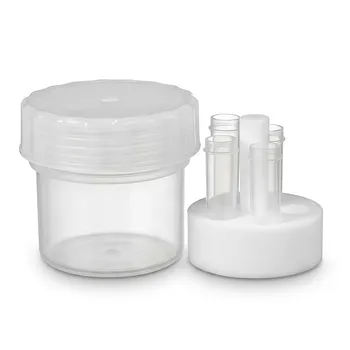
- Corrosion Resistant PTFE Support with PFA Transparent Reaction Tank and High Purity PFA Sampling Tube for Trace Analysis
People Also Ask
- What other PTFE lab accessories are commonly used? Essential Tools for Chemical Resistance & Purity
- How does high fluorination in perfluorinated polymers improve chemical resistance and thermal stability of lab apparatus? Discover the science behind PTFE and PFA's superior performance.
- What inherent material characteristics of non-melt-processable PTFE make it suitable for manufacturing high-purity laboratory containers and custom-machined apparatus?
- What material considerations are critical for laboratory apparatus when performing cage-opening reactions on fluorinated silsesquioxanes using strong superacids? Choose PTFE/PFA for inertness and purity
- What surface chemical species and binding energy signatures are detected on PTFE fluoropolymer sample holders during XPS analysis? Key insights for accurate calcium detection.