The primary tradeoff is chemical and thermal endurance versus mechanical strength. Perfluoropolymers such as PTFE and PFA provide the broadest chemical resistance, the highest continuous-use temperatures, and the lowest friction, making them the safest choice for aggressive chemicals, ultra-pure fluids, and high-temperature processing. Partially fluorinated copolymers such as ETFE and ECTFE generally provide greater tensile strength, stiffness, hardness, and cut-through resistance, but accept lower temperature limits, higher friction, and narrower chemical compatibility.
PTFE and PFA optimize chemical purity, thermal stability, and low-friction performance. ETFE and ECTFE optimize structural durability and resistance to mechanical damage. The correct choice depends on whether chemical exposure or mechanical loading is the dominant failure risk.
The Fundamental Material Difference
Fluorine improves chemical and thermal stability
Perfluoropolymers have a carbon backbone extensively shielded by fluorine atoms. The resulting molecular structure and strong carbon-fluorine bonds provide exceptional resistance to organic and inorganic reagents, low solvent interaction, and minimal risk of chemical contamination.
PTFE and PFA can support continuous operating temperatures of approximately 260°C, depending on the grade, design, and service conditions. This makes them suitable for high-temperature chemical transfer, digestion, and demanding analytical processes.
Hydrogen improves mechanical performance
Partially fluorinated materials such as ETFE and ECTFE retain hydrogen or other non-fluorinated elements in their polymer structure. This reduces chemical and thermal endurance compared with PTFE and PFA, but it allows stronger intermolecular interactions and a more mechanically robust material.
As a result, ETFE and related materials generally offer higher tensile strength, flexural modulus, hardness, and cut-through resistance. They are better suited to components that must resist clamping loads, impact, abrasion, deformation, or installation damage.
How the Materials Perform in Fluid Handling
Chemical resistance favors PTFE and PFA
For highly aggressive chemicals, PTFE and PFA provide the widest compatibility margin. They are preferred for corrosive fluid containment, reagent transfer, trace-analysis vessels, and applications where extractables or sample contamination must be minimized.
ETFE and ECTFE remain chemically resistant, but their compatibility depends more closely on the reagent, concentration, temperature, exposure time, and mechanical stress. They should not be treated as universal substitutes for perfluoropolymers.
Temperature capability favors perfluoropolymers
PTFE and PFA are the stronger choice for sustained high-temperature service, with continuous-use ratings commonly reaching approximately 260°C.
ETFE is typically limited to a lower continuous operating range, often around 150°C, although published values can vary by grade and test method. ECTFE also has a lower thermal ceiling than PTFE and PFA, so the component design must account for both fluid temperature and external heating.
Friction favors PTFE and PFA
PTFE and PFA have very low coefficients of friction, commonly cited in the approximate range of 0.1 to 0.2. This benefits valve seats, seals, sliding interfaces, tubing connections, and components where low actuation force or reduced surface drag matters.
ETFE and ECTFE generally have higher friction. They may require more attention to mating surfaces, actuation force, wear behavior, and the risk of stick-slip movement in valves or moving assemblies.
How the Materials Perform Structurally
ETFE and ECTFE resist mechanical damage better
ETFE generally provides substantially higher tensile strength and stiffness than PTFE or PFA. Representative comparative data place partially fluorinated materials in the range of approximately 40 to 50 MPa tensile strength, versus roughly 20 to 28 MPa for PTFE and PFA, although exact values vary by formulation and test conditions.
ETFE also has much higher cut-through resistance than PTFE and PFA. This is important for fittings, clamps, protective liners, supports, and other parts exposed to concentrated loads or sharp edges.
Higher stiffness helps under pressure
The higher flexural modulus of partially fluorinated polymers, commonly reported in the range of approximately 1,100 to 2,000 MPa, helps components resist bending and deformation.
This can be valuable in pressure-bearing or dimensionally constrained designs. PTFE’s lower stiffness and tendency toward deformation under load may require thicker walls, backup structures, modified tolerances, or designs that account for creep.
PTFE provides greater compliance
The lower hardness and higher elongation of PTFE can be advantageous when a component must conform to a mating surface. This helps explain PTFE’s widespread use in seals, gaskets, liners, and chemically exposed interfaces.
That compliance is not universally beneficial. Under sustained compressive or elevated-temperature loading, PTFE can deform more readily, so sealing geometry and long-term creep must be considered.
Processing and Component Design Matter
PFA supports complex molded and extruded components
PFA is a melt-processible perfluoropolymer. It can be molded or extruded into tubing, valves, fittings, vessels, and other complex fluid-transfer components while retaining very high chemical and thermal resistance.
This makes PFA particularly useful when a design requires both perfluoropolymer performance and repeatable production of intricate geometries.
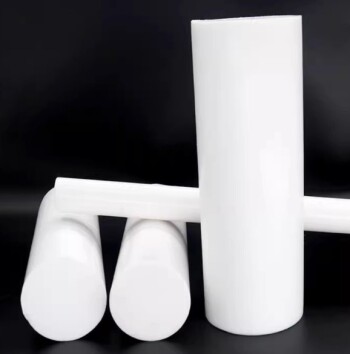
PTFE is commonly machined from stock shapes
PTFE is not conventionally melt-processible in the same way as PFA. It is typically formed into stock shapes and then machined into custom parts.
That manufacturing route is well suited to custom reaction vessels, microwave digestion components, electrochemical cell bodies, seals, and heavy-duty laboratory components. However, machining can increase cost and impose constraints on geometry, tolerances, and production volume.
ETFE and ECTFE can simplify structural design
The greater stiffness and hardness of ETFE and ECTFE can enable thinner or more mechanically stable parts in moderate-temperature applications. Their lower density compared with PFA can also reduce component weight.
The design benefit disappears if the material is exposed to chemicals or temperatures beyond its practical compatibility range. A mechanically strong component that swells, degrades, contaminates a sample, or loses properties is not a successful design.
Understanding the Trade-offs
Chemical resistance is not a single yes-or-no property
A material may resist a reagent under ambient conditions but perform differently at elevated temperature, under pressure, or after long exposure. Mechanical stress can also accelerate environmental stress cracking or other failure modes in partially fluorinated materials.
Compatibility should therefore be evaluated using the actual chemical, concentration, temperature, exposure duration, pressure, and stress state.
Published ratings are not interchangeable
Temperature values can differ because manufacturers use different test methods, safety factors, grades, and definitions of continuous service. A cited ETFE limit may appear as approximately 150°C in one source and higher in another, but that difference does not make ETFE equivalent to PTFE or PFA for high-temperature service.
Use the supplier’s rating for the specific grade and component geometry, then apply an engineering margin for pressure, cycling, and chemical exposure.
Mechanical strength does not eliminate creep
ETFE and ECTFE generally outperform PTFE and PFA in strength and stiffness, but all polymeric materials require evaluation for long-term loading. Fittings, valve bodies, clamps, and pressure-containing parts can experience dimensional change, especially when temperature is elevated.
For PTFE components, creep and cold flow are particularly important. Reinforcement, support rings, thicker sections, or alternative geometries may be necessary.
Purity requirements can outweigh mechanical advantages
For trace analysis, semiconductor-related laboratory work, high-purity reagent handling, and aggressive digestion, even moderate chemical interaction or extractables can be unacceptable.
In these applications, the broader chemical inertness and low surface energy of PTFE and PFA typically justify their lower mechanical stiffness. PFA is often especially attractive when a seamless or complex molded fluid path is required.
Making the Right Choice for Your Goal
Begin by identifying the most credible failure mode: chemical attack, thermal exposure, deformation, wear, impact, contamination, or manufacturing constraint.
- If your primary focus is maximum chemical resistance: Choose PTFE or PFA, particularly for aggressive reagents, corrosive fluid transfer, and long-term chemical exposure.
- If your primary focus is high-temperature operation: Choose PTFE or PFA, with PFA favored when complex molded or extruded components are required.
- If your primary focus is ultra-pure fluid handling: Choose PTFE or PFA because their broader chemical inertness and low surface energy reduce contamination risk.
- If your primary focus is mechanical strength and cut-through resistance: Consider ETFE or ECTFE for components exposed to clamping, abrasion, impact, or concentrated physical loads.
- If your primary focus is dimensional stability under moderate pressure: Consider ETFE or ECTFE, provided the chemical and temperature limits are acceptable.
- If your primary focus is custom, low-volume geometry: Consider machined PTFE when chemical performance is paramount, or molded/extruded PFA when production of complex fluid paths is important.
Choose the polymer by matching the material’s dominant strength to the application’s dominant risk: perfluoropolymers protect against chemical and thermal failure, while partially fluorinated copolymers protect against mechanical failure.
Summary Table:
| Property | PTFE/PFA | ETFE/ECTFE |
|---|---|---|
| Chemical Resistance | Excellent, broadest compatibility | Good, but more limited than PTFE/PFA |
| Continuous Use Temperature | Up to ~260°C | Typically ~150°C for ETFE |
| Tensile Strength | ~20-28 MPa | ~40-50 MPa |
| Stiffness (Flexural Modulus) | Lower, more flexible | Higher, more rigid |
| Friction Coefficient | Very low (0.1-0.2) | Higher |
| Cut-Through Resistance | Lower | Higher |
| Best For | Aggressive chemicals, high temperature, ultra-pure handling | Mechanical stress, dimensional stability, moderate temperature |
Need expert guidance on selecting the right fluoropolymer for your lab? At KINTEK, we specialize in high-performance PTFE and PFA labware and custom components. With our end-to-end CNC machining capabilities and a vast range of products from beakers to electrochemical cells, we ensure your lab operates with maximum purity and reliability. Contact us today to discuss your specific application or request a quote. Our team is ready to support your success!
Related Products
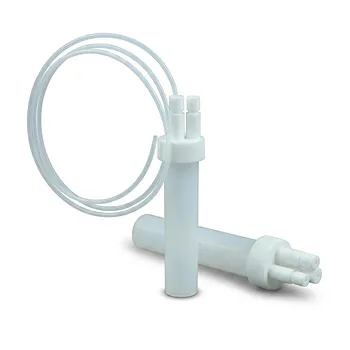
- High Purity PFA Coiled Tubing Custom PTFE Machining PFA Welding and Precision Bending Solutions
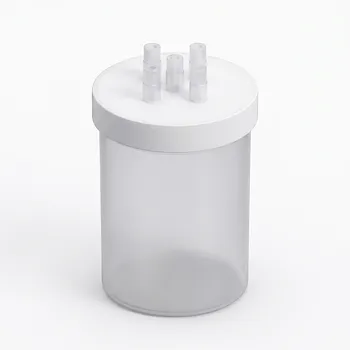
- High Purity 4L PFA Reaction Tank for Proton Exchange Membrane Electrolysis Water Oxygen Separation Systems
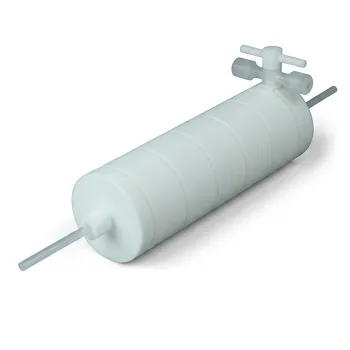
- High Purity PTFE Filter with PFA Valve Connections and Integrated Sieve Plate for Corrosive Fluid Processing
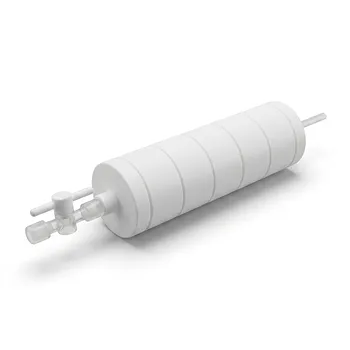
- PTFE Corrosion Resistant Filter with PFA Valve Connections and Integrated Sieve Plate
- Corrosion Resistant High Purity PFA Valve and Weldable Transparent Tubing for Semiconductor Fluid Transfer
People Also Ask
- How does high-purity PFA tubing maintain reagent purity? Achieve Ultra-Smooth, Zero-Contamination Fluid Transfer
- How does die design and core pin arrangement impact PTFE tubing accuracy?
- How has the elimination of ammonium perfluorooctanoate impacted the manufacturing and safety profile of fluoropolymer products? Key changes and what they mean for you
- What are the technical advantages of high-precision PFA tubing in MXene production? Maximize Purity and Yield.
- PTFE vs PFA: High-Temperature & Mechanical Comparison