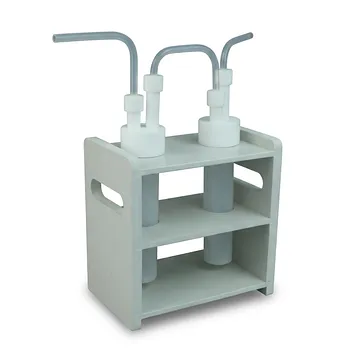
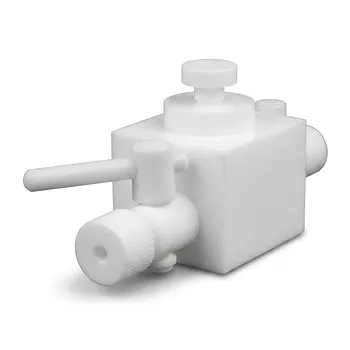
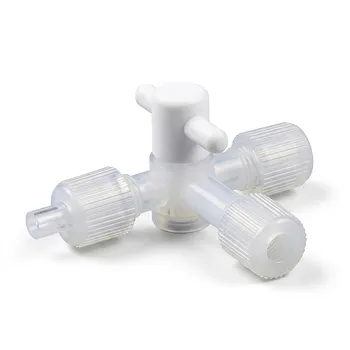
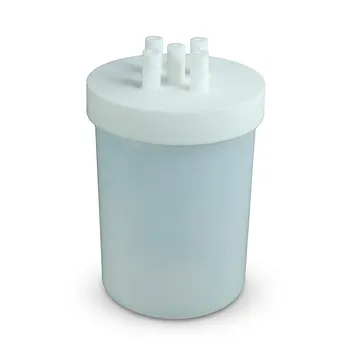
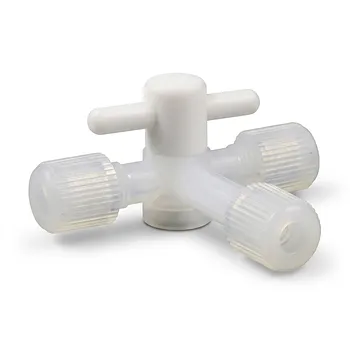
PTFE and PFA share the same practical continuous-use temperature of approximately 260°C, but they differ fundamentally in how they are processed. PTFE has a higher melting point, roughly 327°C, yet its extremely high melt viscosity prevents conventional injection molding and extrusion. PFA melts at a lower temperature, approximately 305°C, but is melt-processible, allowing complex, seamless, and high-purity laboratory components to be manufactured more efficiently.
The thermal ceiling is broadly similar, but the processing choice is not: select PTFE for robust, custom-machined apparatus and heavy-duty vessels; select PFA when complex molded geometry, smooth internal surfaces, translucency, weldability, or sealed fluid paths are priorities.
What the Thermal Data Actually Means
Continuous operating temperature
Both PTFE and PFA can generally support continuous service temperatures up to about 260°C, assuming the design also accounts for pressure, mechanical loading, chemical exposure, and the specific grade.
This makes both materials suitable for demanding laboratory applications such as digestion vessels, reaction components, high-purity tubing, and chemically aggressive fluid-handling systems.
Melting point versus service limit
PTFE melts at approximately 327°C, while PFA melts at approximately 305°C. These melting points should not be confused with recommended operating temperatures.
A material can remain chemically stable near its service limit while losing stiffness, dimensional stability, or pressure capability well before its melting point. For apparatus operating above 200°C, the relevant question is therefore not only whether the polymer melts, but whether the component retains enough mechanical integrity for its load and geometry.
Behavior at extreme temperatures
PTFE generally provides greater ultimate thermal resistance at temperatures substantially above normal laboratory service conditions. However, both polymers should be treated as materials with a practical continuous-use limit near 260°C.
Exposure near or above the melting range, prolonged operation in air at extreme temperatures, or thermal cycling beyond the design envelope can cause dimensional change, degradation, or loss of performance. Such conditions require grade-specific data rather than relying on the nominal melting point.
Why PTFE Is Difficult to Process
Extremely high melt viscosity
Standard PTFE has an exceptionally high melt viscosity, reported in the approximate range of 10^10 to 10^12 poise at 380°C in the supplied references.
As a result, PTFE does not flow like conventional thermoplastics during heating. It cannot normally be processed through standard injection-molding or melt-extrusion equipment.
Compression molding and sintering
PTFE is typically formed by powder pressing, compression molding, and sintering. The resulting stock shapes can then be finished through precision CNC machining.
This process is well suited to solid blocks, plates, rods, seals, reaction vessels, electrochemical cell bodies, and other components where material thickness and mechanical robustness are more important than molding complexity.
Implications for laboratory apparatus
PTFE is advantageous when a laboratory component must be custom-machined to a precise design. Machining also supports prototypes, specialized reaction vessels, microwave digestion components, and apparatus that would be difficult or uneconomical to produce as a molded PFA part.
The trade-off is that complex geometries can require more manufacturing time, more material, and additional assembly or sealing steps.
Why PFA Enables More Complex Components
Conventional melt processing
PFA is a melt-processible copolymer based on tetrafluoroethylene and perfluoroalkyl vinyl ether components. It can be injection-molded, extruded, and thermally processed using methods more familiar from other thermoplastics.
This allows manufacturers to produce intricate fittings, valves, tubing, bottles, sealed vessels, and integrated fluid-transfer components with fewer machining operations.
Smooth, seamless fluid paths
Melt processing can create smooth internal surfaces and seamless geometries that are valuable in high-purity applications.
These surfaces can reduce locations where trace contaminants, particulates, or residual process chemicals might collect. PFA is therefore particularly useful for trace analysis, ultrapure fluid handling, and systems where internal cleanliness is difficult to verify after assembly.
Structural integrity at elevated temperature
PFA retains useful mechanical modulus and structural integrity at temperatures above 200°C, while preserving the high chemical resistance expected from a perfluorinated fluoropolymer.
That does not make PFA immune to creep or pressure-related deformation. It means that PFA can support demanding molded designs when the component is properly engineered for temperature, wall thickness, pressure, and thermal cycling.
Selecting the Material for Reaction Vessels
PTFE for heavy-duty custom apparatus
PTFE is often the stronger choice for solid, thick-walled, custom-machined components. It is well suited to reaction vessels, digestion vessels, electrochemical cell bodies, and apparatus requiring robust support and precise machining.
Its opacity is usually acceptable when direct visual inspection of the reaction is not a primary requirement.
PFA for complex or sealed vessels
PFA is preferred when the vessel requires intricate molded features, integrated ports, smooth internal surfaces, or melt-sealed construction.
Its translucent appearance can also support visual monitoring of fluid level, bubbles, phase behavior, or particulate formation. The benefit depends on wall thickness, formulation, and the application environment.
Pressure and mechanical design still govern
Neither polymer should be selected solely from its temperature rating. At elevated temperatures, pressure capability, creep resistance, clamping loads, seal compression, and thermal expansion can determine whether a vessel remains reliable.
For pressurized reactions, the polymer component may need external reinforcement or a separate structural containment system.
Understanding the Trade-offs
PTFE is not automatically better because its melting point is higher
PTFE’s higher melting point does not mean it is always the safer choice for a high-temperature apparatus. The component may never approach either polymer’s melting point during operation.
If the design depends on a complex molded shape, transparent inspection, or seamless fluid paths, PFA may provide the more suitable overall solution despite its lower melting point.
PFA is not automatically better because it is easier to mold
Melt processability improves manufacturing flexibility, but PFA still has limitations. It can experience creep, dimensional change, and reduced stiffness under sustained load at elevated temperature.
A molded PFA vessel or fitting must therefore be evaluated for long-term pressure, thermal cycling, joint design, and support conditions.
Avoid using the melting point as the design temperature
The melting point describes a phase transition under specified test conditions. It does not establish a safe continuous working temperature for a loaded laboratory component.
Use the manufacturer’s continuous-use rating, pressure-temperature curves, chemical compatibility data, and grade-specific mechanical properties for final design decisions.
Transparency and purity involve more than resin selection
PFA’s translucency and smooth molded surfaces can be valuable for high-purity work, but cleanliness also depends on manufacturing controls, handling, cleaning, packaging, and connection design.
Likewise, PTFE can perform well in high-purity service when it is properly manufactured and machined, even though it is typically opaque and may contain more fabricated interfaces.
Thermal cycling deserves specific attention
Repeated heating and cooling can produce expansion mismatch, seal relaxation, dimensional changes, and fatigue at threaded or clamped connections.
PFA’s molded or welded construction may reduce some assembly interfaces, while PTFE’s machined construction may provide greater flexibility for replacement and customization. The better option depends on the vessel architecture and maintenance model.
Making the Right Choice for Your Goal
The selection should follow the component’s manufacturing and operating requirements, not simply its nominal temperature rating.
- If your primary focus is heavy-duty custom reaction vessels: Choose PTFE when a robust solid component can be compression-molded, sintered, and precision-machined to the required geometry.
- If your primary focus is complex molded geometry: Choose PFA when injection molding or extrusion can integrate ports, channels, fittings, or other intricate features.
- If your primary focus is high-purity fluid handling: Choose PFA when smooth, seamless, translucent, and weldable tubing, valves, fittings, or vessels are important.
- If your primary focus is operation near the upper thermal limit: Treat both materials as approximately 260°C continuous-service polymers and verify pressure, creep, thermal cycling, and chemical compatibility for the specific grade.
- If your primary focus is specialized apparatus or prototyping: Choose PTFE when precision CNC machining and design flexibility outweigh the manufacturing advantages of melt-processible PFA.
For most laboratory selections, PTFE determines what can be custom-machined, while PFA determines what can be efficiently molded into a complex, clean, and integrated fluid-handling component.
Summary Table:
| Property | PTFE | PFA |
|---|---|---|
| Continuous service temperature | ~260°C | ~260°C |
| Melting point | ~327°C | ~305°C |
| Processability | Not melt-processible; requires compression molding + sintering + CNC machining | Melt-processible; can be injection molded or extruded |
| Typical applications | Custom-machined heavy-duty vessels, reaction apparatus | Complex molded components, seamless tubing, high-purity fluid handling |
Ready to optimize your lab with high-performance fluoropolymers? Whether you need custom-machined PTFE apparatus or complex molded PFA components, KINTEK has the expertise and manufacturing capabilities to deliver. From standard labware to bespoke electrochemical cells and microwave digestion vessels, our PTFE and PFA solutions ensure purity, durability, and precision. Contact us today to discuss your requirements and discover how we can enhance your laboratory's efficiency and reliability.
Related Products
- PTFE PFA Vacuum Filtration System Corrosion Resistant Customizable Shatterproof Laboratory Device
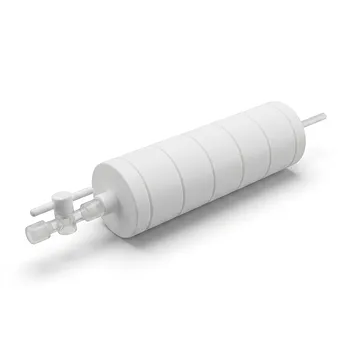
- High Purity PTFE Filter with PFA Valve Connections and Integrated Sieve Plate for Corrosive Fluid Processing
- PTFE Corrosion Resistant Filter with PFA Valve Connections and Integrated Sieve Plate
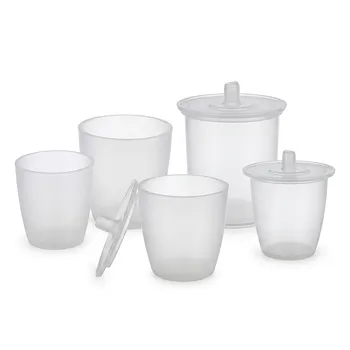
- High Purity PFA Crucible and Corrosion Resistant PTFE Beaker for Trace Analysis and Custom Laboratory Applications
- Custom PTFE Constant Pressure Separatory Funnel Corrosion Resistant Low Background Labware for PFA Flasks
People Also Ask
- What makes PTFE filtration systems advantageous for industrial and scientific use? Unmatched Chemical & Thermal Stability
- How does the hydrophobicity of PTFE filters benefit their use? Ensure Uninterrupted Gas Flow and Solvent Filtration
- What temperature resistance do PTFE filters offer? Unmatched Thermal Stability from -200°C to +260°C
- Which chemicals are fully compatible with PTFE filters? Discover Unmatched Chemical Resistance
- What sizes and pore options are available for PTFE filters? Choose the Right Filter for Your Application