Expanded PTFE (ePTFE) joint sealant tape is generally easier to install and more forgiving than a standard solid PTFE gasket. Its soft, porous structure conforms to pitted, uneven, delicate, or irregular flange surfaces while sealing under lower compressive stress. Standard solid PTFE offers excellent chemical and temperature resistance, but its rigidity and tendency toward cold flow can make it less effective on imperfect flanges and more demanding to install.
The central advantage of ePTFE is adaptability: it combines PTFE’s chemical resistance with the flexibility and compressibility needed to seal irregular surfaces. Its adhesive-backed tape format also lets installers create a correctly sized gasket in place with a single overlap.
Why ePTFE Seals Differently
Solid PTFE Is Chemically Strong but Mechanically Rigid
Standard solid PTFE has broad chemical compatibility and remains useful across very low and high temperatures. However, its dense structure is relatively rigid, so it does not readily accommodate flange pits, scratches, deformation, or changes in surface geometry.
Under sustained bolt loading, solid PTFE can also experience cold flow, or creep. This gradual deformation may reduce sealing stress over time and compromise joint integrity if the design and bolt load do not account for it.
ePTFE Uses a Flexible Microstructure
Expanded PTFE is manufactured so that virgin PTFE develops a fibrous, porous microstructure. The material remains chemically resistant because it contains no additives, but it is substantially softer and more flexible than dense PTFE.
When compressed, its internal fibers deform and adapt to the available space. This allows ePTFE to fill surface irregularities and maintain contact across flange areas that a rigid gasket may not seal consistently.
ePTFE Requires Less Surface Perfection
A solid PTFE gasket depends more heavily on smooth, properly aligned mating surfaces. ePTFE can compensate for roughness, pitting, flange deformation, and more complex geometries.
This makes it especially useful for irregular, fragile, glass-lined, vertical, or suspended-pipeline flanges, where excessive clamping force could damage the equipment or where conventional gasket placement is difficult.
Main Installation Advantages
Adhesive Backing Holds the Tape in Place
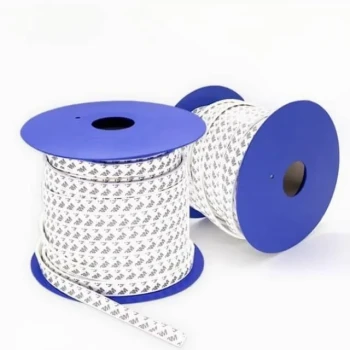
Joint sealant tape commonly includes a pressure-sensitive adhesive backing protected by peel-off carrier paper. The installer removes the carrier and applies the tape directly to the sealing face.
The adhesive is primarily a positioning aid rather than the pressure boundary. The flange compression creates the working seal, while the backing helps prevent the tape from shifting during assembly.
One Continuous Length Fits Many Flange Sizes
The tape can be cut to the required length and applied around the joint. Instead of stocking or fabricating a separate solid gasket for every flange size, technicians can form a gasket from the same material as needed.
The ends are typically overlapped at one connection point. This creates a continuous sealing path without requiring a separately manufactured ring or a complex cutting operation.
It Is Easy to Cut and Shape
Because ePTFE is soft and flexible, it can usually be cut with hand tools or standard gasket-cutting equipment. The material can also be adapted to unusual flange outlines and nonstandard dimensions at the worksite.
This simplifies maintenance work, emergency repairs, and applications where precise prefabricated gasket inventory is impractical.
It Seals at Lower Bolt Loads
ePTFE’s compressibility and conformability allow it to seal effectively without the same level of compressive stress typically needed to force a rigid gasket into surface defects. Lower installation loads can reduce the risk of crushing delicate flanges, damaging linings, or distorting equipment.
The required bolt load still depends on the flange design, pressure, temperature, media, and manufacturer’s installation guidance. “Low stress” does not mean that bolt tightening can be improvised.
It Reduces Assembly Complexity
A technician can apply the tape directly to the sealing surface, overlap the ends, and assemble the joint. This can reduce alignment problems and make installation more predictable than handling a stiff gasket that must remain centered while the flange is closed.
The tape format can also reduce inventory complexity by covering a range of flange sizes and geometries with one material type.
How Performance Compares in Service
ePTFE Maintains Better Contact on Uneven Flanges
The expanded structure helps ePTFE maintain contact as it conforms to irregular surfaces and compensates for some flange deformation. This improves sealing reliability where a dense, rigid gasket may bridge defects rather than fill them.
Its flexibility can also help protect flange faces by reducing the need for excessive clamping force.
Both Materials Retain PTFE’s Chemical Resistance
ePTFE is made from expanded virgin PTFE, so it preserves the material’s major chemical-resistance advantage. It is suitable for demanding chemical environments when its pressure and temperature ratings are appropriate for the application.
The absence of additives can also make suitable grades compatible with clean-service requirements, including applications governed by FDA or NSF criteria. The specific certification must be confirmed for the selected product.
ePTFE Reduces, but Does Not Eliminate, Creep Concerns
Expanded PTFE generally offers better resistance to cold flow and improved sealing stability than standard solid PTFE. Its structure helps maintain sealing contact and a more stable bolt load under service conditions.
Nevertheless, PTFE-based materials are not immune to long-term deformation. Temperature, pressure, flange stiffness, bolt load, gasket thickness, and joint cycling all affect performance.
Understanding the Trade-offs
Installation Simplicity Does Not Replace Joint Preparation
ePTFE can compensate for surface irregularities, but it cannot correct severely damaged, misaligned, contaminated, or improperly supported flanges. Sealing faces should still be clean, appropriately aligned, and free of defects that exceed the product’s ability to conform.
The tape must also be applied continuously, without unintended gaps, twists, or inconsistent positioning.
Overlap Design Matters
The overlap is a practical feature of joint sealant tape, but it must be made according to the manufacturer’s instructions. An overlap that is too short, poorly positioned, or excessively thick can create uneven compression.
The joint should be inspected to ensure that the tape forms a complete sealing path and that the overlap will not interfere with flange closure.
Pressure and Temperature Ratings Still Apply
ePTFE products vary in density, thickness, construction, and intended service. Some sheet materials are rated for temperatures around 650°F and pressures above 3,000 PSI, but those figures are product-specific and must not be treated as universal values for every tape.
The selected sealant must be verified against the actual media, temperature range, pressure, flange type, bolt load, and applicable standards.
Solid PTFE Can Still Be the Better Choice
A standard solid PTFE gasket may be appropriate when the flanges are smooth, rigid, accurately machined, and compatible with the gasket’s compression requirements. Its dense construction can provide predictable dimensional behavior in applications where conformability is less important.
The choice should be based on the joint’s mechanical conditions, not on chemical resistance alone, because both materials can offer the fundamental advantages of PTFE.
Making the Right Choice for Your Goal
Select the material based on the condition of the joint, the installation environment, and the required long-term sealing behavior.
- If your primary focus is sealing irregular or delicate flanges: Choose ePTFE because its high conformability can seal surface defects at lower compressive loads.
- If your primary focus is rapid field installation: Choose adhesive-backed ePTFE tape because it can be cut to length, applied directly to the flange, and closed with a single overlap.
- If your primary focus is standardized, smooth flange assemblies: Consider solid PTFE when the joint can provide the surface quality, alignment, and compression control it requires.
- If your primary focus is chemical compatibility: Evaluate both materials as PTFE-based options, then confirm the selected product’s exact temperature, pressure, and certification ratings.
- If your primary focus is long-term sealing stability: Prefer ePTFE where creep resistance and conformity are important, while still following the manufacturer’s bolt-load and service limitations.
For most difficult-to-install or imperfect flange joints, ePTFE provides the more forgiving combination of PTFE resistance, mechanical adaptability, and practical installation.
Summary Table:
| Feature | ePTFE Joint Sealant Tape | Solid PTFE Gasket |
|---|---|---|
| Material Structure | Expanded, porous, fibrous | Dense, rigid |
| Conformability | High, fills surface irregularities | Low, requires smooth flanges |
| Installation | Easy: adhesive backing, cut-to-length, overlap | More complex: precise alignment, higher bolt load |
| Surface Tolerance | Handles pits, scratches, and deformation | Requires clean, flat, aligned surfaces |
| Cold Flow (Creep) | Reduced due to microstructure | More prone to creep under sustained load |
| Chemical Resistance | Excellent (virgin PTFE) | Excellent |
| Temperature/Pressure Range | Product-specific, up to 650°F / 3000 PSI | Product-specific, similar range |
| Best For | Imperfect, delicate, irregular flanges; field repairs | Smooth, well-prepared flanges; predictable dimensions |
Ready to simplify your sealing challenges? Whether you need ePTFE tape for stubborn flanges or solid PTFE gaskets for standard joints, KINTEK offers high-performance PTFE and PFA lab supplies, including custom machining for complex components. From essential labware to advanced reaction vessels, our products deliver reliability and precision. Contact our experts today to find the perfect sealing solution for your application—get in touch now and elevate your lab's efficiency!
Related Products
- Custom PTFE Sealing Tapes for Industrial and High Tech Applications
- Customizable PTFE Seals Filter Holders for Versatile Applications
- Custom PTFE Sealing Caps and Corrosion Resistant Low Background Teflon Adapters
- Custom PTFE Insulating Gaskets and Corrosion Resistant Fluoropolymer Seals for Industrial Electrical Applications
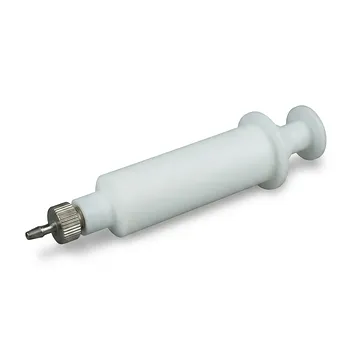
- High Temperature Chemical Resistant 50ml PTFE Syringe Customized Teflon Injector with Threaded Seal for Trace Analysis
People Also Ask
- How are custom PTFE parts used in the automotive sector? Enhance Vehicle Performance & Durability
- Why is PTFE's temperature stability important for sealing applications? Ensure Leak-Proof Performance from -200°C to 260°C
- Why is PTFE popular in the oil and gas industry? Withstand Extreme Heat, Pressure & Corrosion
- What makes PTFE reliable for sealing applications? Unmatched Chemical & Thermal Stability
- What are the drawbacks of using PTFE for sealing needs? The Critical Trade-offs in Chemical vs. Mechanical Performance