Perfluoropolymers such as PTFE and PFA generally outperform partially fluorinated polymers in thermal stability and chemical inertness, but they are softer and less mechanically rigid. Their highly fluorinated structures provide continuous-use temperatures of approximately 260°C and resistance to aggressive acids, bases, and solvents. Partially fluorinated materials such as ETFE, PVDF, and PCTFE are typically harder, stiffer, and more creep-resistant, but they have lower long-term temperature limits and narrower chemical compatibility.
For laboratory equipment exposed to extreme heat, corrosive chemicals, or contamination-sensitive samples, PTFE and PFA are usually the safer material choices. Choose partially fluorinated polymers when mechanical strength, dimensional rigidity, abrasion resistance, or easier processing is more important than maximum inertness.
Why Fluorination Changes Performance
The protective role of carbon-fluorine bonds
Perfluoropolymers contain polymer structures dominated by strong carbon-fluorine bonds. Fluorine forms a protective sheath around the carbon backbone, making it difficult for chemicals or heat to attack the molecular chain.
Partially fluorinated polymers retain some hydrogen or other non-fluorinated atoms in their structure. This improves certain mechanical properties but leaves more chemically reactive sites than in PTFE or PFA.
Perfluoropolymers are not identical to one another
PTFE consists of a linear, highly fluorinated structure and is widely regarded as the benchmark for chemical resistance and low friction. It is non-melt-processible, so components are commonly compression-molded or machined.
PFA provides nearly comparable chemical and thermal performance but is melt-processible. This allows manufacturers to produce transparent, seamless, and complex laboratory vessels, tubing, fittings, and valves with high purity.
Thermal Stability in Laboratory Use
Continuous operating temperature
PTFE and PFA generally support continuous-use temperatures up to approximately 260°C, depending on the design, load, exposure time, and manufacturer’s specification.
Partially fluorinated materials have lower long-term working limits. ETFE, for example, may have a melting peak near 260°C, but that does not mean it can operate continuously at that temperature; its typical continuous-use range is closer to 150°C.
Long-term exposure matters more than melting point
A polymer’s melting point describes when it loses its solid structure under a specific test condition. It does not establish a safe continuous operating temperature for a laboratory vessel or fluid-handling component.
For equipment used in digestion, high-temperature reactions, or hot chemical transfer, long-term thermal endurance is the more relevant measure. PTFE and PFA are less likely than partially fluorinated alternatives to suffer thermal degradation, embrittlement, or contamination from breakdown products within their rated operating range.
PTFE versus PFA at extreme temperatures
PTFE has a higher melting point, approximately 342°C, compared with approximately 305°C for PFA. At temperatures well beyond normal continuous service, PTFE can also show better resistance to thermal weight loss because PFA contains perfluoroalkoxy side chains.
PFA nevertheless provides near-PTFE thermal performance in normal laboratory service while offering much greater manufacturing flexibility. The distinction is important: PTFE is advantageous for maximum thermal margin, while PFA is often more practical for complex high-purity components.
Mechanical Hardness and Structural Behavior
Partially fluorinated polymers are harder
Partially fluorinated polymers such as ETFE and PVDF are generally harder, stiffer, and more mechanically robust than PTFE and PFA. They often provide better resistance to abrasion, deformation, and handling damage.
This makes them useful when equipment must retain its shape under mechanical stress or when resistance to wear is more important than absolute chemical inertness.
PTFE is soft and prone to creep
PTFE has relatively low hardness and stiffness. Under sustained pressure or load, it can slowly deform through creep, which may affect seals, threaded parts, dimensional tolerances, and heavily loaded supports.
PFA can also be softer and less mechanically rigid than many partially fluorinated alternatives, although its processability allows designs that reduce stress concentration and improve component reliability.
Hardness is not the same as laboratory suitability
Greater hardness does not automatically make a polymer better for chemical laboratory equipment. A harder material may resist scratches and deformation, but if it has lower chemical or thermal resistance, it may be unsuitable for aggressive reagents or high-temperature exposure.
For a trace-analysis vessel, preventing chemical interaction and contamination may matter more than surface hardness. For a repeatedly handled fitting or mechanically loaded support, the balance may favor a partially fluorinated polymer.
Chemical Inertness and Purity
PTFE and PFA provide the broadest resistance
PTFE and PFA offer among the highest levels of chemical resistance available in laboratory polymers. They are resistant to most strong acids, bases, organic solvents, and corrosive reagents used in laboratory processing.
Their low chemical reactivity helps preserve sample composition and reduces the risk that the equipment will introduce extractables, corrosion products, or reaction contaminants.
Partially fluorinated polymers have narrower compatibility
PVDF, ETFE, and PCTFE can provide excellent resistance to many chemicals, but their compatibility is more application-dependent. Their partially fluorinated structures are less uniformly shielded than those of PTFE and PFA.
Compatibility can also vary with temperature, concentration, exposure time, mechanical stress, and the presence of mixtures. A material that performs well at room temperature may swell, soften, or lose strength when exposed to the same chemical at elevated temperature.
“Chemically inert” still has limits
PTFE and PFA should not be treated as universally immune to every substance under every condition. Highly reactive materials, including some forms of elemental fluorine, molten alkali metals, and extreme thermal environments, can attack fluoropolymers.
For routine laboratory acids, bases, and solvents, however, PTFE and PFA generally provide the strongest protection against chemical degradation and sample contamination.
Selecting PTFE, PFA, or a Partially Fluorinated Polymer
When PTFE is the strongest choice
PTFE is particularly suitable when the application requires:
- Maximum chemical resistance.
- Very low friction and strong non-stick performance.
- High-temperature containment.
- Cryogenic performance, including service near approximately -267°C in suitable designs.
- Machined components, stir bars, seals, or low-friction sliding parts.
Its limitations are its softness, creep under load, opacity, and non-melt-processible manufacturing route.
When PFA is the stronger practical choice
PFA is often preferable when the application requires:
- Near-PTFE chemical and thermal performance.
- Transparent laboratory vessels or tubing.
- Seamless, melt-molded components.
- Complex geometries, valves, fittings, or fluidic assemblies.
- High-purity handling with reduced risk of seams or fabrication-related contamination.
PFA generally costs more than conventional engineering plastics and does not provide the same extreme-temperature margin or lowest friction as PTFE.
When partially fluorinated polymers are appropriate
ETFE, PVDF, and PCTFE are reasonable choices when the application requires:
- Greater hardness and stiffness.
- Better creep resistance or dimensional stability.
- Higher resistance to abrasion and handling damage.
- Easier melt processing.
- A temperature and chemical environment within the material’s validated limits.
They are best selected after checking the exact chemical mixture and operating temperature rather than relying only on a general fluoropolymer classification.
Understanding the Trade-offs
Maximum inertness versus mechanical durability
PTFE and PFA minimize chemical interaction, but their lower hardness can make them vulnerable to scratching, deformation, and creep. Partially fluorinated polymers reverse part of that balance by improving mechanical rigidity at the cost of some chemical and thermal margin.
Thermal rating versus actual design conditions
A published temperature rating does not account for every condition. Pressure, wall thickness, sustained mechanical load, thermal cycling, and chemical exposure can reduce the practical operating limit.
A thin PFA tube carrying a hot chemical under pressure and a thick PTFE digestion vessel may have very different safe-use limits, even though both materials are rated near 260°C.
Fabrication flexibility versus material properties
PTFE’s non-melt-processible nature can increase fabrication cost and limit geometry. PFA is easier to mold into complex, high-purity shapes, but it may have somewhat lower extreme-temperature performance and higher material cost.
Chemical compatibility must be validated
Chemical resistance tables are useful screening tools, not substitutes for application validation. For critical equipment, verify the supplier’s data for the specific reagent, concentration, temperature, exposure duration, pressure, and mechanical load.
Making the Right Choice for Your Goal
Select the material according to the failure mode that would matter most in the laboratory.
- If your primary focus is maximum chemical inertness: Choose PTFE or PFA, with PFA favored when transparent or complex melt-molded components are required.
- If your primary focus is high-temperature operation: Choose PTFE or PFA for continuous service near 260°C, while checking the specific design and exposure conditions.
- If your primary focus is mechanical hardness and dimensional rigidity: Consider ETFE, PVDF, or PCTFE when their chemical compatibility and temperature limits are adequate.
- If your primary focus is low friction and non-stick behavior: Prefer PTFE, particularly for stir bars, sliding seals, and low-friction components.
- If your primary focus is high-purity fluid handling: Prefer PFA for transparent, seamless, melt-processed tubing, vessels, fittings, and valves.
Perfluoropolymers provide the broadest thermal and chemical protection, while partially fluorinated polymers provide a harder and more mechanically durable compromise.
Summary Table:
| Property | Perfluoropolymers (PTFE, PFA) | Partially Fluorinated (ETFE, PVDF, PCTFE) |
|---|---|---|
| Thermal Stability | Continuous use up to 260°C; PTFE melts at 342°C, PFA at 305°C | Lower continuous limits (e.g., ETFE ~150°C) |
| Mechanical Hardness | Softer, prone to creep | Harder, stiffer, more creep-resistant |
| Chemical Inertness | Broadest resistance to acids, bases, solvents | Good but narrower, application-dependent |
| Best For | High purity, extreme thermal/chemical exposure | Mechanical durability, dimensional stability |
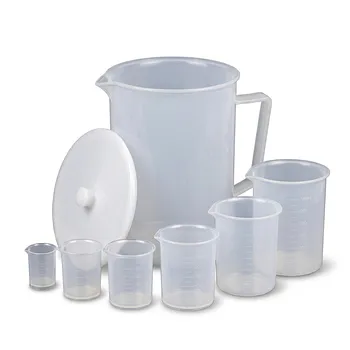
Ready to choose the right fluoropolymer for your lab? At KINTEK, we specialize in high-performance PTFE and PFA labware, from basic beakers to custom CNC-machined parts. Our experts can guide you to the best material for your application, ensuring optimal performance and safety. Contact us today for a consultation and discover how our high-purity, custom solutions can enhance your lab's efficiency and reliability.
Related Products
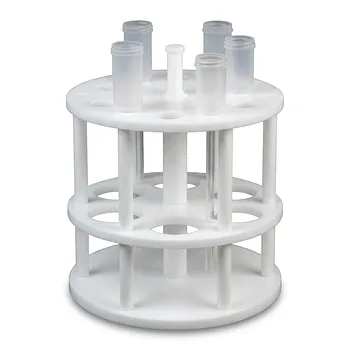
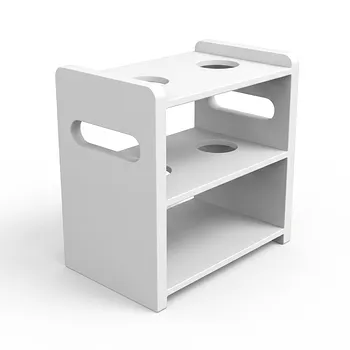
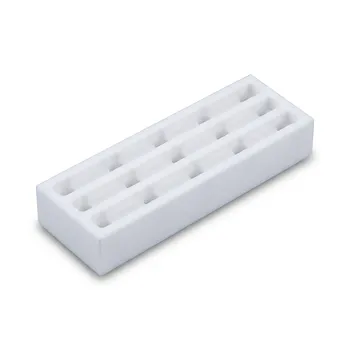
- Custom PFA Microcolumn Racks and PTFE Machined Low Background Corrosion Resistant Laboratory Fixtures
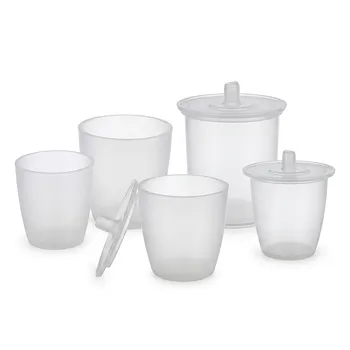
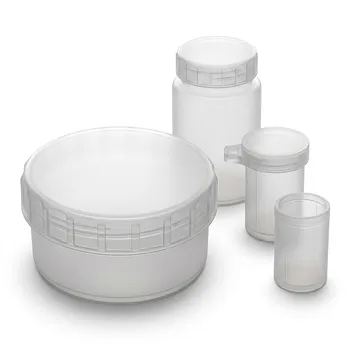
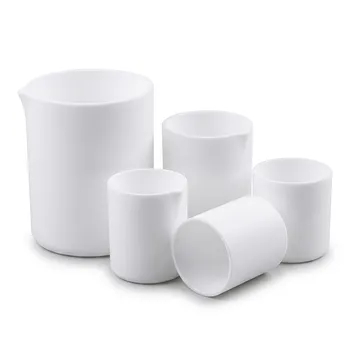
- High Purity PFA Crucible and Corrosion Resistant PTFE Beaker for Trace Analysis and Custom Laboratory Applications
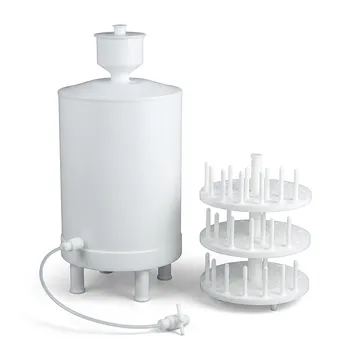
- PTFE PFA Vacuum Filtration System Corrosion Resistant Customizable Shatterproof Laboratory Device
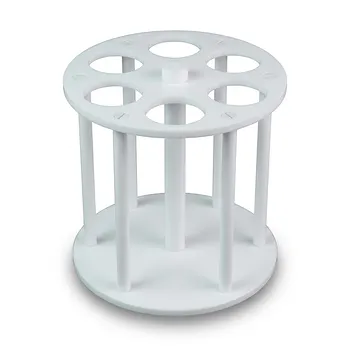
- Custom PFA Separatory Funnel Rack PTFE Machined Laboratory Support Stand Corrosion Resistant Low Background Fluoropolymer Fixture
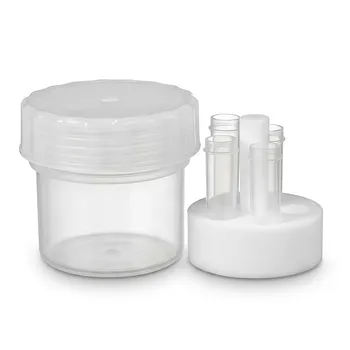
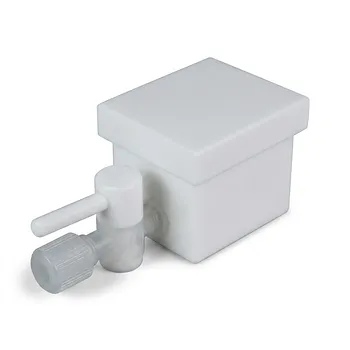
- Corrosion Resistant PTFE Support with PFA Transparent Reaction Tank and High Purity PFA Sampling Tube for Trace Analysis
People Also Ask
- What other PTFE lab accessories are commonly used? Essential Tools for Chemical Resistance & Purity
- How does high fluorination in perfluorinated polymers improve chemical resistance and thermal stability of lab apparatus? Discover the science behind PTFE and PFA's superior performance.
- What inherent material characteristics of non-melt-processable PTFE make it suitable for manufacturing high-purity laboratory containers and custom-machined apparatus?
- What material considerations are critical for laboratory apparatus when performing cage-opening reactions on fluorinated silsesquioxanes using strong superacids? Choose PTFE/PFA for inertness and purity
- What surface chemical species and binding energy signatures are detected on PTFE fluoropolymer sample holders during XPS analysis? Key insights for accurate calcium detection.