Temperature control is critical because PTFE resin can be permanently damaged during blending if it is exposed to excessive heat and shear. When PTFE paste is prepared, the resin is mixed with approximately 15% to 22% lubricant and must remain strictly below its relevant crystalline transition temperature. This helps prevent premature fibrillation, protects particle integrity, and ensures that the lubricant is distributed uniformly before extrusion.
The blending stage must preserve PTFE as a uniform, undamaged particulate system. Controlling temperature prevents heat-assisted fibrillation and shear damage, which are difficult to reverse and can ultimately produce uneven fibril structure and pore distribution in the finished membrane.
Why the Blending Stage Requires Tight Thermal Control
PTFE particles are sensitive to heat and shear
Fine-powder PTFE does not behave like an ordinary thermoplastic during initial mixing. Mechanical shear can cause polymer chains to uncoil prematurely, forming hard, irreversible fibrillated lumps.
Temperature makes this risk more significant. As PTFE approaches and passes its crystalline transition region, molecular mobility and particle deformability increase, allowing friction and shear to alter the resin structure before the intended extrusion step.
The crystalline transition changes resin behavior
PTFE undergoes a first-order crystalline transition at approximately 19°C, accompanied by a change in crystal structure and a volume change of roughly 1%, with reported expansion approaching 1.8% across the broader transition range.
This dimensional and structural change means that resin temperature affects how particles interact, compact, and respond to mixing forces. The blending process therefore needs a controlled thermal window rather than relying on uncontrolled room-temperature conditions.
Premature fibrillation damages the starting material
Fibrillation is useful later during paste extrusion, where controlled deformation creates the fibril network that supports a porous membrane. During blending, however, premature fibrillation is undesirable because it creates nonuniform agglomerates before the resin has been evenly lubricated.
These damaged regions can remain in the paste and later become weak points, irregular fibril zones, or local variations in membrane structure.
How Temperature Affects Membrane Quality
Controlled temperature supports uniform lubricant distribution
The lubricant must coat and distribute among the PTFE particles consistently. If the resin begins to fibrillate or agglomerate during mixing, the lubricant cannot be distributed evenly throughout the paste.
Uniform distribution produces more predictable paste flow during extrusion and helps the preform deform consistently under pressure.
Stable paste flow improves fibril alignment
Membrane formation depends on controlled deformation of the paste during extrusion and subsequent stretching or drawing. A paste with uneven lubrication does not flow uniformly: some regions may deform easily while others resist movement.
That inconsistency affects fibril alignment, which is central to the mechanical strength and pore-forming behavior of the porous fluoropolymer structure.
Uniform processing supports reproducible pores
The membrane's pore distribution is influenced by the resin's initial condition, lubricant distribution, extrusion behavior, and stretching history. Temperature-related damage at the blending stage can therefore appear later as variations in pore size, porosity, thickness, or permeability.
Thermal control is consequently a quality-control measure for the finished membrane, not merely a mixing parameter.
Temperature Control Must Match the Processing Stage
Blending and extrusion have different thermal requirements
The requirement to blend below the transition temperature should not be confused with the temperature used for extrusion. The resin must remain intact during lubricant incorporation, while extrusion requires the preform to become sufficiently deformable for controlled flow.
For this reason, temperature is managed as a staged process: low enough during blending to protect the powder, then raised in a controlled manner during extrusion to support deformation.
Preform molding also requires a defined thermal window
The supplementary references identify approximately 21°C to 25°C as a useful conditioning and molding range for achieving improved compaction, uniform density, and structural integrity. This is a separate operation from cold blending and must be controlled according to the specific resin and process sequence.
Molding too far below the transition region can reduce the resin's response to compaction pressure and contribute to weaker billets that are more vulnerable to cracking during sintering.
Drying requires another form of thermal protection
During lubricant removal, ovens may operate at substantially higher air temperatures, often around 150°C to 300°C. The PTFE substrate must remain below its melting point, approximately 342°C, because premature partial sintering would prevent the material from being drawn into a uniform porous membrane.
The principle remains the same throughout processing: use enough heat for the current operation, but prevent the polymer from entering a state that compromises the next operation.
Understanding the Trade-offs
Excessively low temperature can impair compaction
Keeping the resin cold protects it from premature fibrillation, but temperatures that are too low can reduce particle response during preforming. Poor compaction may produce low-density or mechanically weak billets.
The correct temperature is therefore process-specific. Cold conditions may be appropriate for resin handling and blending, while molding may require controlled conditioning near the recommended range.
Excessive temperature promotes agglomeration and structural damage
Allowing fine-powder PTFE to warm during handling or blending increases the risk of particle friction, premature fibrillation, and hard agglomerate formation. Once these structures form, later mixing may not restore a uniform powder-lubricant system.
The result can be nonuniform extrusion pressure, inconsistent paste flow, and defects in the final membrane.
Temperature gradients are also a problem
A batch can have an acceptable measured average temperature while still containing warmer regions. Localized heating from mixers, friction, poor heat transfer, or extended residence time can create damaged material even when the bulk reading appears acceptable.
Effective control therefore includes monitoring the resin, lubricant, equipment, and batch temperature, as well as limiting mixing intensity and residence time.
Uncontrolled ambient conditions can introduce defects
Temperature control also helps manage condensation and contamination. Moisture reaching the dew point can contribute to cracking during sintering, while dust or oil contamination can carbonize at high temperature and produce visible defect spots.
Clean, stable environmental conditions support the thermal control strategy but do not replace direct monitoring of the material temperature.
Making the Right Choice for Your Goal
The practical objective is to preserve resin quality during blending and introduce deformation only when the process is ready for it.
- If your primary focus is resin integrity: Keep the PTFE-lubricant blend below the relevant transition temperature and minimize friction, shear, and residence time.
- If your primary focus is paste consistency: Control both resin and lubricant temperatures so the lubricant distributes uniformly throughout the powder.
- If your primary focus is membrane performance: Protect the blend from premature fibrillation because fibril uniformity directly affects structural consistency and pore distribution.
- If your primary focus is dimensional and preform quality: Use a separate controlled conditioning and molding range appropriate for compaction, rather than applying the blending temperature indiscriminately to every process stage.
- If your primary focus is production reliability: Monitor local temperature gradients and establish defined limits for mixing, preforming, extrusion, and drying.
Temperature control preserves the difference between deliberate PTFE fibrillation during extrusion and destructive fibrillation during blending, which is fundamental to producing consistent fluoropolymer membranes.
Summary Table:
| Aspect | Why It Matters | Consequence of Poor Control |
|---|---|---|
| Resin Integrity | Prevents heat/shear-induced fibrillation | Hard lumps, non-uniform paste |
| Lubricant Distribution | Uniform coating of PTFE particles | Inconsistent flow, weak spots |
| Paste Flow & Fibril Alignment | Predictable deformation during extrusion | Irregular pore structure |
| Membrane Reproducibility | Consistent pore size/porosity | Variability in final product |
| Preform Quality | Proper compaction and density | Weak billets, cracking during sintering |
Ensure flawless PTFE membrane production with our precision-engineered labware and custom processing solutions. From blending vessels to extrusion dies, we provide PTFE/PFA equipment tailored to your process. Contact us today to optimize your membrane manufacturing.
Related Products
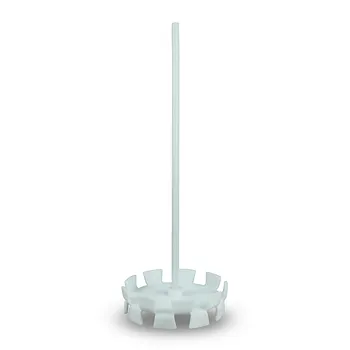
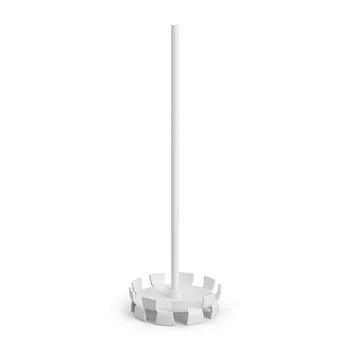
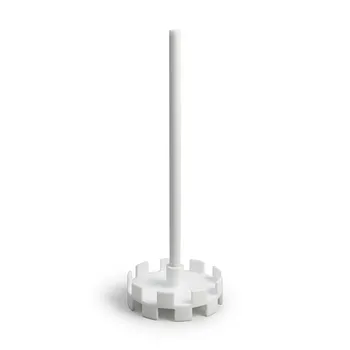
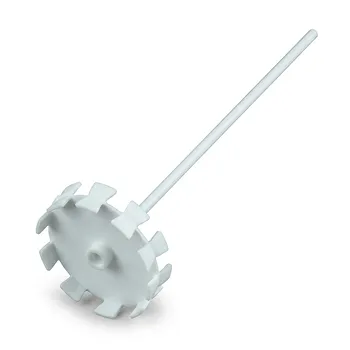
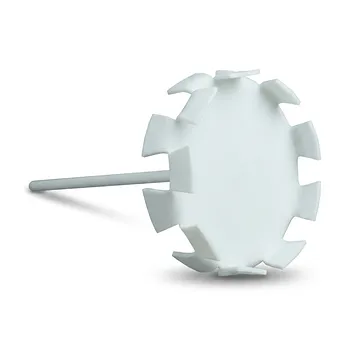
- Corrosion Resistant PTFE Dispersing Disc and High Temperature Propeller Stirring Paddle for Laboratory Chemical Mixing
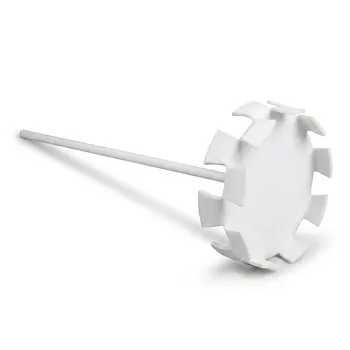
- Custom PTFE Dispersing Disc and Stirring Rod for Chemical Processing and Laboratory Mixing
- Corrosion Resistant PTFE Stirring Impeller and Customizable Polytetrafluoroethylene Dispersion Disk
- Corrosion Resistant PTFE Stirring Paddle and Customizable Toothed Dispersion Disk for Chemical Pharmaceutical Mixing
- High Purity PTFE Dispersion Disk for Food and Cosmetic Processing Non Stick Corrosion Resistant Large Stirring Paddle Customizable Fluoropolymer Impeller
People Also Ask
- How many variations of PTFE disks are available and what parameters do they differ in? Choose the Right Material for Your Application
- Where are PTFE stirrers typically applied? Essential for Chemical, Pharma & Bioprocessing
- What are the benefits of PTFE stirrers? Ensure Chemical Purity and Protect Your Labware
- What is Dispersion PTFE used for? Creating Thin, High-Performance Coatings and Films
- How are PTFE stirrers and shafts typically constructed for industrial use? Choose the Right Method for Your Process